
9 Lathe Upgrades – FineWoodworking
Synopsis: A lathe can often be improved with a minimal amount of time, effort, and money. Furniture maker Andrew Finnigan demonstrates how to make the following improvements: adding a sturdy base, upgrading to a better banjo, upgrading to a better tool rest and/or purchasing additional tool rests for different functions, replacing or improving the cam plate, installing an inline paddle switch, replacing the centers, adding faceplates, and installing proper lighting.
Whether it’s brand-new or has been rusting and gathering dust in the corner, a lathe can often be improved with a minimal amount of time, effort, and money. While aftermarket upgrades, accessories, jigs, etc., can always be added to a machine to improve something specific, I’d like to cover some fundamental things that will improve the overall stability, functionality, and safety of a lathe. A stable lathe that functions properly and adjusts easily allows you to turn more efficiently and more enjoyably.
Midi lathes, with a combination of affordability, modest footprint, and portability, tend to be a good first lathe purchase compared with full-size machines, which are more expensive, or mini lathes, which are less versatile. Once you’ve spent time with your midi and logged turning miles, you may want to make some upgrades to make the lathe perform even better.

After doing a tool test on midi lathes in FWW #307, I decided to use one of those machines to demonstrate a few simple ways to notch up the performance level of any lathe. The Grizzly G0844 is a good vehicle to demonstrate on because it is an all-around nice machine with good power. On its own it’s a good investment. By building a solid stand for it, adding a new banjo and tool rest, modifying the cam plate under the banjo, and adding a safety switch, it’s even better. Any lathe can be upgraded in this way.
The best part of these upgrades is that you don’t have to do all of them or do all of them at once. The lathe you have may only need one or two of these tweaks. You can decide when to take the time and spend the money on upgrades.
Stability is a huge factor

I’ll start with the stand. Whatever your lathe sits upon, it will perform better with ballast. Ballast is simply a heavy material used to improve stability and control. Ballast can be as simple as sandbags, loose stone in a box, or masonry. At some level, vibration is responsible for most turning frustrations. The addition of ballast greatly reduces vibration throughout the entire system, which leads to better work and less sanding, and makes for a much better turning experience.
The footprint of your stand is another important factor to consider. Most contemporary commercial stands, whether stock or aftermarket, have some degree of rake and/or splay to increase their overall footprint and make the lathe more stable. However, once ballast is added, the larger footprint is unnecessary for stability and in fact can get in the way of use. Earlier lathes were generally very stocky, built in oversize cast iron, and were fairly square in design. With time, manufacturers have repeatedly redesigned their machines to use fewer, lighter, and cheaper materials, and lathe footprints have expanded to compenate for the decreasing weight. However, a wider footprint is not a true solution to the problem of a lack of ballast. The result can be a light, somewhat unstable lathe that takes up too much room and pushes the user farther from the lathe.
Stand your ground
Take height into consideration when modifying your lathe setup. Turning is physical, and hunching over or standing uncomfortably has a way of adding up. As a guideline, the center of your spindle should land just about at elbow height. If you’re building a dedicated stand, this is easy to account for in plans. But if your lathe is mounted to legs or a bench, you may need to raise the lathe or build a platform you can stand on to bring you up to height.
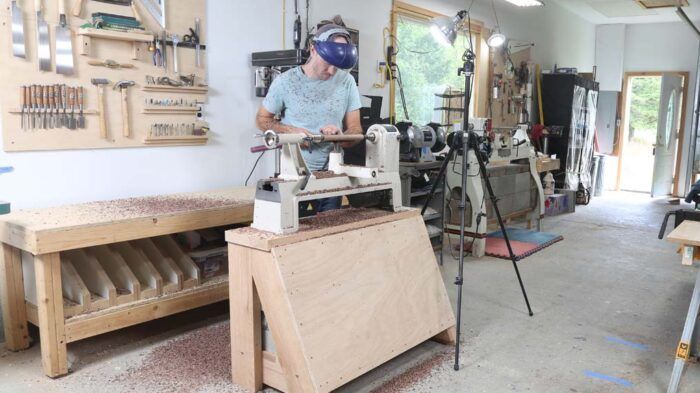
I built this stand with common solid 5/4-in. and 7/4-in. red oak and plywood. It’s important to use structural fasteners, as the stand is rather heavy and will endure stresses. I used lag screws and framing screws to construct the stand, wood screws for the back, and grade 5 bolts with washers to attach the lathe to the stand. All these products can be sourced from hardware stores and lumberyards.
I sized the top slightly wider and longer than the lathe’s own footprint—enough to accommodate bolts and screws but not so much as to hinder access to the lathe as I turn. The thick legs don’t splay, but the back legs rake out enough to allow for concrete blocks to fit in the stand. The shelf is suspended 6 in. off the ground for foot access, and the back is sheathed in 3⁄4-in. plywood.
Consider your tool rest
The tool rest should create a stable, adjustable pivot point to support your cutting tool. The tool rest and banjo are the most frequently adjusted working portions of your lathe, and they should move easily and lock securely with minimal effort. On many lathes, unfortunately, the supplied tool rest is designed without ergonomics in mind. And its construction often is less than robust, so eventually it will need replacement.

Dway, Best Wood Tools, Oneway, and Robust all make nice aftermarket tool rests. Robust’s tool rests, for example, are ergonomically designed for extended use, give good accessibility to the work, and have a hardened top bar that resists denting and marring.
| From Fine Woodworking #314
To view the entire article, please click the View PDF button below. |
 |
Fine Woodworking Recommended Products
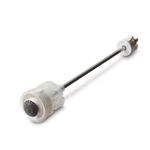
CrushGrind Pepper Mill Mechanism
Matt Monaco designs his pepper mills to accept the CrushGrind mill mechanism, which he likes because it doesn’t require drilling through the top of the mill’s cap and having hardware exposed on top.
Sign up for eletters today and get the latest techniques and how-to from Fine Woodworking, plus special offers.
Download FREE PDF
when you enter your email address below.