
Templates and Jigs Up Your Efficiency, Repeatability, and Accuracy
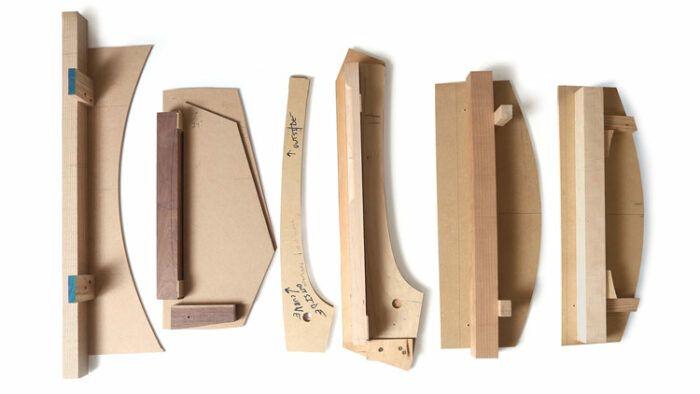
Creating templates (flat patterns, often in MDF) and associated jigs (devices that cradle and guide the workpiece through a cutting operation) is a part of designing and building original furniture that I enjoy. Making the templates is when the preliminary drawings and ideas start to come to life.
When I have arrived at a shape that I am satisfied with and would want to duplicate, then I make jigs that reflect those templates. These jigs make the shapes easier to duplicate reliably and many times easier and safer to hold while machining.
Templates help me work out a design, but they also give me a concrete history of the piece I’m making. When finished, I have a full-size map to easily recreate the piece; if I want to evolve the design, I already have a place to leap from. This table (see “Glass-Top End Table”) is the latest in a series of end tables, each building off and utilizing the templates of the previous one.
I save all my templates and jigs. After labeling them, I store them out of the way. Once you begin working with templates, you realize how quickly and accurately you can make your parts. You may find yourself doing it more and more.
Begin with a template

When I am making an original piece for the first time, I rout my parts to shape by attaching them to templates with double-stick tape and then flush-trimming them on the router table. I turn my concept into 3D, actual size, on 1/8-in. or 1/4-in. MDF. I draw freehand and with straightedges, and with bendy sticks for curves and lines. Then I cut those shapes out on the bandsaw. After that, I fair the curves to my liking. That leaves me with a hard version of the shape that I can run a flush-trim bearing on. Once I arrive at a design I want to duplicate into furniture parts, I make jigs from the templates, either incorporating the template in the jig or by making another template from the first to use in the jig.
Then come the jigs
With a jig, I can quickly put a part in, trace the shape on it, take the part to the bandsaw to rough cut, and then pop it back in the jig to flush-trim it on the router table.
When I make a jig, I need to incorporate a flat reference surface in the jig to match it up with a flat reference surface on the blank. Also, I often lay out the joinery on the jig or template so I can transfer locations directly and consistently to the piece. I use MDF for the jigs (usually 1/4-in.), and for the reference fences I grab leftover material from the shop that is milled flat and square. To locate the fences to the shapes, I drill pilot holes and fasten with short screws.
Putting the jigs to work

Although both sides of the legs are curved, I must start with a straight edge for reference. The outside edge remains straight for now. I rough cut the parts, joint an edge, and square an end. That squared corner and straight edge are my references in the jig. I set a leg blank into the jig, trace the shape onto the blank, bandsaw close to the line, and then shape the inside. I mark Domino centers on the jig to transfer to the piece after shaping.
There are five shelf slats: three convex and two concave. These need to get milled straight and square all around for the jigs to work. To shape the convex slats, I use two jigs; one holds the rectilinear blank and the other cradles the blank after one side is shaped. The concave slat is made with just one jig.
The table’s top amounts to a square with a hole in the middle. The location of the corner joints in relation to the outside corners is more interesting than a conventional mitered corner. Again, the blanks begin with a straight edge and a square end. The straight edge is the reference for the angled joinery surface, and the square end is the reference for cutting all four parts to the same length.
Once that square frame is glued, I center the circle jig by lining up crosshairs on both the circle and the square. I rough cut it with a jigsaw and template-rout it with a handheld router. Use a template to draw the outside curves, bandsaw close to the line, and do a final template-routing at the router table.
Doug King is a custom furniture maker in Missoula, Mont.
| From Fine Woodworking #321
To view the entire article, please click the View PDF button below. |
 |
Fine Woodworking Recommended Products
Incra Miter 1000HD
One of many extremely accurate Incra miter gauges, this model offers 180-degree adjustment to 1/10 of a degree, and a long, straight fence with a telescoping stop system.

Double Sided Tape
A thin woven core makes XFasten tape strong yet not too thick (0.008 in.), and helps it hold powerfully without being difficult to peel off.
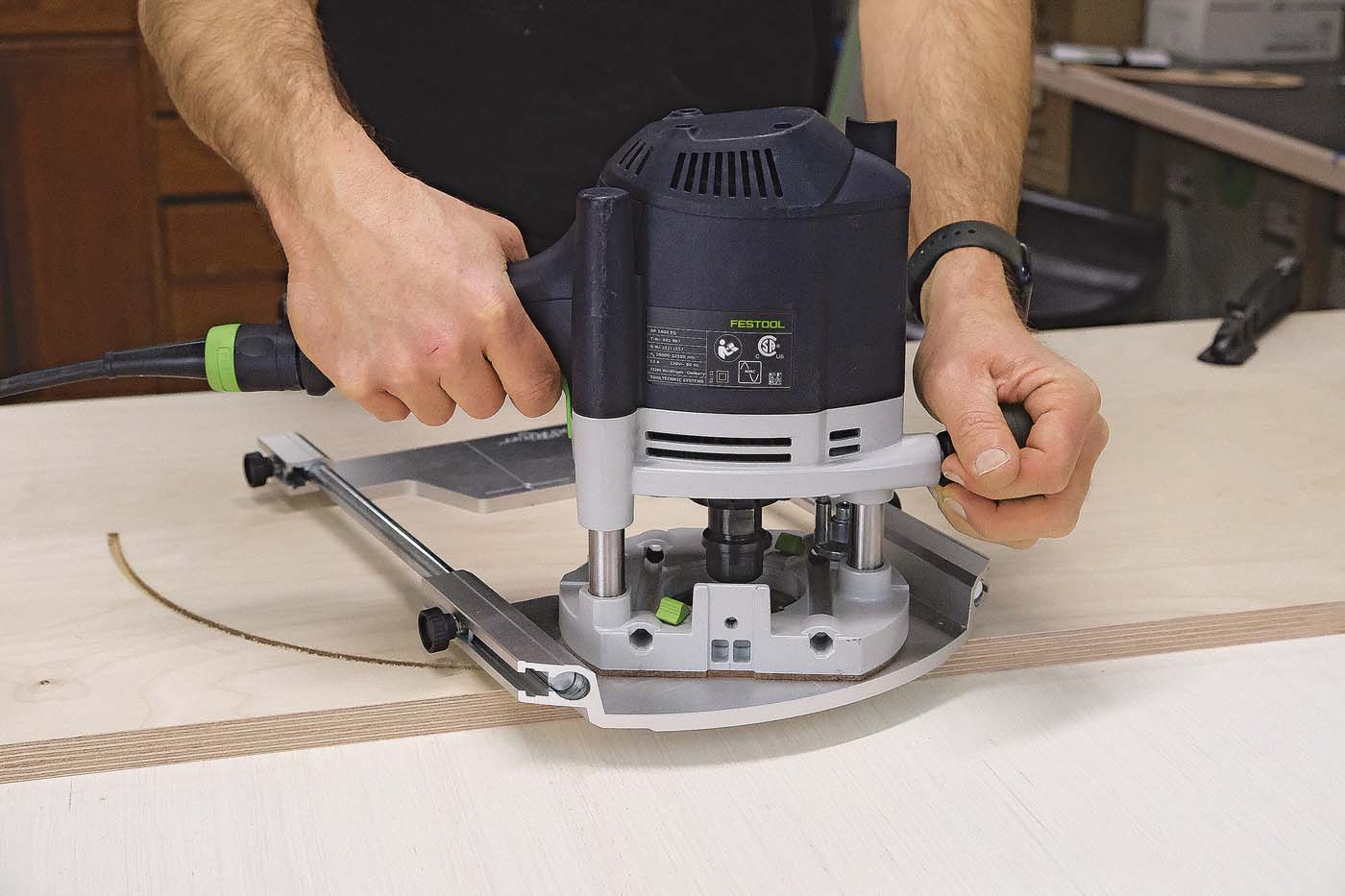
Woodriver Circle Cutting Jig
The WoodRiver circle jig, which produces cuts up to 32-1/2 in. dia., and I can confidently recommend it. Unlike similar jigs that can pop off of their pivots mid-cut, ruining a panel in the process, this one has a robust pivot point that registers securely in the jig and workpiece.
Sign up for eletters today and get the latest techniques and how-to from Fine Woodworking, plus special offers.
Download FREE PDF
when you enter your email address below.