
Handplane Ergonomics – FineWoodworking
In this series, I have been exploring how to make and modify handles for common hand tools, with a focus on ergonomics. The motivation is personal: I live with chronic hand pain from tendonitis and arthritis—complications of hemophilia and years of repetitive work—and small changes in tool design make a big difference. But whether you spend a few hours a week in the shop or build full time, it’s worth thinking about how your tools meet your hands. Today’s discussion is around the ergonomics of different hand plane styles in Western woodworking, focusing on their comfort and chronic pain.
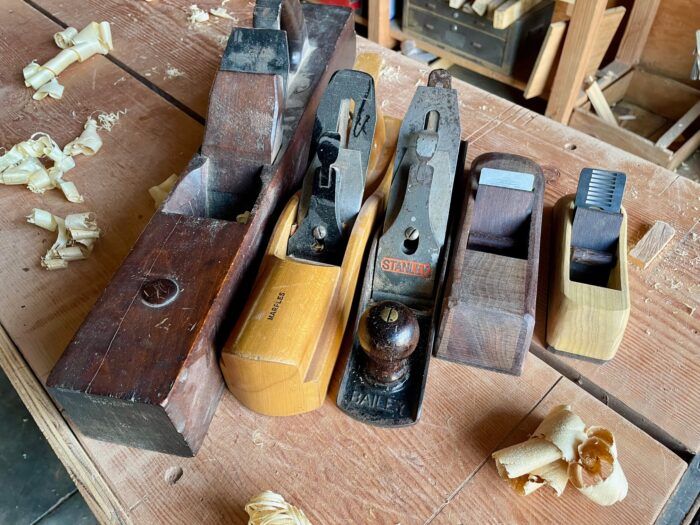
The earliest hand planes were simply blades embedded in wooden blocks. Their primary function was to slice wood at a consistent depth, in contrast to the more variable depths produced by other hand tools such as chisels, hatchets, or knives. Many of us still prefer the wooden body styles of planes, even though modern industry has left them behind. These planes are lighter, warmer to the touch, glide more smoothly without oil or wax, and are mechanically simpler. Although Stanley introduced its first metal-bodied plane in 1867, wooden-bodied planes continued to be produced in the United States until approximately 1920. There are some modern wooden plane makers out there (including Japanese and Euro styles), but most of the planes of this style you will find are old.

My 22-inch jointer plane, for example, weighs a full pound less than my Stanley No. 7. While wooden-bodied planes require some practice to adjust, generations of skilled woodworkers managed this with nothing more than a small hammer. The basic grip involves a pistol grip with the right hand, while the left hand either grips the body overhand or lightly rides along the top or left edge. Ergonomically, the most common complaint is the large, blocky shape. Over time, however, I have learned to minimize thumb engagement—my most painful joint—by allowing the weight of my left arm to engage the front. Despite its bulky appearance, I regularly use this plane for fine work in my lutherie shop, including jointing pieces for invisible glue joints. User tip: wooden planes work best with some speed to the stroke. Take advantage of the light weight and give it some forward motion, you might be surprised how easily they cut this way.

The next style to consider is the so-called “transitional” plane, produced by Stanley and others into the mid-twentieth century. These planes combine a wooden body with a metal frog, blade, and adjustment mechanism. The right-hand grip remains a pistol grip, while the left hand either grasps a knob (if it has one) or lays on top. Although some find the knob more comfortable than grasping the full body of a traditional wooden plane, I find it more painful because it forces my hand into a smaller, compressed shape. I own a British example made by Marples, known as a “technical” jack plane. It would be a daily user were it not for a critical flaw: when holding the pistol grip, my right hand cannot reach the adjustment mechanism. This eliminates the one-handed adjustability that is a key advantage of modern planes. If I must stop and use both hands to adjust the plane, I would rather use a traditional wooden plane and a hammer. That said, it excels in weight, at 2.1 pounds compared to the 4.4-pound Stanley No. 5.

The most familiar design is the metal-bodied Stanley plane, which dominated woodworking for more than a century. The grip is similar to those of transitional planes, but its greater weight and the need to lubricate the sole are notable drawbacks. As with transitional planes, I avoid grasping the front knob and instead hold the body along the left side. User tip: lubricating the sole of a metal plane makes a substantial difference in ease of use. I use a rag rolled into a can with oil on it, others use an oil-soaked rag in a bag. Either way, keep it on the bench and apply often. Don’t be worried about getting oil on the work, it is such a small amount that it has no effect.


Across all three of these styles, the right hand relies on the same pistol grip. The Krenov-style plane is the first to fundamentally address this limitation by offering a more relaxed and ergonomic hand position. I initially dismissed this design as fussy and pretentious after reading James Krenov’s writing, particularly his comparisons between a woodworker and a musician with their instrument. As a musician and luthier, I should have been more receptive! This video, in which Krenov describes his planes as simple and unpretentious—especially his critique of the pistol grip—ultimately convinced me. https://www.youtube.com/watch?v=TsZzznyK7MA

I decided to build a small Krenov-style plane roughly equivalent to a smoothing plane, but with a slightly cambered iron and an open mouth. Functionally, it behaves like a small jack plane capable of many tasks. I followed plans from a Fine Woodworking article by David Finck. The rear of the plane is shaped to match my right hand and left intentionally rough to improve grip. It requires almost no gripping force, as it conforms naturally to my hand. I have not yet finalized the shape for the left hand, but this is one of the strengths of the design: it can be continually refined through shaping. While the sole and sides are smooth, all other surfaces remain rough from the bandsaw, rasp, or spokeshave. I used walnut and wenge, finished with a light application of oil and wax. I eventually purchased a Hock blade and chip breaker, which have proven excellent. Enjoying the process, I also made a smaller plane to hold a toothed blade, which is particularly effective for highly figured woods in lutherie and for roughing surfaces in general shop work. User tip: look through the old, cast-off plane blades you have and cut one down to fit a plane of this style. You don’t have to use a hock blade, but they sure are nice.

I will give one last user tip: Keep your blade sharp! A dull blade dramatically increases the force required to push a plane, exacerbating stress and pain. Sharpening doesn’t have to be high tech and fussy, just get a fresh edge on it and get back to work. For daily work, I have not settled on a single plane style. My shop contains a mixture of antique wooden planes, common Stanleys, modern Lie-Nielsen planes, and homemade Krenov-style planes. Because my shop is larger than that of most solo makers, with distinct stations for different tasks, I can distribute tools where they are most useful. If I were to downsize to a single tool chest, however, I would be forced to make more difficult choices. I hope this article can offer some insight on my journey, as I strive to keep working despite chronic pain. Pick a style and try it out, your body will tell you when you find the right one.


Fine Woodworking Recommended Products
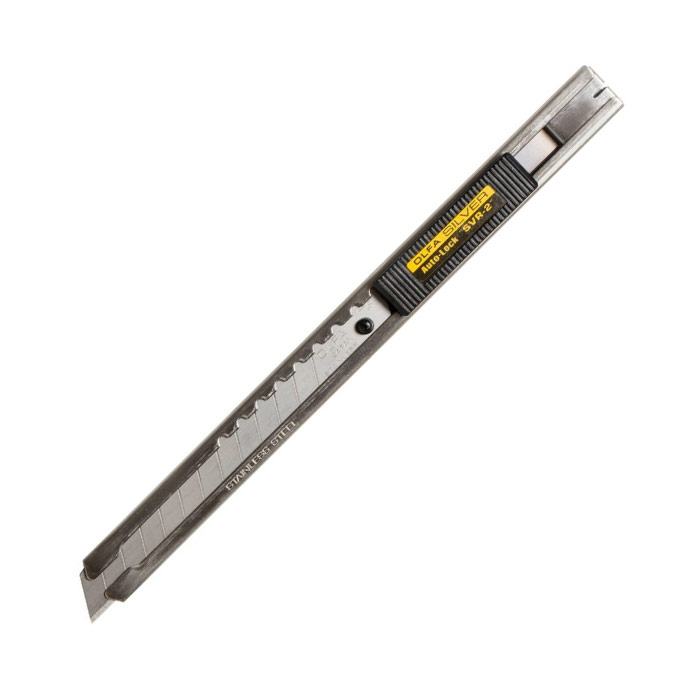
Olfa Knife
Comfortable metal handle with a break off blade. A tool for breaking off the blade is built into the handy pocket clip.
Stanley Powerlock 16-ft. tape measure
With its smooth lock, tough case, compact size, and excellent accuracy, this Stanley tape is perfect for workshop use.
Lie-Nielsen No. 102 Low Angle Block Plane
With smooth, precise adjustments and wonderful balance, this compact block plane is a joy to use. It doesn’t have any bells and whistles, but there’s not a better block plane available for the money.
Sign up for eletters today and get the latest techniques and how-to from Fine Woodworking, plus special offers.