
From the Stage to the Workbench
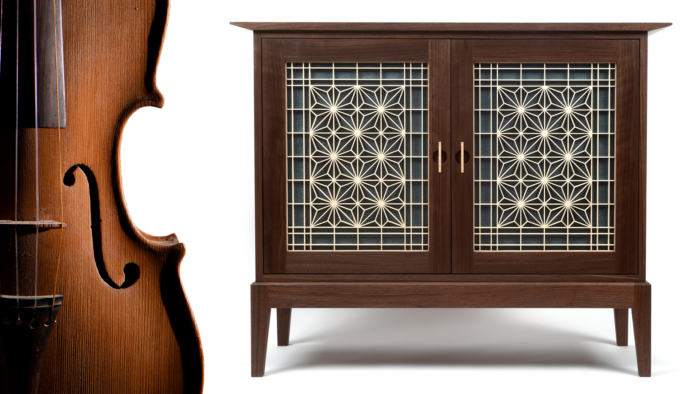
As someone who became a full time furniture maker after 16 years in a completely different career, I’m always curious about others’ transitions. Typically, whether I’m talking to professional woodworkers, or serious hobbyists, the most typical backgrounds are in engineering, design, or the visual arts. A few years ago, I noticed another micro trend: professional musicians. I was reminded of this during Vic Tesolin’s Shop Talk Live interview with Jeff Miller.
This is a smaller group, sure, but there are some standouts among them. Beyond Jeff Miller, Frank Strazza probably comes to mind for many. Strazza is an accomplished cellist in addition to being an incredible woodworker. John Cameron, whose band Bim Skala Bim was constantly in my rotation at my college radio show has become an award winning furniture designer and builder. Mike Pekovich, Fine Woodworking’s Editor and Creative Director, also spent time on the stage as a musician. There are others, of course, but the first person that comes to mind for me is my friend and fellow DC-area furniture maker Mike Jury, of M. Jury Woodworks. I met Mike years ago at an event with Nancy Hiller where Nancy shared her years of wisdom with aspiring professional woodworkers. Mike and his wife Amanda were there and we’ve stayed in touch as we made our moves from one career into another, more or less on the same timeline. In their work, Mike handles most of the joinery, milling, etc., and Amanda does the marquetry and weaves chair seats. In fact, Amanda was busy on a marquetry commission for another furniture maker on the day Mike and I met to discuss the career transition.
Mike and Amanda have been creating some truly beautiful pieces in their small home shop in Suburban Northern Virginia since their retirement from the US Army band 2020. The US military has several bands. The musicians are members of the respective services and are generally considered among the best in the country. If you get a chance to catch a performance of any of these bands, do it.


I was curious about this trend and whether it was maybe just a coincidence so asked Mike about it over lunch one day. As we talked, some of the similarities became obvious with a little reflection.
Mike noted that performing music at a high level requires a lot of practice–intentional practice where you’re learning from mistakes. Like woodworking, this typically happens alone and you need to be self-motivated to do it. Truly, it has to be something you’re passionate about to the point of working long and hard to get better. Having spent many hours in practice rooms by himself, Mike was used to the self-discipline it took to get the results he wanted on the stage. Those same attributes translated to the woodshop where he would spend hours getting the design and joinery just right.
I asked Mike if he saw a similarity between woodworking and music performance. What I meant here is that we can practice our joinery on inconsequential scraps, but eventually, we need to do it on a real project. Invariably, mistakes will happen, but like a performance, we have to carry on…in woodworking, at least we can fix our mistakes (hopefully without anyone noticing). Mike generally agreed and added that there is a similarity between our tools and one’s instrument. You need to fully understand how your tool works and is responding to your efforts. Making very small adjustments (your hand grip on a saw handle, pressure on your plane) can make all of the difference. This dance between the woodworker and the tool, the musician and the instrument, probably carries over across other creative pursuits but is something I think many humans value.
One element that really stood out to me in my conversation with Mike was the similarity of chasing high standards. Musician is a broad category, but in the case of people like Mike and Amanda, we’re talking here about classical, orchestral ensembles. The attention to detail that it takes to perform at this level is intense. Their audiences may have included the President, foreign dignitaries, members of Congress, or the family of fallen soldiers. Performances where getting it just right is the only acceptable outcome. That level of attention to detail and appreciation for the difference between really good and excellent is something that Mike thinks translates well from music to woodworking.

In thinking about the two pursuits, it occurred to me music and woodworking are two professions that our friends and family may try to steer us away from: “it’s a hard way to make a living! Go to law school.” Mike was fortunate not to have that experience with either career choice. In both cases, he decided early on that it was something he was going to pursue, and knew to be successful at it, he was going to have to work hard and get really good.
These types of professions, where the drive comes not from a desire for fame or money, but simply the joy of the craft itself and the compulsion to get as good as possible, can be tricky pursuits. Many very talented and skilled people struggle to make a living; others find good fortune to meet their skill and work ethic. How do you decide when to keep such pursuits as “hobbies” (even if they’re all-consuming) or transition them into a profession. It’s always a personal decision, really. But if anything, in craft, I think we have to measure success by own individual improvement, the satisfaction of our best efforts, and the drive to keep getting better. The “likes and followers,” the paid commissions, those are great (and necessary for some of us). But the real pay day is doing the work you love, as much as you can, as well as you can.


Sign up for eletters today and get the latest techniques and how-to from Fine Woodworking, plus special offers.


