
A Couple Exceptional Wooden Objects in Kenya
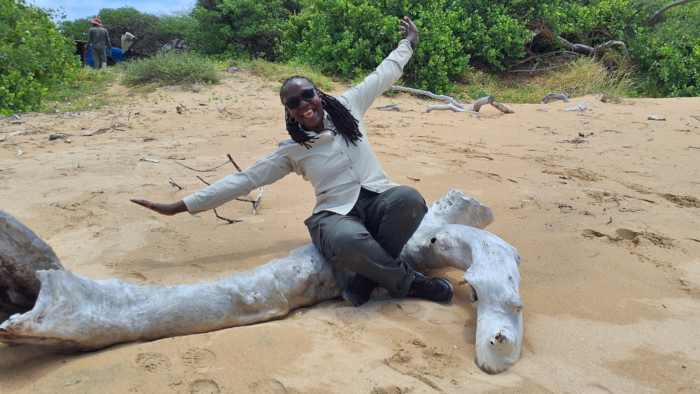
Talking with archaeologist Angela Kabiru about Indigenous wooden history
Angela Kabiru has worked as an archaeologist and research scientist with the National Museums of Kenya for most of her life as well as being a research fellow with the Mapping Africa’s Endangered Archaeological Sites and Monuments project. When I asked her what she’s been doing work-wise lately, she abruptly answered “Archaeology”, to which I laughed and replied, “Yeah, of course, but what does that entail exactly?”
For context, I’m currently attempting to conduct a very informal study of historic wood finishes around the world. I’m trying to develop a broad understanding of different materials used for coatings on wood and find out what different researchers have learned from analysis of historic objects, as well as what we know from observed trade practices and oral histories. Angela was the first person on my list to talk to, largely because she introduced me to the ongoing use of sheep’s fat on many Indigenous pieces.
We met at a Wood Conservation Technology course in 2024, and I constantly think about her first presentation for the program. She presented on a wooden object called the Ekicholong, a traditional carved stool that men of the Turkana people in north-western Kenya make for themselves. To this day, sheep’s fat is used to coat and season these pieces, but more on that later.
While it wasn’t the primary purpose of our initial conversation, I asked her if I could write a little for the Fine Woodworking website about some things we discussed. I have no real theme or throughline for this post, other than that they came up in our talks. There are so many different cultures and histories and crafts in Kenya; we talked briefly about ladles dried in the smoke above a cooking fire, large wooden mortars carved from a single piece of wood, and the ornate Kiti Cha Enzi chairs and Omani style doors and door frames in Lamu (which is now a UNESCO World Heritage Site where Angela has previously written about developing sustainable tourism).
To force a theme on this feels odd. The reality is: these were a couple of things Angela told me about, and now we’re telling you about them.


By the way, the answer to what “Archaeology” entails, it seems, encompasses a great deal. She has studied Archaeology at the University of Nairobi, but also continued her education in tourism management in the UK, Geographical Information Systems in both Sweden and the Netherlands, and, of course, attended the ICCROM course with me in Norway.
She’s been involved in numerous excavations across Kenya, conducted several geographic informational surveys, written a number of papers and articles, engaged with community and international education and knowledge sharing programs, and partook in what sounds like an overwhelming number of meetings.
I highly recommend checking out more of her work, as well as the rest of the efforts of the National Museums of Kenya. A Short History of Karura Forest is a really good, quick read about an urban forest in Nairobi and the archaeological research done there. It doesn’t, however, contain a lot of woodworking, so let’s instead look at two of the wooden pieces that she did tell me about.

Ekicholong: A Living Craft History
The Ekicholong is a small wooden seat and headrest made and used by men of the Turkana people in north-western Kenya. There are many communities in Africa that make similar stools and headrests, and each has its own tradition and significance for them. For the Turkana, only the men are allowed to have them, and they are expected to carve their own once they reach a certain age of maturity. They will carry this object with them for their entire lives, not to be used or even touched by anyone else unless that person has sought direct permission from its owner. Women are not to touch them at all. The connection between object and owner is so strong that when they die, their Ekicholong will often be left at their grave alongside their sandals.
You can see some Turkana men speaking passionately and enthusiastically about their Ekicholong in this Citizen TV segment:
The Turkana are one of the many groups associated with the Nile River (called Nilotic peoples) and just one of over 40 different Indigenous ethnic groups across the country. They are a traditionally pastoralist–sophisticated herding societies– having historically travelled the region near Lake Turkana and Omo Valley in North Western Kenya with their animals. While the Turkana themselves are understood to have migrated into the region in the 1600s (the coalescence of more than one ancient lineage), earlier pastoral funerary sites have been uncovered nearby that are dated to roughly 3000BC and evidence of human life has been found around Lake Turkana going back millions of years, with one of the earliest complete examples of hominid remains (homo erectus) being uncovered and dated to roughly 1.5 million years ago[i].

Carving Ekicholong
The Ekicholong themselves are often made from local woods like Ewoi, the umbrella thorned acacia (Vachellia tortilis), or Ebei (Balanites Rotundifolia), a small shrub/tree with spiny branches and round leaves found in the arid savanna and scrubland of the region. They are carved from a single piece of wood with no joinery, and so a branching part of the tree is often selected to ensure the strength and grain direction in such a small and deliberately shaped piece.
For a different nearby tradition, that of the Samburu (another pastoralist community in northern Kenya), the making of these stools is reserved only for highly regarded and privileged craftspeople. They guard their craft carefully, and the selection of timber is one of the most important of trade secrets.
A lot of these desert timbers are very dense. After watching a man carve his own stool, Angela said she developed a real appreciation for the skill and care taken in making and maintaining them. They often show really crisp lines and strong shaping in their design, sometimes with carved illustrations or decorative embellishments.
Interestingly, one of the oldest stone tools ever discovered was found in the Turkana region[ii]. It’s a 3.3 million-year-old stone blade, which could perhaps suggest a very long history of carving there. Ancient harpoon heads carved from bone have been found nearby as well. It may not have always been the Turkana, but it seems people have been carving and crafting in that region for about as long as humans have been using tools.

Sheep’s Fat on Wood
In our conversation about wood finishes, Angela emphasised that for a lot of the traditional pieces, what mattered most was the selection of the appropriate timber, followed by the careful drying and seasoning of that wood. It seems that if the right timber is chosen and it’s seasoned appropriately, there isn’t always a need for further finishes or coatings to be applied.
In the case of the Ekicholong, for both that drying process and their ongoing protection, sheep’s fat is the common choice. “Sheep’s fat has a lot of uses”, Angela told me. Many people, of course, use animal fats for keeping leather supple, among other things, and Angela told me how it is combined with red ochre in many hair treatments. The Morans, warriors of the Samburu and Maasai peoples, combine it with red ochre in their hair treatments.

According to Angela, it seems that even when sheep’s fat is not being used on wood as a finish per se, it is an important part of the drying process, similar to how I learned to put wax on the ends of boards and logs to ensure they dry evenly.
Animal fats are, in fact, shown to improve wood’s resistance to biodeterioration. Tests have found that, like linseed oil, pure tallow has a capacity to reduce water intake when timber is completely submerged, while not entirely blocking water transfer and still allowing the wood to maintain a natural relationship with humidity. It also blocks a lot of the vessels and empty cells where fungi like to delve, preventing rot[iii].
The concern with natural fats is that they will break down if left alone and can provide food for mould. Regular maintenance of continued fat application and cleaning can, however, prevent mould growth, and these are definitely objects that are cared for and maintained by their owners.
Additionally, when fats break down, they can become ‘rancid’, binding with sulphates and dissipating into the air. This doesn’t really harm the wood, but it can smell pretty bad. I did ask if they smelled at all, to which Angela laughed and replied, “Oh yes!”
Apart from the practicalities and “despite the smell,” the use of animal fat is also exceptionally significant because of the community’s connection with their herds. The materials, like the timber selected and the fat, are part of the traditional connection with land and life.
Pieces of Living History
In spite of the fact that many of these headrests were never meant to last more than one lifetime, or meant to be handled by anyone other than their owners, Angela emphasised the value in conserving and preserving the examples that they do have in their collection, in large part due to their significance to the society, and their representation of Indigenous knowledge and technology.
Like many Indigenous African communities, the Turkana maintain their histories orally, through song, proverbs, and storytelling, but also through teaching new generations these crafts, and through the crafted objects themselves.
To me, Turkana Ekicholong is one of the most perfect examples of how a wooden object can be personally and communally significant. Very few historic Ekicholong are owned by the National Museums of Kenya collection, in part because of the cultural rules surrounding them. Angela tells me how they aim to directly cooperate with communities in collecting and caring for these pieces. I have seen a few similar stools for sale online as “antique art pieces.” This is unsettling to say the least, as it is hard to know whether pieces found on markets and in international collections were taken with the consent of the community who made them. Sold online or at antiques shops, they can feel, and often are, completely disassociated from the context of their creation.
“It is important to note that beliefs surrounding traditional objects are generally less restrictive than they were several decades ago. This shift has facilitated the circulation of such items beyond their original contexts of use; objects such as the Ekicholong can now be purchased in markets in response to external demand,” She tells me, emphasising that “this does not necessarily indicate a loss of meaning, but rather a reconfiguration of value as objects move between cultural, economic, and institutional domains.”
It is important, however, to distinguish between the pieces that were approved for wider distribution and those that were never meant to be handled by anyone other than their owner.

Change and Tradition
Political and environmental factors are forcing life to change in north-eastern Kenya. The land is becoming harder to live on due to changes in climate, and many of the traditional aspects of Turkana culture are shifting with outside influence. As a small and more fun example: as of 2017, Turkana County now has its own women’s soccer team called The Desert Roses.
Even as that happens, however, there is an importance in keeping and maintaining these living traditions, this history, and the respect given towards them.
The founder of The Desert Roses herself, Rael Nkoi Lomoti, has said in an interview before that “the greatest achievement of the Turkana community is our enduring resilience and cultural continuity despite numerous challenges. Our ability to preserve our traditions and way of life across generations and to give today’s youth a sense of identity while continuing to adapt to change is a testament to our strength.”

A 3000-YEAR-OLD Carved Wooden Vessel
The other exceptional wooden object I want to share is a beautiful carved vessel found in the excavation of the Njoro River Cave in central southwestern Kenya. Angela described how the cup-like object was found amongst other items from a cremation burial site dated to 970BC.
You can see from the photo that even though the object was completely carbonised in fire, the details of the crisp carving work have remained, which is all the more impressive when you remember how hard and brittle the woods of the region can be and that the carvers were likely using stone tools (potentially a fine green-hued obsidian blade)[iv].
The Njoro River Cave excavation work was largely undertaken in the 1930s, overseen by British paleoanthropologists, Mary and Louis Leakey, when Kenya was colonised by Britain. Their work has contributed to the realisation that humanity had initially evolved in Africa, and that we are all descended from early people in this region.
The site at Njoro River Cave is believed to have been a cremation and burial site for the Elmenteitan, a proposed Neolithic pastoralist group with an incredible capacity for craft. Skeletal remains of roughly 80 individuals were uncovered, along with numerous decorative and functional objects, including pendants made from obsidian and semi-precious colored stones.

Because I know there is a tendency for a lot of these objects to end up overseas, I checked to see where the Njoro River Cave findings were. Many of them are kept at the Archaeology Section of the National Museums of Kenya in Nairob. However, Angela reminded me that the National Museums’ collections were largely assembled from the 1950s onward. Many culturally significant or historic objects from the region were taken or given away to museums and private collections around the world. It is believed that the majority of Kenya’s historical artifacts are not in Kenya, and they’ve been trying to get many of these objects back since before they first gained independence in 1963[vi].This vessel is, thankfully, one of the objects they do have in the Kenyan archaeological archives, especially given the rarity of ancient wooden objects.
Carbonization of Wood
Because of how easily wood naturally decays when left alone for a long time, we tend to have fewer ancient wooden artifacts than we do ceramics, stone, or glass. When wood is burned, however, a lot of the complex carbohydrates that bacteria and fungi like to eat are broken down, making it less likely to rot. This is one of the reasons that the tradition of charring wood in Japan is so effective as an external wood treatment.
Just burning wood like this won’t make it last for thousands of years, though. It’s important to understand the difference between burning and carbonizing wood in order to understand how lucky we are that this vessel is still with us.
As you know from any fire you’ve sat at, when wood burns, it often crumbles away to ash. Partially charring a wood surface can allow enough structure to keep things together, but bits of wood that have fully charred will scrape away pretty easily. However, if the wood reaches temperatures of over 200 °C (392F) without being exposed to oxygen, many of the non-carbon aspects and natural tars turn to gas and dissipate rather than combusting. This leaves behind what’s called carbonized wood.


This is actually how charcoal is made. When making charcoal for drawing, North Wales-based artist Kate Boucher told me that she puts the pieces of dried willow into a metal container in a fire. In some cases, the willow is covered with a special sand to help ensure they don’t come into contact with oxygen until they have completely cooled (if they do, they will burn rather than carbonize). According to Kate, the hardness of the final charcoal is dependent on how dry the timber was, as well as how long the wood was cooked and at what temperature. At a higher temperature, the carbon crystallises more densely, filling in pores and creating a harder graphite-like result[vii]. A long, slow roasting of very dry timber at a very high temperature can create a charcoal so hard that it barely makes a mark on paper.
An Important Finding
There were probably many other wooden objects burned at the Njoro River Cave site back then, but most would have burnt away completely like firewood. This one vessel, the only wooden object found at this site, got lucky. Potentially, it became covered in ash, dirt, or sand early on, and the fire burned long enough and hot enough, allowing it to carbonize and survive thousands more years with its carvings still relatively crisp.
Findings like this are really important to understanding craft and life amongst ancient societies. Angela and her colleagues are still studying and learning about historic peoples in Kenya all the time.
Ongoing studies of objects like those found at Njoro River Cave, including looking at the unique carved decoration on this wooden vessel, show a history of fine locally developed craft, industry, and culture. In both the production of fine obsidian blades capable of working this wood and the precision of the lines left by the carving, this object reveals a very refined wood carving history.

The Exceptional Collection
Likely thousands more examples of exceptional wooden objects can be found in Kenya. These were just two of many that came up in our conversations. I’m hoping (fingers crossed) to go visit Angela someday to look at many in person, especially the Akamba artisan woodcarvings and the wooden doors in Lamu, which she has now tempted me further with more photos just this week.
The title for this post was taken almost word-for-word from one that Angela wrote about many of the incredible archaeological objects found around the country (‘Exceptional Objects From Kenya’s Archaological Sites, pg 53. As such, I’d like to conclude with a passage taken word-for-word from that article. She was referring to a slightly different and longer list of objects, but still…
“Africa has a very long history of human habitation and is considered the Cradle of Humankind. Kenya so far has the most complete collection of hominid species in the world. Kenya’s archaeological collection is also the most diverse and represents human activities from 3 million years ago, preserved in more than 6000 sites……All archaeological finds are special; however, I consider the ones listed here to be truly exceptional (and interesting) objects that have made Kenya famous as the Cradle of Human Imagination.”


NOTE: Special Thanks to Sam Faer and Kathryn Sullivan for technical edits on this piece.
[i] Clack, T., & Brittain, M. (2018). The river: Peoples and histories of the omo-turkana area. Archaeopress Publishing Ltd.
[iii] Sivrikaya, Huseyin & Can, Ahmet & Yaman, Barbaros & Palanti, Sabrina & Morrell, Jeffrey. (2020). Effect of tallow impregnation on moisture behavior and decay resistance of various wood species. Wood Material Science and Engineering. 15. 10.1080/17480272.2020.1862298.
Fine Woodworking Recommended Products

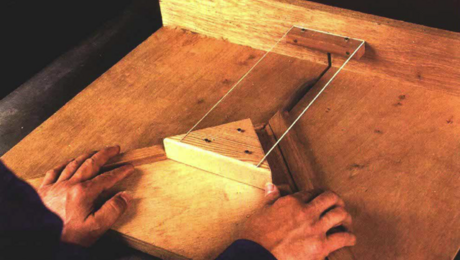
Circle Guide
If you like to draw your designs on paper, you’ll find the simple circle guide to be very helpful.
Compass
An essential tool for drawing circles and curves accurately. Also good for layout.
Blackwing Pencils
If you’ve listened to Shop Talk Live, you’ve heard them talk more about these pencils than you could possibly imagine.
Sign up for eletters today and get the latest techniques and how-to from Fine Woodworking, plus special offers.
Download FREE PDF
when you enter your email address below.