
A Step Into the Pages of Fine Woodworking
I couldn’t help but wonder how many twin-prop commercial airplanes were left in operation as I stared at the giant propeller through the window. There weren’t even shades to pull down over the window to block the glare on my computer screen. Luckily, the flight from Nova Scotia to Boston was empty, and I could move to the aisle seat next to me. I eagerly plugged in the SD card from my camera, anxious to see the images I had just shot in a larger format than that small pixelated screen on the back of the camera. I flipped through the pictures quickly as we started to taxi down the runway. I stowed the laptop for takeoff as advised by the flight attendant. As the plane took off, the propellers hummed into unison, and I took a second to appreciate my two days in Halifax.
I came up to Halifax as the newest assistant editor for Fine Woodworking magazine, something the customs agent really had a hard time understanding. “You brought all this photo equipment up here for only one night, to shoot woodworking?”
“Mmm hmm,” I replied. I probably should have spoken a little more clearly to the uniformed officer, because said photo equipment was promptly searched. Lesson learned.
It is a small percentage of us who pause a few seconds at a well-cut miter joint at the airport Starbucks, or sink extra deep into a handmade chair and appreciate the design and craftsmanship required to make it come together. I don’t know if this is an inherent feature in us, but for me it was instilled. It was my parents who bought an old house that we could learn to maintain as kids, complete with storm windows, sticky doors, a rotting roof. But also, when we were older, we built a cabin in the woods for a family ski house, which taught us to think ahead and be precise, and most of all to learn that wood movement stops for no nail. Our hardwood floors are proof of that.


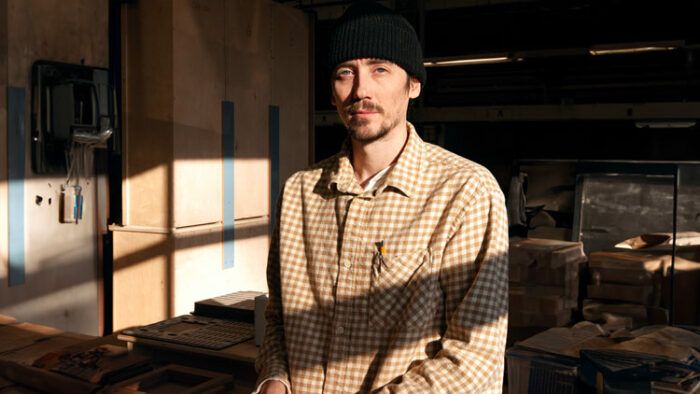
Since then, I have had a steady background in woodworking. I have jumped around among different jobs, from beautiful historic homes to modern monstrosities filled to the brim with millwork. I’m confident in my knowledge of woodworking, but I have never done professional photography before. The anxiety started to set in on my way up here to Canada. I have always marveled at the photography in Fine Woodworking; the editors shoot photographs that make you feel like you are in the shop along with them. This seems like a daunting task to live up to. I have had good training up to this point, assisting on a couple of shoots and getting advice from other editors, like “Set the lights here,” “ISO set to this,” and “Don’t cut off the tops of their heads” (something I became famous for while learning). But being out on my own, with no one to turn to when I was having trouble getting the lighting just right, gave me an uneasy feeling. Or was it turbulence?

There is a little dance between the editor and the author when a photoshoot first starts. Me, setting up the lights and moving things around, trying to find the best angles. The author, gathering all their parts and tidying up any forgotten corners. Once the initial awkwardness passes, the work often comes quite easily. For context, this is usually the second time the author is building the piece, if not the third or fourth. The first one they build is the impetus for the article at its beginning, but to document the process, we need to start from scratch. To peel another layer back, sometimes if the project is large, the author needs to have the piece in a few different stages of production to keep the shoot running smoothly. (Think cooking show. The turkey goes in the oven and then comes out done five minutes later. Magic.) There is a point in each photograph where I have an idea of what I want the picture to look like, but I move around until it feels right, zoom in, zoom out, a little to the left, a little higher. “Hold that position there” is a phrase I commonly squeak out from behind the camera while trying to get the shot. It feels like I’m behind the page of the article, moving around until the reader in me snaps in and understands exactly what’s happening. For a moment, looking through the camera lens feels just like flipping through the pages of the magazine.
Once we hit cruising altitude, I unfolded the laptop, powered it back up, and studied the pictures with a more discerning eye. I flipped through, and there were plenty of good ones that I was excited for people to see, and some I hoped would disappear magically. What I was more excited about than the actual pictures was the subject—not just the work but the worker. The author, Bill, a retired neurosurgeon, had mastered the process in the shop, which does seem easier than brain surgery if you ask me. He moves through his shop with ease, which afforded us the time to sit and talk—from woodworking to neurosurgery, with a little bit of golf thrown in as well. I was pleased to get to know someone I would almost never encounter in my normal life. The warmth and friendliness of Bill and his wife, Susie, have possibly warped my experience early on, for I don’t think an inaugural foray could have gone so well without them.

Half of me hopes my anxiety around photography will fade with time, but the other half enjoys the excitement. I like chasing the feeling of getting the exact shot to sit beside the author’s words, perfectly landing the one-two punch of information. Coming back to earth from the sky seems only physical at the moment, because I am still in the clouds when I think about my future of learning and sharing the craft we all love.
Sign up for eletters today and get the latest techniques and how-to from Fine Woodworking, plus special offers.


