
Build a Glass-Top End Table

Synopsis: This article by furniture maker Doug King details the design and construction of a sculptural end table featuring a circular glass top within a cube-like frame. King explains how the table evolved through multiple iterations, emphasizing curves, movement, and open structure within a geometric form. He outlines step-by-step building techniques—both with and without jigs and templates—including shaping the legs and rails, assembling curved shelf slats, prefinishing parts, and crafting a precise top frame to hold the glass insert.
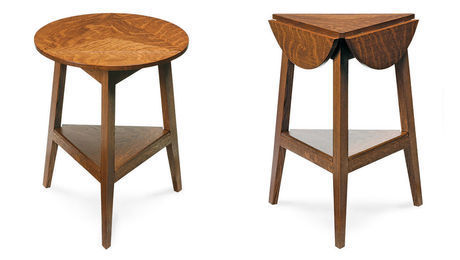
This small, curious end table is the product of multiple generations of tables I have built over the years. Each one has evolved aesthetically from the previous one. The circular piece of glass in the top draws the eye, but as a whole the table amounts to a cube. Within that typically square, static form is quite a bit of movement, however. Subtle curves and shapes as well as an open, sculptural structure were my goals.

I have a lot of templates and jigs for the shapes and curves of the table. I could write a whole separate piece on how to make and use jigs and templates. In fact, I did (see Master Class). But while I tend to favor templates and jigs when I work and always use them when I make this table, you can make it without the templates and jigs. It’s just a matter of tracing a pattern, cutting close to the line on the bandsaw, and then hand-shaping with a spokeshave, planes, files, and sandpaper. For this article, I’ll go through the build process assuming you don’t have all the templates and jigs, focusing on the order of operations and fitting all the pieces to each other.
Sidestepping
I begin the construction by building two side assemblies, each of which consists of two legs with a low rail between them. All the joinery in this project is done with #6 Festool Domino tenons.
Begin with the legs. Keep the bottom and one long edge of the leg blank square to each other. Then trace the inside curve of the leg onto the blanks and rough cut close to the line on the bandsaw. Whether you are template-routing or shaping by hand, clean up to the line. Then cut the angle where the rail will join the leg. I create the angle by template-routing in a jig. You can also cut that angle at the table saw with a miter gauge or a crosscut sled.
 The rails are a simple affair—just a block with angled ends. Make the rail a bit wider than needed so its bottom edge is proud of the bottom of the legs. It will be used as a reference surface throughout the process before being cut to shape at the end.
Once the legs and rails are prepared, cut mortises in both using the Festool Domino. Then glue up two separate side assemblies.
After the glue dries, draw the upper curve on the rail and cut it out on the bandsaw carefully. Here again, I use a template and cut the final shape on the router table, but you can use hand tools to shape the interior. (The same goes for the exterior shapes.) I draw, rough out, and template-rout it to its finished shape. The exterior curves of the legs get a roundover, and I do that on the router table as well.
Next, cut the mortises for the shelf slats. I use a jig that provides a fence and layout marks for the Domino. I cut the mortises in one side assembly, registering off the bottom edge of the rail. Then I flip the jig over and use it to cut the mortises in the other side assembly.
Registering the flat bottom of the rail against the table-saw fence, cut the side assemblies to length. Finally, cut and shape the scoop at the bottom of the side assemblies. This curve creates visual lift and lets the legs contact the floor at four points rather than having the whole length of the side assembly sitting on the floor.
Slats
The table has five shelf slats, three with convex curves on each side and two with concave curves on each side.

Begin with the three convex slats. With the blanks still square, cut two Dominoes on each end. Then trace the shape on the blanks, cut them close to the line on the bandsaw, and refine the shape with hand tools or by template-routing. Repeat the process on the two concave slats.
Dry-fit the convex slats into one of the sides, one to either side and one centered. These will be constants. You’ll fit the concave slats between them, and any adjustments will be made to the two concave slats. Set the concave slats in their locations without Dominoes. Look at the spacing, and mark where they need to be trimmed for more desirable spacing between slats. Then use a spokeshave, block plane, or file to remove material.
-Doug King is a custom furniture maker in Missoula, Mont.
| From Fine Woodworking #321
To view the entire article, please click the View PDF button below. |
 |
Full size templates can be found here. There is a 1″ square in the corner for proper printing reference.

Sign up for eletters today and get the latest techniques and how-to from Fine Woodworking, plus special offers.
Download FREE PDF
when you enter your email address below.