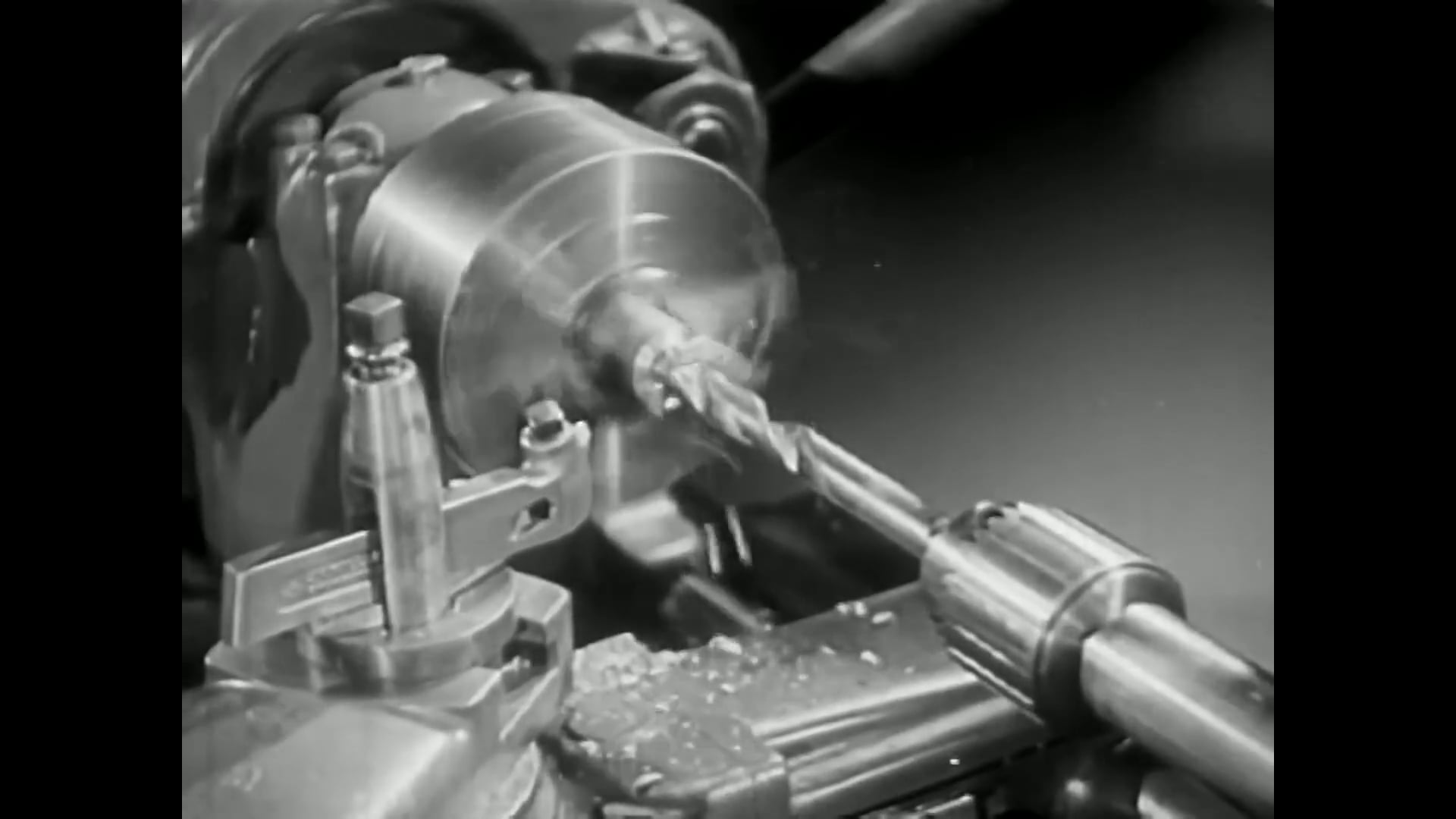
Machinist and Tool Maker 1942 Vocational Guidance Films
Support this channel: https://paypal.me/jeffquitney OR https://www.patreon.com/jeffquitney
more at http://quickfound.net/
SHOWS & EXPLAINS THE 5 WAYS OF MACHINING METALS, EMPLOYING THE ENGINE LATHE, DRILL PRESS, MILLING MACHINE, PLANER & GRINDER. IMPORTANCE OF KNOWLEDGE OF BEING ABLE TO USE MEASURING DEVICES & BLUEPRINT READING IS PRESENTED.
Originally a public domain film, slightly cropped to remove uneven edges, with the aspect ratio corrected, and one-pass brightness-contrast-color correction & mild video noise reduction applied.
The soundtrack was also processed with volume normalization, noise reduction, clipping reduction, and/or equalization (the resulting sound, though not perfect, is far less noisy than the original).
https://en.wikipedia.org/wiki/Machinist
Wikipedia license: http://creativecommons.org/licenses/by-sa/3.0/
A machinist is a person who machines using hand tools and machine tools to create or modify a part that is made of metal, plastics, or wood…
A traditional machinist is one who can operate, disassemble,reassemble and repair the machine tool as well as build new parts such as gears, splines, and shafts using various machine tools such as mills, lathes, grinders, and planers.
Some titles reflect further development of machinist skills such as tool and die maker, patternmaker, mold maker, programmer, and operator. A machinist is one who is called on to fix a problem with a part or to create a new one using metal working, plastic, or in some cases, wood. Depending on the company, a machinist can be any or all of the titles listed above.
Under the machinist title are other specialty titles that refer to specific skills that may be more highly developed to meet the needs of a particular job position, such as fitter (assembles parts), turning hand, mill hand, and grinder.
Role in manufacturing
A machinist is usually called upon when a part needs to be produced from a material by cutting. Such a part may be unique or may be needed in the thousands. This could include a machinery part for a production line or anything that can be made from metal or plastic. Producing a part will often require several steps and more than one machine tool. Each machine tool plays a specific role in cutting away excess material. When large numbers of parts are needed, production planning is required to plan the most logical workflow through a series of machines. Computer numerical controlled (CNC) machines are a special computer-driven tool that can machine a large variety of shapes, and whose use in the workflow depends on the part to be machined.
CNC machines are becoming the standard due to their speed, precision, flexibility, and reduced downtime while changing jobs. Production runs consisting of large numbers of parts are more cost effective and commonly referred to as production work in the trade. Conversely, small production runs are sometimes referred to as prototype or jobbing work.
Production engineers use blueprints and engineering drawings to produce detailed specifications of the part, especially its geometry (shape), then decide on a strategy to make it. Machine tools are then configured by the machinist or toolset and production commences. The machinist works with the quality department to ensure the specifications are maintained in the finished product…
https://en.wikipedia.org/wiki/Tool_and_die_maker
Tool and die makers are a class of machinists in the manufacturing industries. Variations on the name including tool maker, toolmaker, die maker, diemaker, mold maker, moldmaker or tool jig and die-maker depend on which area of concentration or industry an individual works in.
Tool and die makers work primarily in toolroom environments—sometimes literally in one room but more often in an environment with flexible, semipermeable boundaries from production work. They are skilled artisans (craftspeople) who typically learn their trade through a combination of academic coursework and hands-on instruction, with a substantial period of on-the-job training that is functionally an apprenticeship (although usually not nominally today). They make jigs, fixtures, dies, molds, machine tools, cutting tools, gauges, and other tools used in manufacturing processes…
Likes: 3
Viewed:
source