

Reshaping a Classic: Bringing Comfort Back to a Vintage Saw Handle
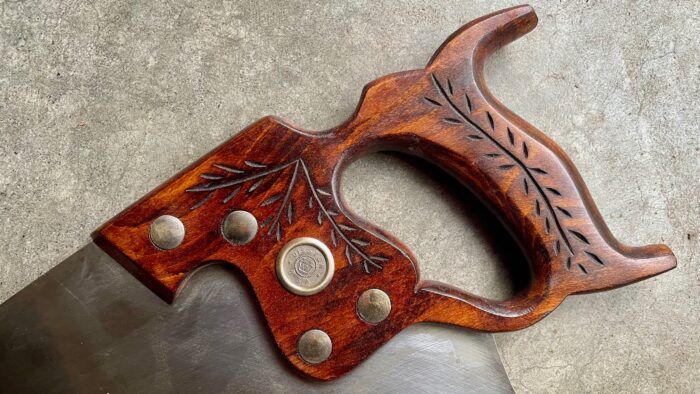
In this series, I’ve been exploring how to make and modify handles for common hand tools, with a focus on ergonomics. The motivation is personal: I live with chronic hand pain from tendonitis and arthritis—complications of hemophilia and years of repetitive work—and small changes in tool design make a big difference. But whether you spend a few hours a week in the shop or build full time, it’s worth thinking about how your tools meet your hands. Today’s project: reshaping a blocky panel-saw handle, adding a touch of chip carving, and refinishing it for another lifetime of use.
Once a month, my son and I wander through the Gorge ReBuild-It Center hunting for wood, tools, and other second-hand treasures. He knows to look for handsaws with the best handles, which usually means the oldest saws—better steel, better craftsmanship. This time, though, I went in the opposite direction. I found a Disston D-8 with a fine plate and a truly awful handle. I’m no Disston historian, but it looked mid-century: good steel, less care put into the grip. For five dollars—my usual upper limit for a project like this—we brought it home.

Getting the handle off was easy enough; the nuts needed a common flathead instead of a split nut driver. The nickel-plated brass nuts suggested it wasn’t as late as the ’70s or ’80s, when pot-metal hardware took over. To plan the reshaping, I studied a few favorite saws, including a Bishop rip saw and a Disston crosscut with an extra thumbhole. I love the Disston’s smoothness, but the Bishop feels better in my hand—bulkier, rounder, more substantial. I decided to smooth the D-8 handle but keep some mass as a compromise.

With the handle clamped in the carving vise, I rasped down the sharp edges and used Japanese files to reach the tighter curves. Grain direction on a shape like this is tricky, so I worked carefully to avoid tearout. A scraper took the finish off the flat areas, and a razor blade handled the tight corners. The wood looked like a fine-grained fruitwood—apple or cherry, maybe.

Next came sanding. For complex curves, nothing beats cutting sanding belts into strips and “flossing” the handle while it’s still in the vise. Every few minutes, I checked the fit in my hand, looking for high spots or bulky areas. This is the dangerous part of the job—the point where you can shape away too much. Because I’m a luthier, blending flats and curves is familiar work, but still hard to describe. You want flow and smoothness without losing crisp facets. I’m after elegance, not a “Gumby” silhouette.

Once I’d sanded through 320-grit, I turned to decoration. Many old saws have wheat-pattern chip carvings, likely done by machine in the factory, though some look hand-cut. I’m no chip-carving expert, but I practiced on scraps during a recent camping trip. The chip-carving knife gave me the closest look to the old factory style, so I penciled in the pattern from my Bishop saw and dove in.

The key is committing to clean, single strokes. Multiple little cuts make the design look fussy. I tried carving in the vise but eventually held the handle in my lap for better control. After carving, I sanded up to 400-grit, cleaned up the wheat pattern, and applied alcohol-based stain, shellac, and wax. The result looks great—and feels far better in the hand.
 |
 |
Of course, the blade needed attention too: rust removal, tooth setting, and filing for rip. That was as much work as the handle, and a story for another time. This blade turned out to have a breasted toothline—a gentle curve that’s supposed to help with heavy rip cuts. It’s the only saw I own with this feature, so I’m excited to put it through its paces. At 5 tpi, it’s a coarse, eager cutter at the saw bench. When ripping cherry and poplar, I found the handle comfortable in both one-handed and two-handed grips. Using both hands distributes the effort, which helps with my hand pain.

A project like this is undeniably more work than buying a ready-to-use saw. But restoration teaches you about the tool—its lineage, its design, its quirks—and builds a sense of ownership that store-bought tools rarely match. And there’s satisfaction in rescuing something discarded and giving it new life.

If you’ve ever hesitated to refine a clunky saw handle, I hope this encourages you to give it a try. There are plenty of blocky handles out there waiting for a second chance.
Fine Woodworking Recommended Products
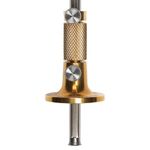
Tite-Mark Marking Gauge
These gauges can be easily and precisely adjusted with one hand, which allows you to set the tool while holding a ruler or workpiece in the other. The quality is exceptional, and all have sharp cutters that offer great visibility.
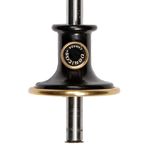
Veritas Wheel Marking Gauge
A wheel-type gauge is the easiest to use, and this wonderful Veritas model is a steal at $38.
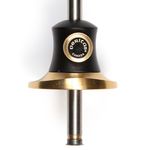
Veritas Micro-Adjust Wheel Marking Gauge
The adjuster runs through the beam from a small knob at the back end right to the cutting wheel, which moves in and out as you turn the knob. This arrangement works well but makes adjustments a two-handed operation, requiring a little more effort.
Sign up for eletters today and get the latest techniques and how-to from Fine Woodworking, plus special offers.