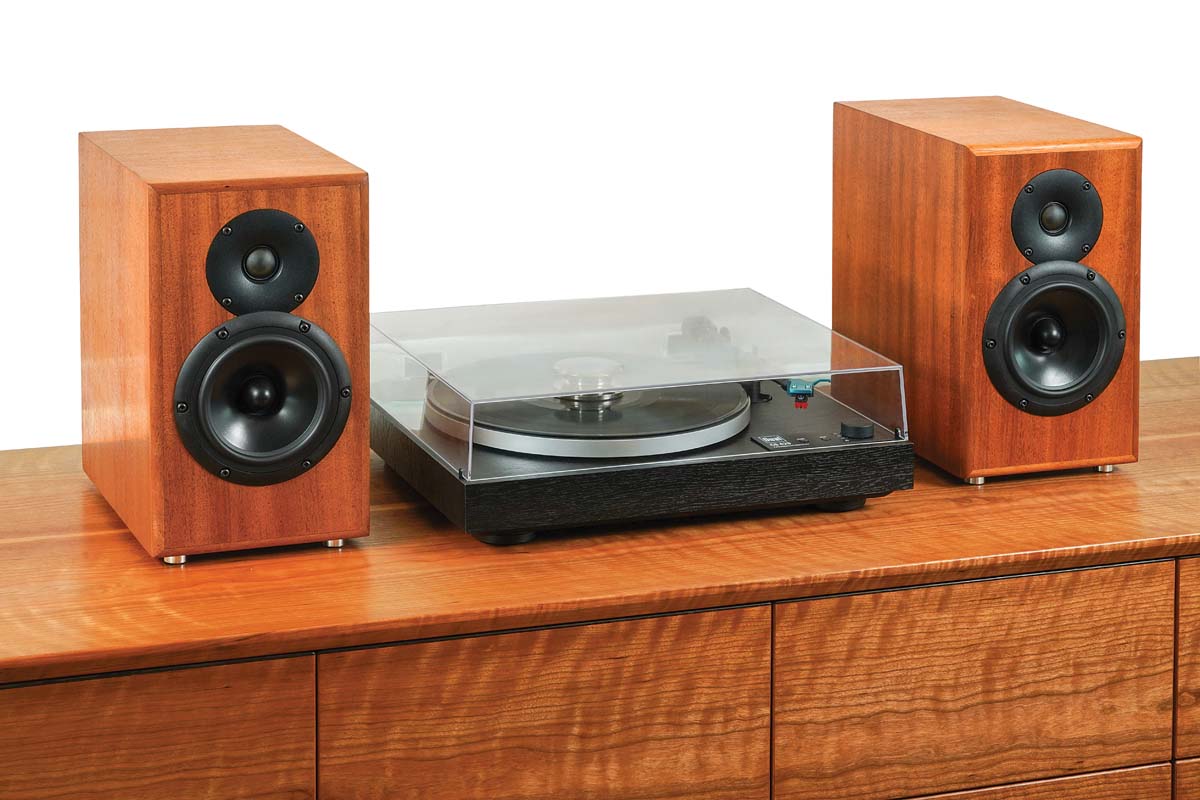

Shop Lighting: Update your old fluorescent bulbs with LEDs
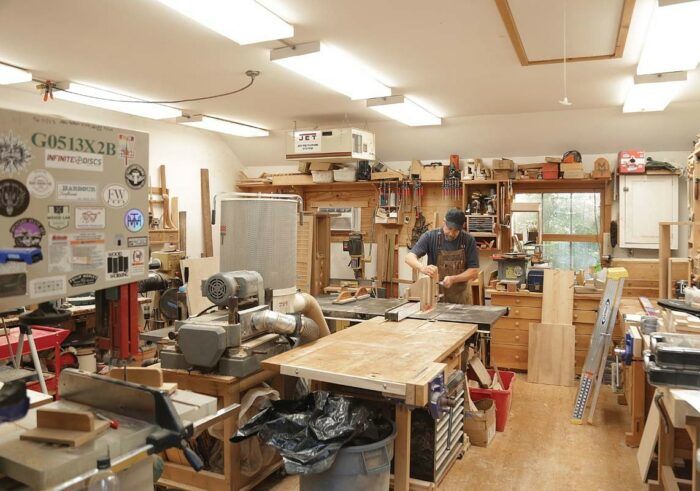
When I set up my shop 20 years ago, I loaded it with fluorescent fixtures. They provided plenty of light, but colors were somewhat washed out and dull with a slight greenish cast, an especially frustrating problem when trying to match a finish. In a few years I also noticed a decline in the lights’ brightness, increased flickering, and eventually some ballasts completely failing. When it came time for an upgrade I turned to LED lighting, which has become the common replacement bulb for its annual energy savings and the longevity of the fixtures.
Options for LEDs
 |
 |
Once I started researching LEDs, I found a few good options for upgrading to them. You can make use of existing fixtures in a couple of different ways. The easiest option is simply to replace your fluorescent tubes with LED tubes. Some LED tubes can be dropped right in, while “direct wire” tubes require removing the existing ballast.

Although changing to LED tubes will provide a better color and quality of light than fluorescents, it won’t measure up to the light that is produced by LED strips. You can convert your old fixtures to LED strips with a retrofit kit consisting of an LED driver, which replaces the ballast, and self-adhesive LED strips, which replace the tubes. While this approach requires more work than dropping new bulbs, the strips offer greater light intensity with more consistent color. The final option is to start from scratch with new LED-strip fixtures.

Color temperature and rendering

Understanding the color-temperature numbers on the box can help guide your lighting choice. As you slide up the Kelvin scale, you go from warmer to cooler. In the shop, I want lighting that is as close to natural daylight as possible to lessen any surprises when I bring a piece to the outside world. I go for LED strips that provide a temperature of 5000K, which approximates the color temperature of direct midday sun. You can get LED strips at temperatures of 2700K to 3000K, which produce warmer light, but you may find that you need more fixtures or additional task lighting for detail work. Warmer light might also impair your ability to match colors on a project’s finish. That said, avoid going too high on the Kelvin scale, or your shop will feel cold and industrial.

A second scale, the color rendering index (CRI), assesses the accuracy with which a light source renders colors. The higher the CRI number, the more accurate the rendering. CRI measures the visible wavelengths of the color spectrum on a scale from 1 to 100. Working with color temperature, a higher CRI will bring you even closer to the look of natural daylight. You may find LEDs with a 5000K temperature but a color rendering similar to that of fluorescents.
A few manufacturers have started to produce high-CRI LEDs with color rendering scores around 95, as opposed to the average fixture that lands at 80.
They do watt?

When thinking about upgrading your own shop lighting, it helps to keep a few equivalents in mind. In terms of light output, one 12-watt LED strip roughly equals one 40-watt fluorescent tube, and one 24-watt LED strip equals two 40-watt fluorescent tubes. A two-strip 24-watt LED fixture would then be equivalent to a fixture with four 40-watt fluorescent tubes. If you had an existing two-tube fixture, you could double its output by installing two 24-watt LED strips. This is where the flexibility of the retrofit kit really shines. Fixture size and wattage will depend on your lighting needs and shop layout.
Time for an upgrade

Having replaced all the fixtures in my own shop, for the sake of demonstration I sought out a shop in need of upgrading. Mike Pekovich’s shop hadn’t had a lighting update since its renovation in 2011. It had nine 4-ft. fluorescent fixtures, uniformly spaced, each with four tubes. The fading and flickering tubes had dulled in intensity over time, leaving the shop dim.
 |
 |
Pekovich’s original layout gave him generally uniform light at all his work surfaces, so it made sense simply to do a retrofit. We selected a retrofit kit for each fixture with two 4-ft. 24-watt, 5000K, 95-CRI LED strips and a 48-watt driver. In terms of light emitted, this is equivalent to the original four fluorescent tubes with much better color rendering and lower overall wattage.

In my shop, the lights hang from chains with Romex feeds from junction boxes running to and from the fixtures. I took them down after disconnecting them from the power circuit to retrofit them at the bench and then hung them back up. In Pekovich’s shop, the lighting circuit was fully contained in a run of conduit attached to each fixture, so it was easier to do the retrofit with the fixtures remaining in place.
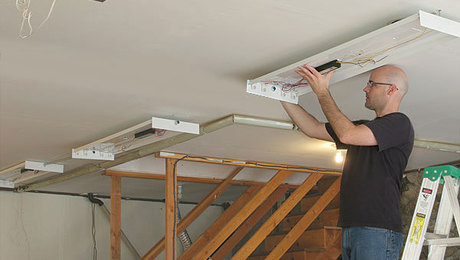
If you are comfortable with minor home-wiring projects, a job like this is a snap. Start by disconnecting power to the lighting circuit if the fixture is hardwired, or unplug it if it has a power cord. Remove the diffuser lens and the fluorescent tubes, along with the wire cover from the fixture housing. Disconnect the ballast from the incoming circuit wiring and remove it from the fixture along with the tombstones.
Shine a new light on your shop
 |
 |
Now it’s time to reconfigure the housing to fit the new parts. Start by installing the LED driver where the old ballast was previously mounted. If the driver is a different size, use a 1/4-in. #6 self-tapping sheet-metal screw to mount it. Feed the leads from the driver to one end of the fixture, leaving 6 in. to 8 in. of slack free at the end to connect to the lighting strip. Then connect the 120-volt wiring to the LED driver, making sure the connection is snug and grounded.

Attaching the rigid LED strip is as simple as removing the protective tape from the strip’s adhesive back and sticking the strip to the fixture. After doing that, connect the driver leads to the strip. Tidy up the LED leads from the driver with a zip tie before replacing the wire cover. Put the diffuser lens back on the fixture, and repeat for the rest of the lights on the circuit. Restore power to the lighting circuit and take in your updated shop in a new light.
As a hobbyist, Doug Lee has been designing and building homes, furniture, and cabinetry for the past 35 years.
Sign up for eletters today and get the latest techniques and how-to from Fine Woodworking, plus special offers.
Download FREE PDF
when you enter your email address below.