

Slicing up a Slab – FineWoodworking
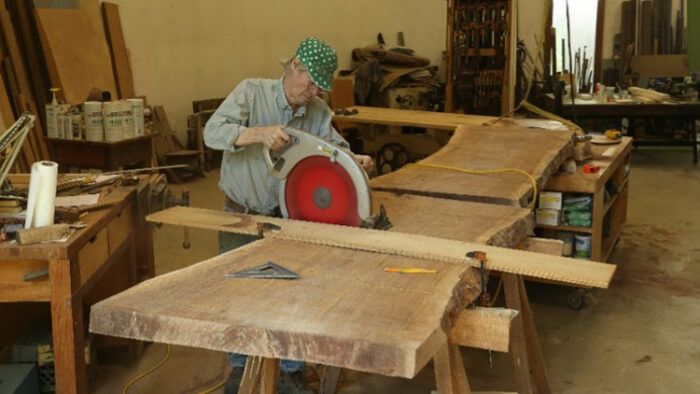
The wood for a project such as this, a queen size bed with a coopered headboard and matching bedside tables, is not easy to locate and not for the faint of heart. This plank from Good Hope Hardwoods is just over 16 feet long, 2 1/2 feet wide and 3+ inches thick. Back in the 1980’s I would have gladly built this furniture for what this plank cost. However, I have learned the hard way that careful milling and proper drying is worth every penny. Primarily because I can sleep at night knowing I will not get the dreaded midnight call from a client who was woken up by the sound of a big check opening. Having chosen Claro Walnut with my client for this project I searched Good Hope’s website, where every piece of wood is shown with dimensions on one side and the other side wetted with diluted alcohol to show the grain. I enlarge and print the dimensional image and then use an architect’s scale to layout the approximate dimensions of all the pieces I will need. A single plank assures me that the color and figure will match throughout the project

The first step is laying out exactly how and where to cut the slab into manageable pieces. My assistant Keith Johnson is providing invaluable help in checking the dimensions of my required pieces on the actual plank. Although I have already thought long and hard about how the wood grain will look especially on the headboard, this is where decisions can make or break the project. A bad choice now and it’s back to Good Hope and any thought of income is history. For smaller pieces such as the sides and top of the bedside tables, I make cardboard templates which more easily allow shifting future sections around. With wood of this sort I have become very focused on book matching wherever possible, not only with the headboard. For instance the bed drawer fronts are matched side to side on this bed. Details like this are not readily apparent which is important to me. In my view, discovery over time enriches the joy of living with fine furniture.
A clean supported cut is very important. Because of the extraordinary figure in this plank it is easier than you might think to crack off the face of the plank. The 16 inch Beam Saw makes a through cut possible with wood this thick. A big part of planning where to cut the plank is also thinking about how to actually cut it. Notice the section in the background. This will be re-sawn into the bookmatched headboard. The arc on the leY will be a canoe shape of sapwood at the center of the book match. The waning edge on the right will be saved becoming the top and bottom edges of the headboard. I am not a big fan of waning edges when they interfere with the function of the furniture. However, I do think it is important to show that the wood is solid and was used as completely as possible.

The headboard section of the plank must be very carefully re-sawn in order to have the 7/8 inch planks that will be coopered. Thankfully, Good Hope mills their planks thicker than the stated thickness of 12/4” that you can see in the top right corner of the first plank photo. In this case it was milled to 3 1/4 inches so I can re-saw 3 – 7/8 inch thick planks.
Note that in this photo the edge to my right has already been ripped straight and essentially parallel to the waning edge under my left arm. I am ripping the plank section a second time because I don’t have access to a truly accurate bandsaw that can cut a full 33 inches wide. This cut will be very minimally jointed so that the grain pattern will not be visually interrupted in the finished headboard book match- joint #4 to #5 in the coopering article.

Friendships are what makes the world go round. In this case my good friend, David Morton of Big Tree Woodworking, has a beautiful bandsaw with an accurate 24 inch resew capacity. There is no rushing this process! At his point I have easily 100 hours invested in this project and plank. I use “scrap” from cutting up the plank to check the cut multiple times before committing the wood to the saw. If you doubt the sharpness of the bandsaw blade by all means buy another, it is way cheaper than the cost of another plank or your lost time.
Each re-sawn piece must be cut starting at the same side of the original plank in sequence. Make certain the saw fence is very securely fastened, any shifting will cause a mismatch in the book match. Do not reset the fence in the middle of the process.
Whew! I have done this many times and it is a big relief to see that the cut did not wander. One of the heartbreaks of re-sawing on any band saw is discovering that the blade wandered out of a true straight line leaving a big cup in the face of your book match.
With smaller veneer re-sawing, the errant blade can wander right outside of the board being cut ending any chance of a book match. In this case it could mean anything from an obvious “hole” in the finished headboard to firewood.
A note on setting up bandsaws: The blade guides are only for fine tuning the cut after the blade is running true. Install the blade and then, by hand, spin the wheels to check that the blade is running true- hopefully at the center of the tires or close to it- with the guides set way back from the blade. If not, adjust the tracking of the upper wheel until it is. Then increase the tension on the blade and try a quick “On/Off” of the motor looking at the blade to see if it wanders. The guides will not stop wandering. If need be, adjust the tracking of the upper wheel and try again. When the tracking under tension looks good, set the guides very close to the blade but not touching. Now try re-sawing a test piece. If the cut shows signs of wandering adjust the tension. The guides will only affect the tracking for the first inch or two beyond the guides. The guides encourage proper tracking but it is up to the tension and free tracking of the blade to make a successful cut. 
Fine Woodworking Recommended Products
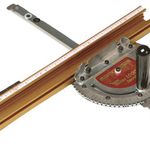
Incra Miter 1000HD
One of many extremely accurate Incra miter gauges, this model offers 180-degree adjustment to 1/10 of a degree, and a long, straight fence with a telescoping stop system.

AnchorSeal Log and Lumber End-Grain Sealer
Good for both sealing the end grain of freshly cut logs and boards, this wax prevents end-grain checking and saves material
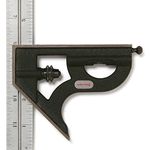
Starrett 12-in. combination square
This accurate, robust, well-machined, easy-to-read combo square is as great as ever.
Sign up for eletters today and get the latest techniques and how-to from Fine Woodworking, plus special offers.


