
STL356: Unconscious Competency – FineWoodworking
In this year-end episode of Shop Talk Live, Ben Strano and Vic Tesolin run through a grab-bag of “quick-fire” questions that quickly turn into thoughtful, meandering conversations about how woodworkers actually work. They dig into sharpening discipline and how learning to stop early is often the key to working better and with less frustration, debate when it’s worth changing blades or saws for ripping versus crosscutting, and confess their very human struggles with hoarding scrap wood and “perfect” boards saved for the right project. Along the way, they talk candidly about tools that didn’t live up to expectations, what they always carry in the shop, snacks and coffee breaks as part of a healthy workflow, and the moment when woodworking starts to feel intuitive rather than forced. The episode wraps with reflections on experience, teaching, and the idea of “unconscious competence”—that point where tools become extensions of your hands—making it a relaxed, honest, and fitting close to the year for the podcast.
Quickfire questions answered:
- How do you know it’s time to sharpen, and how do you get yourself to accept it?
- Do you actually change blades for crosscutting and ripping? Do you actually change handsaws for crosscutting and ripping?
- How small is too small when hoarding scrap wood?
- What is the longest you’ve had the perfect piece of wood lying around?
- Favorite domestic hardwood?
- What tool did you look forward to buying, but you were disappointed when you got it?
- Snacks in the shop? Yes or no. If yes, what’s your favorite shop snack?
- What’s your EDC in the shop?
- When did you feel like you knew what you were doing?

Every two weeks, a team of Fine Woodworking staffers answers questions from readers on Shop Talk Live, Fine Woodworking‘s biweekly podcast. Send your woodworking questions to [email protected] for consideration in the regular broadcast! Our continued existence relies upon listener support. So if you enjoy the show, be sure to leave us a five-star rating and maybe even a nice comment on our iTunes page. Join us on our Discord server here.
AI Transcription to feed the SEO robot overlords:
Ben:
All right, Vic, thank you so much for coming on. You are, um, you are not in your home territory, but you still agreed to come on and record with me for this last episode of 2025.
Vic:
This is how much I love spending time with you, Ben.
Ben:
Well, I mean, I am a gift given to all the world, but some indulge more than others, and you are one.
Vic:
I am, for sure.
Ben:
But, so, um, uh, about a month ago or so, Amanda came up with this list with the Discord server for quickfire questions, and there are lots of really good questions here that are, like, I don’t know if they’re gonna be so quick. We’ll see, but I thought it would be good. The idea was that we could ask—we could have a set of questions to fill an episode and start conversations.
And I think it’s got to start with you and me, because, yeah, you know, um, we gotta set that bar. You can drag out a simple answer. It’s me and you. Listen, we amuse each other. That’s all that matters.
Vic:
That’s all that matters. It’s an audience of two.
Ben:
All right, so, actually, one or a few of these questions are from me, uh, because I think I started it on the thing, but from me: Vic, how do you get yourself to accept that you’re not sharp right now?
Vic:
Oh. So the first thing that I—it’s OK, that’s oddly technical and philosophical at the same time. Yeah, yeah. I—I didn’t screw around. No, no.
And so, if you’re looking for rapid fire, I think you’ve already thrown a wrench in our plans. But, um, here’s what I think. I think that you have to get comfortable with your sharpening technique. Enough to the point where you don’t have a minor panic attack when you think your tools are dull.
OK, right? And so, like, I mean, I know they’re dull, because they tell me they’re dull, right? If I’m paring with a chisel on end grain, let’s say in the case of a dovetail—like, if I see I’m starting to get wood fibers pulling out, I know I’m dull. Yeah.
Right, and then, but the problem is that it’s like, well, you start to have that rationale in your head. It’s like, well, it’s still cutting, and, like, that surface really doesn’t matter, so, like, who cares? And then just keep hitting harder.
Um, and then it’s the same thing with the handplane—it’s a no-brainer. Because you’re getting these beautiful shavings, and then all of a sudden, it just stops taking those shavings. And the only thing that’s changed is the fact that your blade has become dull.
And then, I remember as a beginner not wanting to, because I wasn’t confident in taking the blade out of the plane and being able to get it back in, and like operating, the way it took me 20 minutes to get it in the first place. But really, the only way you can do that is to do it.
And so, you have to get comfortable with your sharpening technique.
I’ve got it to a point now where, um, because I use the Tormek, like 95% of what I’m doing is just maintaining an edge using the leather wheel. And I don’t have to re-grind or whatever, so it’s literally like ten—whatever—seconds on the strop.
But you could port that over to a Japanese stone setup where it’s just like, I’m just like ten seconds on an 8,000-grit stone, right? Clean it up, hit the back to remove the few micro-burrs that are there, and then go back to work, right?
And that all goes to, like—so, like, when I teach sharpening, I always tell people you want to grind once and then polish forever, right? And the whole idea behind that is that if I catch my—as soon as I see a little bit of tear-out, like from the end grain with my chisel—I stop, go over my Tormek. It’s like I turn around, it’s right there, boom, I hit it for ten seconds, and now it’s cutting fresh again.
Right? So what I’ve done is I’ve eliminated a lot of the things that can cause a person’s stress with sharpening, which is like putting it into the jig. Putting it into the jig properly, making sure I got the right angle. Make sure I got my—you know, in the case of Japanese water stones—when was the last time I flattened those guys? Like all of that stuff, I basically done away with all of that.
And if I do something catastrophic, like hit the edge of a tool with something hard—whatever—and I get like a chip or whatever, it’s like, OK, well then it’s like: deep breath, then do the remedial work that has to get done.
But often enough, it’s like just getting comfortable with what you’re doing, so that you don’t get that thought in your mind, like, “Oh, I don’t wanna do this.”
Ben:
OK, so my take—my little addition—’cause I agree with almost everything you said: I wish I were better at stopping or acting quickly, and I think that would help apply to… I am good with like gouges—carving gouges—doing that. Um. I wish I were better about it with chisels.
So why are you good with carving gouges, but not with chisels?
I think, well, I’m not gonna lie, I push chisels way farther than I should have. Really should. Like I like—well, well—because I don’t use chisels very often. OK. And I just assume they’re always ready to go. I’m gonna do a couple quick things with it—just zip, zip—and then they go right back up.
But like a month or so ago, we were shooting a video, and I was chiseling out a hinge mortise, and I pulled my chisel out, and it was like: there’s this quarter-inch chisel that’s chipped, and here I am—I have to do this on camera and hope no one catches that this chisel is chipped.
Um, I felt deep shame, but chisels are one thing that there’s no excuse for not quickly zip them.
I will say a plane: if I’m pulling the blade, I’m going back to the 1,000-grit stone. I’m not gonna hit my highest grit and strop or, you know, do the highest. I’m just gonna go back, ’cause I—I just want to make sure that it’s done.
And one thing that really settled that for me is like: if I go to my 1000 or if I really have to go to my 300 diamond, it’s like, man, that first one is the only one that’s gonna take any time because I use a honing guide. So it’s just like that first one, and then everything else is, like, you know, ten seconds. Ten seconds, ten seconds, move on with your life. Put it back in, and you’re good.
Um, so, planes. Planes, I’m a little more diligent about, because they’re—they’re really getting, you know, it’s distinctly possible it’s the finished surface.
Chisels, I’m not so great at, even though I should be, ’cause it’s easier.
But I will say this: the thing that really cemented that whole thing is that the realization that the longer I wait, the moment I notice a chisel or a blade possibly being dull, the longer I go, the longer it’ll take to sharpen it. And that realization is like, dude, you are—you’re walking away from it. The target is right now. The more you go—
Vic:
So that’s 100% right—yep, exactly.
And, in fact, I go one step further, so when I cut—so, for example, I’m gonna teach a class locally making a dovetail box. And so I created a dovetail box for photos and all that other stuff. And then you end up with three or four chisels on your bench that you’ve been using to craft these, right? They don’t go back on the wall. They get touched so that every time I put the chisel back, it’s sharp.
Ben:
And you’re a better man than I am. Because I know if I grab it off of there, it’s dull, I’m gonna be so messed up, because I’m like, I’m starting this with, like—
You know, a lot of people say that, too. About, like, cleaning the shop after every project, so that everything’s back where it’s supposed to be and everything, you know what I mean? Like, I try to do that.
Um, you know, it’s that whole 5S situation that the Japanese at Toyota worked out years ago, and it’s like, for me, if I can do a reset—even if it’s like a reset of like, OK, I used these three chisels; I know I just touched them up a bit while I was working, but I’m just gonna quickly touch them up again, and then put them back on the wall; that way, when I grab them tomorrow, they’re sharp.
Yeah. You’re right. You’re right, Vic. It doesn’t mean it’s easy to do, and I was never good at it. And I’m not good at it in any other part of my life. Like, my office desk is a catastrophe. Like, there is stuff everywhere; there is—but I know where everything is. And you know, all the other lies we tell ourselves, right?
But, um, the only other place I’m diligent with it is with students. Like I have a folder, I have a file for each of my students so I can journal—basically where we are at, what we’re working on, and all that other stuff, because there’s nothing worse than someone who’s coming to pay—you want to learn—and you’re like, where did we leave off? Yeah, right?
So, where it really matters in my life is work with students and chisels. Otherwise, I’m nothing else, nothing else. Everything else, just write me off.
All right, so that was a quick answer. That was actually not bad, actually.
Um, all right. Oh, here’s another one I did that’s really good. I’m so good, um.
So, um, this one was more a table saw thing. But I actually just published—published—on your “No table saw, no problem” article. Uh, do you—and let’s say this is gonna apply to track saws, or hand saws now—do you actually change blades or saws for crosscutting and ripping?
Vic:
Mm, that’s a good question. Um, everybody says they do. So when I did use table saws, it absolutely—I would change it every time. And the reason is that I didn’t feel a combination blade would do it. Huh.
And so, um, with the track saw, I find more often than not—I don’t often rip with the track saw, because I have a bandsaw. Yeah.
And so, the bandsaw is what I learned to rip on, right, when I was a student, because we were forbidden then at Rosewood to rip hardwood on a table saw, because at that time, these were old Canadian-made Generals that had like zero safety features on them. There wasn’t even a splitter.
And so it’s like if you try to rip hardwood without a splitter, and it bows in there, it’s gonna shoot it right back out. So, of course, because these were, you know, nice saws—they were like, you know, five and six horsepower—like you weren’t stopping the blade.
And so, um, yeah, oftentimes I use the—like with the track saw—it’s technically a combination blade that they—you know, the as-provided saw blade.
I have a rip blade for a track saw, and I also have a dedicated crosscut blade, but that’s more for veneered products—like, if I’m veneering something or whatever—because it just has that whole triple-chip pre-scoring situation.
But like, I would say that because of my workflow, 90% of the time, the blade that originally came with the track saw is what I use.
Ben:
OK. What about hand saws?
Vic:
Oh, always the appropriate—rip on it. Yep.
Like when I cut dovetails, whether it’s with a—with the, um—oh, I say that. I say that, but, uh, I’m kind of fortunate to have a few from Mark Harrell’s saws, and I asked him to file them hybrid.
Ben:
Same.
Vic:
Which is basically like, you know, a rip with a bit of fleam, right? But it’s still like 70% a rip saw. So, I have like the Bad Axe carcass saw—the long carcass saw—and that’s the one that is in a little holder right next to my bench. And that’s, let’s be honest, 98% of the time the handsaw that I grab.
I do have a dovetail saw, um, but I only use it if I’m dovetailing thin stock because I just don’t like it half inch or under that, because otherwise the carcass saw is just—I mean, that thing just goes whoosh right through thin stock without thinking twice.
It’s a little aggressive for that, but yeah, I am a hybrid file fan.
Ben:
And, um, I don’t think I’ve ever switched the table saw blade from rip to crosscut or anything like that? So, what’s in your saw? What’s in your table saw?
Uh, in my table saw, I just have a Forrest 8-inch combination blade. Okay, yeah, a Woodworker II or whatever.
And again, since I have that little weird table saw, uh, you know, getting other blades for it is—I actually think you can use track saw blades on it, depending, because the arbor—that’s the problem.
Vic:
Well, the arbor is the problem with my saw, right, yeah, so—
Ben:
Oh, because it’s like, whatever, 20—like it’s metric. It’s 20 or 18 millimeters. Yeah, it’s like a—it’s metric. I don’t know what it is, but, um.
Yeah, but, uh, I barely use my table saw. Um, but at work at the Fine Woodworking shop, I just use crosscut for everything, so, so.
All right, uh, Groggy Rat asks: how small is too small when hoarding scrap wood?
Vic:
Uh, so the key term in that question is hoarding. OK, so that’s the key term, to my mind.
So, my rule used to be, uh, if it was shorter than ten inches, it got burned.
Ben:
Wow.
Vic:
Because ten inches is, uh, the smallest I can safely put through my thickness planer. OK.
Ben:
Wow, there is a solid reason.
Vic:
Right, because otherwise I have to do everything by hand. Or—and in some cases, like, don’t get me wrong, there are some pieces of wood that are shorter than ten inches that I’ve kept.
But since I started learning how to turn, now you recognize that like a four-inch piece of eight-quarter—you could get three projects out of that.
Ben:
Yeah, yeah. Like I could make ten pens—well, no, not quite—but you know what I mean.
Vic:
Like, so, for me, as a beginner turner, like, I just sort of put into practice the same thing I’ve been teaching about flat woodworking my whole time is that—you just gotta do it. Just gotta do it.
And it’s like, so I made countless ugly bowls and boxes just to practice, right? It’s like, OK, I’m only gonna cut this with a skew, and then I’m gonna get tons of catches, and I’m gonna learn tons from that. And then, you know, whatever, whatever.
So it used to be ten inches, but now I—like, if it could be—if it’s a turning blank now, then, you know, because if you take an end off a board, let’s say a piece of walnut that has a bit of a check in it, right, and it was an eight-inch piece, but the check is like two inches in. So you can get a six by six.
Ben:
Right, well, that’s a six-inch bowl.
Vic:
Yeah, right, that you can—and it’s shallow ’cause if it’s eight-quarter or whatever—but platter or whatever. Yeah, but still, I use those things in the shop all the time.
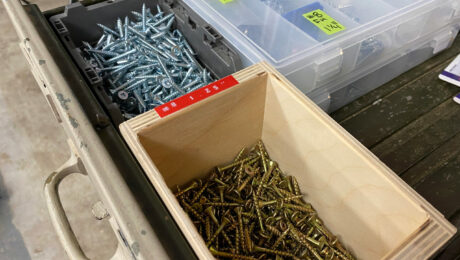
Like people say, “Oh, well, you have that nice workbench. Like, how do you not lose screws?” And I’m like, I have like a little—I have dishes and bowls and things that I put my hardware in.
Ben:
You see, OK, so I’ll give you this. Yes, that’s great, but I drop screws as I’m taking them out of something, and they fall through the holes, and that’s when I get really pissed off.
Vic:
Oh, well, then maybe you should look at magnetizing your tips or something like that. Or being, you know, not an idiot—or careful.
Ben:
Yeah.
All right, so my scrap wood project, there’s one thing that I make: turned handles for a weaving tool my wife sells. And, um, if the piece will work for that, then it’ll get set aside for those.
Besides that, I have talked about it before: the bakery that we go to in town, they sell square buckets—which I love. Square buckets because they’re very space-efficient. They sell them for 50 cents.
If the piece will fit in the square bucket—when I’m done cutting a piece of wood—if it’ll fit in the square bucket, it goes in the square bucket. When that bucket is full, the lid is put on, then it goes in the firewood stack.
And my wife is generally the one who starts fires in the afternoon, and, um, she does not care what that piece of wood looks like. But if that lid goes on that bucket, that means I am emotionally done with whatever is in there.
And I have had to just say: this is my line. Like, if that bucket is full, I might give it a real quick glance and maybe yank one thing out, but no. I am. That has solved my wood and scrap wood hoarding problem.
All right, so now coming back around, here’s another question. Related question: What is the longest you’ve had a perfect piece of wood lying around?
Vic:
Um, so, oh God. It’s gotta be close to 20 years.
Ben:
That’s not too bad.
Vic:
So, I mean, yeah, when you consider that I’ve been at it for about 25 years. Um, it’s a piece of pear—Swiss pear—that I bought and thought, oh, this would make like a fantastic set of doors, because one edge is live, so it has this cool sort of shape.
And at that time, and at this time, I was heavily influenced by Krenov and his ideas—the wood telling you what it wants to be—and so, like, I look at that shape and think, oh, book-matched open, this would be gorgeous and create this beautiful negative space, and like, oh, beautiful.
And so, to this day, I see that board every day in my wood area. Every day I feel a little pang of guilt that I haven’t done anything with yet, but at the same time, it’s one of those crazy situations where I think that wood is too much—beautiful to use.
Ben:
Yeah. So, I mean, you’ll make the project one day with it, right?
Vic:
Oh sure, one day I will, and one day I may end up just using it and making a box and like, you know, not using it for its intended sort of shape and beauty.
But like, I think the distinction, though, is that you actually have a project in mind with that piece of wood. I just don’t know which cabinet to build, or what cabinet I need.
And what I recognize as I look at my home, it’s like I have a lot of empty wall space because I don’t have a ton of artwork. Um, and I mean the closest thing I have to artwork is my new Yamaha six-string classical that is hanging on the wall.
Um, which again, when we talk about things that we didn’t need to buy. But, um, anyway, I think you needed to. Turns out a classic neck is perfect when you have bare hands or bare paws for hands.
So, um, but anyway, all that to say, like, you’d be like, oh, it’d be nice to have a nice cabinet there, you know, with a couple of nicely, you know, hand-thrown pots in there, or, you know, those sorts of things, because to me, that’s more artistic.
So, like, I even know where I think that cabinet would go. Right? I think it would go in my entryway, and I would likely put keys or whatever on it.
I think this needs to happen in 2026. Is 2026 the year I use this? I think 25 years in—or 20, whatever, yeah.
Ben:
But see, like, I don’t think that’s you hoarding a piece of wood, though. I think that’s you waiting until you want to make that project.
I’m gonna be an enabler here, and I’m gonna say, good on you. And if you want to make that—
But like, I don’t think—like, in my head, sometimes it’s like that piece of wood lying around is like, I don’t—like, all right, here’s mine.
I have a beautiful piece of Eastern white pine that is 20 inches wide, mostly clear. I think it’s 10 feet long or something like that. You showed me that board.
Vic:
I think, yeah.
Ben:
Barry Dima left it here when he moved, and it was like, yoinks, that’s mine now, and possession is nine-tenths. I don’t know what I’ll do with it. I have no clue what I’ll do with it. I don’t really do anything in pine. And it’s just beautiful, and honestly, I should probably give it to a friend.
There’s another one, though, that I think Jeff—maybe he can confirm or deny it. So my uncle—my wife’s uncle—who’s a woodworker, when he found out I was getting into woodworking about 15 years ago or so, he gave me like a dozen little 8-inch Jorgensen clamps, which are still my most-used, favorite clamps, and two flamed maple boards.
And I knew at the time I was not ready to use those maple boards. And, um, then they became this weird thing for me that I moved with and I just stored, and then eventually when I was ready for them, they weren’t that magical anymore. They’re like, oh, that’s just a flame maple board.
And it’s just—so I think I might have used one of them on top of a side table, and then another one or two, I think—like Jeff—Jeff is making Mike’s traveling tool chest. And he was like looking for wood. I was like, use these, you know, and I think that’s what he was planning to use for his drawer fronts.
Um, so, uh, and if they are, it’s like, I feel like that’s the appropriate use for it. Because I was so scared of the boards, but I’m glad someone’s gonna use them.
And Jeff, if I haven’t given them to you, they’re yours now.
Um, but yeah. So I just—it’s like, I was too afraid of it.
But… so, just yeah.
I’ll tell you what I’m more relentless with: actually, plywood scraps. A nice piece of Baltic birch, man.
So the way I jig and fixture is, I make it with drywall screws and hot glue. Like that—if I need a jig or fixture for something, that’s how I make it.
I don’t make permanent hang-it-on-the-wall jigs and fixtures, because my goal in life is to never build the same thing twice. And so, if I do, I don’t need to keep it around.
Um, so, if I have to make a jig, like, sometimes that—you know, a two-inch by one-inch by three-quarter-inch piece of plywood is the perfect fence panel on there to add a Destaco clamp to, like lock it in place or whatever.
And so, I actually keep more bits and bobs of plywood than I do hardwood. Because I find that I use them. Like I use them for stops. Sometimes I’ll hot-melt glue them to my bench.
Although nowadays with the perforated bench and all that other stuff, there are so many places to place stops that I don’t do it as often. But I used to screw pieces of wood to my bench or glue them to my bench.
I know, I know, and people say, “Oh my God, it’s your workbench!” And it’s like, yeah, it’s a tool. It’ll work.
Yeah, yeah, I’m working at it. I’m not serving cucumber sandwiches to royalty. So, um.
Vic:
Though there’s nothing wrong with a good cucumber sandwich, I’ve come to learn. Yeah, that’s a lovely thing.
Ben:
But I’m more inclined to be relentless with tiny little pieces of plywood. And I have like a box. And then once that box gets overflowing, I take about five—ten minutes—and I just assess it.
And it’s like, OK. I have lots of little pieces this size, I can get rid of a few of those. And because those—and then that’s trash, right? Like, you can’t burn it, no. You can’t—you know. Whatever, whatever.
So I’m a little more careful about it—what I throw away when I burn plywood.
Vic:
Yeah, I’m not in your house.
Ben:
Well, I mean, we have a wood-burning stove, so it’s not like going—
Vic:
Oh, right, right, right. I, that’s a man used to kindling plywood. It’s like the best kindling ever.
Ben:
All right, well, it’s super dry, but it’s the other issue that for me is just like the chimney. I think it gums up your chimney more.
Uh, yeah, I’m just using it for firestarter, but, um, yeah, no, no, that’s not like the BTU reasons. But we do use plywood as kindling.
So, did you ever see the video of Ishitani Furniture where he makes—he takes sawdust and makes up this paste with paraffin, and then he compresses the block. He has this whole system that he made up.
And then, because of course, he heats his shop with wood, and he’s in northern Japan. So, like, it’s cold there. He’s in the mountains.
And, um, he just puts a couple of those in, puts the kindling over the top, lights it and walks away.
Vic:
See, I did that one time—I got little muffin tins and… you know, you know, uh, shavings and sawdust mashed up with paraffin, and I felt like it was super wasteful of the wax the way I was doing it.
I think the way you described it, where he’s like compressing everything, is probably a bit more legit. And then I felt like the wax was gonna gum up my chimney. So I stopped.
Ben:
Ah, OK, ’cause when he does it, he seems to make it into the same sort of consistency like casting sand.
Vic:
Yeah, that was not how I was doing it.
Ben:
Yeah, yeah. He’s into woodworking; he’s better at it than me.
Yeah, he’s so good. How do we get him on the podcast?
Yeah, all right, um, okay. Favorite domestic hardwood from Kevin.
Vic:
Cherry, it’s a toss-up for me. Cherry or walnut, but if I—if my feet were held to the fire—I would say cherry.
Ben:
Yeah. For all of its issues, it can be cantankerous, right? Like a lot of people say, oh, it works perfectly, but if you pet it the wrong way—like curlies and cherry, man—like that does not want to get along. Curlies and cherry will ruin your day.
And then finishing it can be a challenge because of the blotchiness of it. And, like, you know, some people swear they have the best system. They start with a coat of shellac, then they do this.
And I think, actually, Christian Becksvoort—didn’t he do—like, obviously the master of cherry—but he did an article where he talks about how to prepare cherry so that it doesn’t blotch.
But then, at the same time, like, I’ve worked in cherry that was sort of high-end figured, um, and like, then I didn’t want the blotch, because of the blotchiness. It’s just like absorbing more than—you know—I didn’t want that to go away, necessarily.
So, um. But just like a nice—like I love rift-sawn cherry legs. Yeah, there’s nothing better than that.
Uh, I will say, with the right piece, rift-sawn ash will give it a run for its money. And I am going to say right now, yes, overall, when the book is written on Ben Strano, cherry will probably be the predominant wood.
But right now, I’m using all the ash I can.
Vic:
Well, yeah, because it’s going to disappear.
Ben:
And I love it, and, um, God, I remember the first time I used ash, I was like, “This is awful. Why would anyone ever do this? Why is everyone always talking about ash?” And it’s like, no, dude, you just suck at sharpening.
And—but like, now it’s just like I made a prop table, and it was—man—perfectly rift-sawn ash legs. Hard to beat.
Vic:
Yeah, well, and like you don’t get away with anything. Ash shows you exactly where you’re at.
Ben:
Man. Yeah, because if you, like, don’t cut that piece right and you get that little bit of runout, you’re gonna see it plain as day. Whereas with cherry, it’s a little bit more forgiving.
You’re right. Cherry, runner-up ash.
Vic:
Yes, I agree with that.
Ben:
Um, all right.
[Ad break: Osborne Wood Products]
Ben:
I want to read this one, and let’s say we’re not gonna trash anything. But what tool did you look forward to buying, yet you were disappointed when you got it?
I’m going to answer this one quick: combination plane.
Like I had hopes and dreams for my life with a combination plane and, um, I got one, and, uh, it was just—it just sat on the wall.
Vintage? Uh, no, it was a new one. It was the new Veritas one right when it came out, and we got one in for review. And I bought it after the review.
And, um, a lovely plane; it works great. I was like, it’s a great thing. It’s just like, that’s not the woodworker I wanted to be. That woodworker—it turned out I wasn’t.
And then, you know, first 500 bucks I needed, I sold it. You know, it was just—uh—that was it.
I thought it was a thing that I would really enjoy using, and I just never used it.
Vic:
So, the combination plane is an interesting one. Because, like, I worked for Veritas then when that was being developed, and um, it was Terry Saunders, who is basically a legend, sat down with 15 different combination planes from different eras, from different companies. And it’s like, how do we make this thing actually work?
Right? Because the joke always was like, um, it was so fussy to set up, right? And everyone I knew who used one had six of them. And they would leave them set up—this is my drawer one, this is my carcass one, this is my—you know—all those sorts of things.
And it’s like, could we make it? ’Cause that’s part of the heartache about that tool is the change-out time, right? Because you have to completely reconfigure it, um, to use it.
And if you’re that person, then you will get an extreme amount of joy out of it.
Because the one thing that they did do is they made the adjustable parts—fences, stops, and all that other stuff—more reliable and right. Unlike the original ones, which were a little shaky; the fence wasn’t parallel, and you had to—yeah—it was a bit of a nuisance.
And so, like poor Terry, he was like—that was a tough one. Right? Because he had to make it so it actually—
‘Cause my advice was, well, if it’s gonna work just as good as the originals, then I wouldn’t even bother, because like, they can be had for much less money.
Uh, and oftentimes, you know, the joke was the reason why you can find it mint in the box, all the cutters are because people got frustrated with it and didn’t use it.
You know, so, yeah, like that’s a—like I never bought a combination plane because that wasn’t the way that I wanted to sort of do things.
Um, I have made wooden planes, like a grooving plane and things like that, you know, that are a consistent size I use for, you know, whatever, when I want to work that way.
Um, and sometimes I will build a little something out of, like—and just use all hand tools, right? Just to remind myself that, you know, this is exactly how they did it; this is what they did.
Um. But at the same time, when I’m working in my like a sort of natural environment, I use a combination of the two.
Right? Um, and sometimes the router is loud. It’s dusty, it’s all those things, but it’s pretty cool.
You know, and then, uh, the shaper by extension is also like—you know—it takes some of the scariness out of just using a fence handheld router and making it a bit less scary for people.
But all that said, I don’t know that I’ve ever been like that disappointed. Because I’m pretty fastidious about researching stuff and, like, do I really need it, and do I really like it, do I really think that?
Like, I’ve been disappointed with the quality of some things. I thought it should be better than it was. But sometimes that’s just subjective, I guess—your own head, right? Like, I have a very low tolerance for tools that don’t do what I think they should do.
I can remember, um, chatting with Michael Fortune one time, and like Michael Fortune has all the patience in the world for tools that aren’t the best.
And so, I remember being in his shop and seeing him spraying with a spray finish using Harbor Freight guns. And I’m like, how—how do you do that? And he says, “Ah, you just get used to the fact they drip at the end of the thing. So I keep a rag in my hand, and I spray, then I wipe. And then I spray, and then I wipe.”
And I’m like, I couldn’t do that. Like, I want it to work the way I think it should work.
Ben:
And I’ll tell you, man, I am the guy—I need to take a lesson from Michael Fortune, because that Harbor Freight price point for a sprayer is where my heart is at.
Um. And, like, I have stared down many a Marketplace, you know, nice quality sprayer, and I just—I can’t do it yet, but, uh, one day.
Vic:
I don’t spray because of the work size and the frequency at which I do it. It’s like it would take twice as much time to set up and tear down than actually use.
Ben:
So that’s—and I actually just had Owen, um, who, you know, sprays, you know, all the time.
Yeah, um. I had, like, he and I had a heart-to-heart about it, where I was like, listen, man. Like, this is the problem I’m having. And he’s like, “Yeah, you gotta clean the gun after everything you do.”
And I was like, yeah, but I’m doing a ukulele neck, and I spent 37 seconds spraying.
He said, “Yeah, then you’ve got to clean the gun.” That’s just the game.
And it was like, OK. I do. And so, like, I might—I don’t know. I like—I just… It just doesn’t fit my mind of, like, I’m gonna do something for 37 seconds, then 15 minutes cleaning the gun. And then, an hour later, do the whole thing again.
But that’s the game. So if I want that thing, I gotta do the thing.
But—well, I don’t agree—like, I mean, if I were making ukuleles, I would be using rattle cans.
Um, well, I use rattle cans for small stuff all the time. Like if that’s what the finish I’m looking for is, I’ve been wanting—so yeah—I’ve been wanting to go water-based finish, though.
Just because I—I—I feel like it, but you can do that with a rattle can. I don’t know if I’ve—I don’t know if I know of any rattle-can water-based finishes that would be appropriate for an instrument, but maybe I need to look at it.
Vic:
There’s a lot of new stuff out there, especially on the waterborne side of things. Like, are you just looking for, like, something to replace a catalyzed lacquer kind? What kind of thing?
Ben:
That’s what I would do, yeah. So right now I’ve been using, um—and I really—my newest uke—I really like the finish I got. Crystalac has a finish that is water-based, it’s, um, you know, they’re pre-finished with a slight amber tone added to it. So it gives you that kind of oil-based look thing, that warmth.
Um, I was really pleased with the finish I got. It’s not the same. It’s not the same as it will be, and it never will be. But I just—I have it in my head that 20 years from now, like, that’s kind of what we’re doing, so maybe I should start walking that way and getting used to it or figuring it out now, you know.
Vic:
Sure. Um, well, you can always—like, I mean, with a rattle can. You can’t—But you can’t add toner or anything.
Ben:
Like I—I mean, I could rattle-can toner like if I went with rattle-can lacquer. I could rattle-can toner on it, you know.
Yeah. I think we got a bit off subject there.
Vic:
Yeah, I don’t even remember the original question was.
Ben:
Uh, disappointment in tools, um—yeah, completely off.
Um, OK, this one makes me giggle. ’Cause I don’t know how this is a question. Judging, you’re gonna be like, yeah, it’s pretty clear that Ben doesn’t have, you know, anything to say about these. Snacks in the shop? Yes or no? You gotta have a snack.
Vic:
Well, first off, this is my work area. Of course there’re snacks in here.
Ben:
Yeah, yeah, I mean, like, I think it depends on how much time you spend in the shop, right? Like, you leave your house in the morning, and you come out to your shop and you spend the day in there and stuff.
And it’s like, you know, you go in for lunch, I presume.
Vic:
I eat out; I have lunch out here most of the time.
Ben:
Oh, do you? OK, um. But for me, like, my shop is attached; it’s like a garage to the house. And so, like, it’s very quick for me to just zip upstairs and make a cup of coffee quickly, you know, grab a protein bar or a cookie or whatever, and head back down again.
Um, so I wouldn’t—I don’t store snacks in my shop.
Um, but yeah, of course, like, because that little bit of a coffee break—like that’s where, like, you know, you stop, second, you look around and you think, and you like, oh, I’m gonna do this, and like, you know—or especially, like, I’ll go and get a coffee if I’m stumped on something.
Because while I’m making a cup of tea, coffee, and like I’m thinking the whole time; then, like, oftentimes as I’m walking back to the garage, I’m like, “Oh yeah, yeah,” that’s what I can do.
I also think there’s something to be said for a hot cup of coffee in the shop. That makes you mindful of it.
Like me, I cannot stand it when hot coffee gets cold. So it’s like, OK, what am I doing? All right, I need to drink that now. I need to drink that coffee too. I need to—like—it keeps me from getting too far in the zone.
And sometimes that’s a good thing, especially early in the day for me.
[Ad break: Gorilla Wood Glue]
Ben:
This one I really like, again from Kevin. Uh, what’s your everyday carry in the shop?
And I think you’ve written a blog on this with your little holster, Haven’t you?
Vic:
Yeah. What’s in it depends.
Ben:
Oh, I thought it was a very fixed thing for you.
Vic:
Well, it was at one point, and then what I realized about that is I use different tools; I need different tools accessible quickly at different phases of the build.
So, when I am processing material to make parts, like I need a measuring tape. And I need a lumber crayon, and the most fidelity—the lumber crayon—is about the highest-fidelity tool that I need at that point.
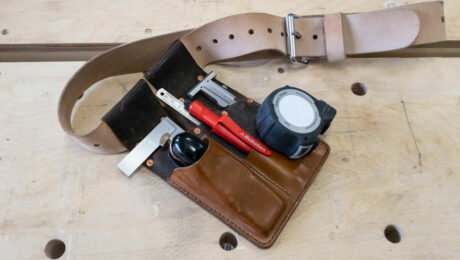
And so I have, um, I have a little pouch that was made by, um, Leather by Dragonfly—was made in conjunction with, um, with Brian Sedgeley from the festival. It’s called the Sedge.
Um, and it’s basically this small tool pouch that has a main compartment, and then it has a few outer compartments. It’s got some magnets laid into it. So you can quickly put, like, a—so when you work with a lot of fast tools, you learn to keep a 4- and 5-mil hex on you at all times, because that’s what they use.
Um, and so it has a spot for a marking gauge, right? It has a slightly differently shaped pouch for that.
Um, so oftentimes, what I’ll do is I’ll use—like, I take tools out of it. But then I put tools into it, right?
So, if I then go on to the joinery phase, well, oftentimes I have a couple of specific tools—squares and things—that I use all the time, and so then, like, that’s what’s in there.
Um, so it is—and then if I’m working—like when I’m building something in the house, right—same thing. Like, I can take everything out of that, and, you know, put like a couple of electrician tools—screwdrivers and linemen cutters and stuff—like that in it, and it works equally as well.
Um, so, like, I don’t think I have an everyday carry. Like something that is always on me.
Actually, if I’m gonna—I’m gonna say the best thing I ever bought was a clip for my belt. Allows me to hang my ear defenders on them.
Ben:
Oh, so people that go to ranges and stuff like that, yeah.
Vic:
I don’t know if that’s a big thing in the US, or not, but I’ve heard of it. No? OK.
Um, but yeah, it’s just basically a clip with a flexible-like design—plastic bit—that you can push out of the way then hang your ear defenders on.
I’m very fastidious due to my hearing problems from past noise exposure. Um, I can’t—like, um—I can’t stop the tinnitus, the sound that I hear in my head, but I can prevent it from getting worse.
So, you know how when you use the chop saw and just quickly cut like that? “Oh, it’s just a quick cut.” Well, for me, I can’t do that because it’s gonna lead to more and more problems.
Neither should anyone else, really, if you’re concerned at all about your hearing.
Um, I always have my ear defenders, like, boom—right there every time.
Ben:
I, uh, I’ve got my earmuffs that live on the bandsaw, and that’s because it’s the big problem child for me.
Um, I’ve gotten to the point where it is, uh, 90% of the time I’m using AirPods—or Air—what are the AirPods? AirPods? Yeah.
I started to realize those things are actually really good at it. They’re good for consistent sounds. They’re not great for percussive sounds. They’re not great for, um—and then there’s some things that are just too dang loud.
Um, CNC is one that’s like, nope, that’s not cutting it. Um, you know, like heavy router use—nope—just put the earmuffs on. Dude, like, do the thing.
Um, I don’t think they’re a replacement. I think that they’re a good—uh—like they’re the shop apron. You don’t need to have it on you all the time, but you might as well.
You know.
Um, all right. Yeah, uh, everyday carry for me—I just about—I don’t know if anyone noticed, but, uh, I now always have a mechanical pencil with me. My breast pocket holds a pen and a ruler. I carry them everywhere I go.
And like, I don’t right now at this moment, it’s throwing me off while we’re here recording a podcast, um. Those two things are just stone-cold everyday carry.
Uh, I also have that—my Rock— I got it because you’ve got one—the knife—the Stanley blade pocket knife thing, you know. Uh, that is an everyday carry thing for me.
But then also shop-wise: if I’m in woodworking mode, I usually have a card scraper on me. Um, just because it functions like a—oh, I need to check square on something real quick. Or I need to—you know—it’s like, it’s not just a card scraper.
But, um: card scraper and then, uh, a knife. Those are like gotta-have items.
Vic:
So, well, I mean, to be fair, when I’m not milling material, oftentimes those things are—all of those things are in my pouch, right? So my Myro knife, my, um, card scraper—I have, like, a thick card scraper the size of a business card, um, and it’s perfect for taking the errant glue off something really quickly, or like cleaning off a piece of glue that’s errant stuck to the bench or whatever.
Um, yeah, so, um.
So yeah, I mean, I have all of those things. But like I said, it depends on, you know, what I’m working on and what I need at each individual stage.
Ben:
Um, all right, Vicky, you have time for one more?
Vic:
All right.
Ben:
Uh. This one: Macha—when did you feel like you knew what you were doing?
I’ll let you know. I remember I had a very distinct one where I was making a quick thing for my wife. Like, you know, I just need something to put the thing on. It was like whatever scrap was lying around, and I remember going through all the processes and doing all of the things that I watch the pro woodworkers do all the time.
And I remember when I just cut boards, and they were perfect—perfect size—right off the saw, and it was like everything perfectly lined up flush. And it was like a thing that I was just throwing together on a Saturday morning, and everything was coming together, and I was like, oh. Maybe—maybe I’m learning how to get good at this.
And that was my moment.
But yeah, I had a—I mean, I kind of joke because, I mean, you can’t know everything, but you can’t have it all all worked out.
Vic:
But, um, I think it was a similar moment for me, where I was like, it’s almost like meditating. It’s like while you’re meditating, if you think, “Oh, I’m meditating,” you’re not meditating, right?
But after the fact, I think I knocked together something quick and, like—but quick, but complicated, right? But it’s like, oh, I need to make a box for this, and I just go boom, boom, boom, boom. Boom. And then it was done.
And then at the end of it, I was like, huh. That was very low effort or not a lot of thinking, you know? Right? And like—and that’s the thing.
So, like, when you start sort of like, um, when tools just become an extension of you, right?
And I can remember—like, I remember I had this moment as a student when I was at Rosewood, and Garrett Hack was up teaching. I was watching him use his block plane, and it’s like that thing is just, like—it’s like he took his hand off and put the block plane on, and like—just—it was an extension of his body.
And it’s like—and I thought like, oh man, I hope to get to that level. And that’s like, um, what’s that called? That’s called, um—
Ben:
Competent?
Vic:
Yeah, yeah, well, yeah, but it’s like unconscious competency.
Ben:
OK, yeah, oh, dang. That’s the word.
Vic:
So basically, it’s like when you don’t have to think about it—how to use the handplane in your hand—and you just do it. You just do the task that it’s meant to do. That’s when you’ve sort of gotten to a point where it’s like, OK, you’ve mastered that tool. Yeah, right?
And so it’s like, that’s when you— you have this sort—And I don’t know where that term came from, I read it in a book somewhere that had nothing to do with woodworking, but it was about sort of this sort of like—you don’t have to think about it. You just do what you’re supposed to do with it.
Ben:
And it’s the title of this episode: “Unconscious competency.” Thank you, Vic.
Vic:
My pleasure.
Ben:
All right, well, go, go have a relaxing, uh, mojito on the beach.
Vic:
I will. I, I, uh, I can see the bartender down there, and he’s like, “Where is my amigo?”
Ben:
Vic? Yeah, there we go. All right, man. Well, thank you.
I’m sure you and I will talk before 2026. But, um… to the podcast audience, thank you for being around for 2025—or 2026—and into 2026.
And, uh, thanks for listening and all that. And I guess we’re—this is it. We’re gonna do a live outro. Haven’t done one of these in a while, but, uh, you know: click that thumbs-up on YouTube. Uh, leave a five-star review on iTunes or whatever it is.
And I don’t know if you review on Spotify. I don’t—I don’t know Spotify or anything.
So, uh, yeah, and head on over to ShoptalkLive.com, uh, check out the show notes and all the stuff we’ve got going on. But thank you for being a part of Fine Woodworking community and listening, and subscribing, and all of that stuff, and giving us a reason to do all this.
So, Vic, thank you, because you’re just such a huge part of what we do here, and I appreciate you more than you ever know.
Vic:
My pleasure.
Ben:
All right, I’m going to stop recording.
Vic:
I, it’s gonna get hard—it’s gonna be hard to get out of the habit of having a mimosa breakfast.
Sign up for eletters today and get the latest techniques and how-to from Fine Woodworking, plus special offers.


