
The “Gold of Sicily” Project: How to Decorate Turnings with Marquetry
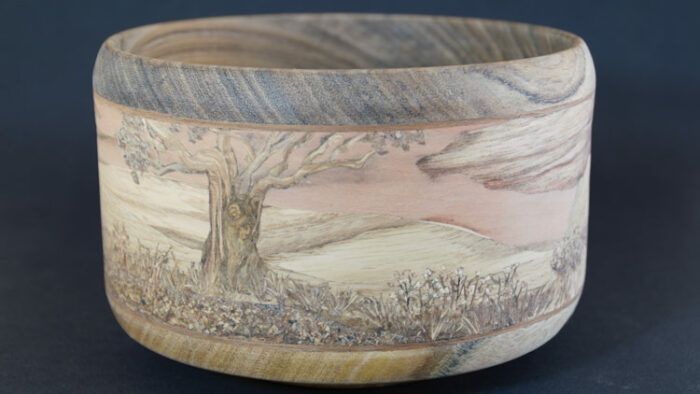
To me, woodworking is about building upon and emphasizing the innate beauty of the wood through its form, color, and grain. I had a 7.5-in. by 7.5-in. by 4-in. block of marri set aside for some time, and its grayish-yellow hue reminded me of the sunburnt hills I’d seen on a trip to Sicily. That sparked an idea: I envisioned a fruit bowl decorated with a marquetry landscape that evoked Sicily’s scenery. Thus, the concept of “Gold of Sicily” was born. In this article, I’ll guide you through the steps I took to bring this idea to life.
The Concept of Turning the Wooden Bowl
In the planning phase, I identified several milestones for success. First, I needed to design the marquetry to faithfully represent the Sicilian landscape. Next, I needed to prepare the bowl so it could accept the marquetry picture. I also had to find a way to press the marquetry onto the bowl without investing in a vacuum press. Finally, I aimed to achieve a seamless transition between the two ends of the marquetry once applied to the bowl.
Using Marquetry to Transform Woodturning into Artwork
This article won’t cover the basics of marquetry—there are plenty of resources available, such as the Staffordshire Marquetry Group website—but instead it focuses on what was crucial to this project. I used 1/32-in.-thick veneer, since thicker veneer wouldn’t soften enough to bend around the bowl during pressing. I selected veneers that would complement the marri wood’s color: For the background, I chose European oak, ash, and olive wood; for the sky I used European cherry; and for the clouds I used tigerwood in a matching tone. The trees were crafted from a combination of olive wood, burl European oak, Indian palisander, and tulipwood for the leaves. To enhance the realism of the scene, I cut each blade of grass individually and formed the road by using small, precut wood pieces. This latter technique is called fragmentation. I intentionally left the two ends of the marquetry unfinished so I could add inlays after I smoothen the overlaps.

Once most of the marquetry was complete, I shifted my focus to the bowl. Because the marri block wasn’t tall enough for the width of the marquetry panel, I glued an ovangkol block on top. While turning the bowl, I cut a groove sized to match the marquetry’s width, ensuring the panel would remain parallel to the rim once pressed. At this point, I faced a decision: attach the marquetry first or finish turning the inside of the bowl. Leaving the interior solid would have provided extra support during pressing, but turning the inside afterward risked damaging the marquetry. I ultimately chose to finish hollowing out the bowl first, leaving only the outside unsanded.
Challenges of Applying Marquetry to Curved Woodturning Items
Pressing the marquetry presented its own challenges. I needed to apply sufficient pressure for the glue to set while maintaining the ability to reverse adjustments for any misalignments and to create a seamless transition where the marquetry ends met. An article by W. Patrick Edwards in Fine Woodworking #173 proved invaluable, guiding my approach using hide glue to adhere the marquetry, which I then secured with elastic tape. When slight misalignments appeared, particularly at the edges, I reactivated the glue with a hair dryer and repositioned the veneer accordingly.

Hide glue’s reversibility was crucial for creating a smooth joint between the marquetry ends. I began by cutting along the top veneer’s pattern to define the meeting points, following the natural lines of the clouds and hills to conceal the seam. I then reheated the overlapping area to separate the layers and carefully trimmed away any extra veneer. If the glue held too firmly, I used the hair dryer to loosen it, allowing the two edges to fit together naturally. After regluing and pressing that section, I added additional vegetation details to cover the joint lines in the foreground.

Finishing Touches: Surface Treatment of the Woodturned Bowl
To complete the project, I applied an extra-matte varnish. I sanded back the first three coats to fill any tiny gaps between the marquetry pieces, and once I achieved a perfectly smooth surface, I applied two final coats of varnish.
The result was satisfying. I believe the bowl captures the essence of Sicily’s sun-drenched hills. I was pleased to see that this impression resonated with others as well, as the piece was awarded third place this year at the International Marquetry Exhibition in Ongar, Essex, UK, in the Advanced Applied category.
I hope this detailed walk-through helps you understand the process and inspires your own marquetry-on-turnings projects. If you have any questions or need further information, please feel free to reach out.
Fine Woodworking Recommended Products

Bahco 6-Inch Card Scraper
The size and thickness are what matter here. A consistent performer, this Bahco scraper is found in many shops we visit.
CrushGrind Pepper Mill Mechanism
Matt Monaco designs his pepper mills to accept the CrushGrind mill mechanism, which he likes because it doesn’t require drilling through the top of the mill’s cap and having hardware exposed on top.
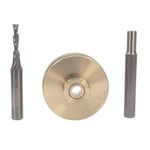
Whiteside 9500 Solid Brass Router Inlay Router Bit Set
Set includes solid carbide down-cut spiral bit (for chip-free cutting), quick-change bushing, template guide and complete instructions. Fits Porter-Cable, Black & Decker and any router with a Porter-Cable bushing adapter.
Sign up for eletters today and get the latest techniques and how-to from Fine Woodworking, plus special offers.