
The Joy of Glue Injectors
The Bém Steno-Injector
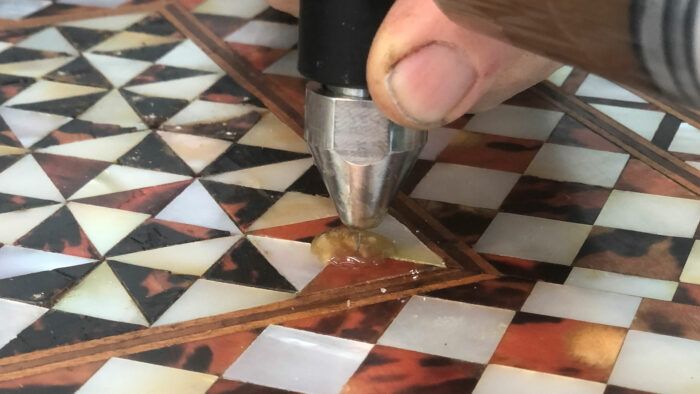
I was working in Vienna on a small Syrian chest of drawers when I first learned about Jiří Bém’s Steno-Injection machine, a pressurized glue dispenser. We had hundreds of abalone and tortoise shell components to glue down, replace, and/or flatten on this little project, and I spent nearly five weeks using the Steno-Injection machine to make sure we got glue underneath every piece.
This machine was specifically designed for wood and furniture restoration. With it, you can push warm hide glue through a 0.3mm needle with adjustable levels of forced pressure. Hide glue isn’t the only glue you can use with it, but it was designed with protein adhesives in mind.
If you need to get glue into a tight joint, into a tiny split or break, or underneath veneer without having to take everything apart, while making sure that you actually got the glue where it needs to be, there is basically no better way.
Jiří’s machine is battery powered and portable. It actually uses a Makita drill with a custom-rigged foot pedal attachment as the power behind the pressure. It has its own syringe cartridges and an adjustable warmer, so you can make sure your glue is ready to go at the right temperature. It also utilizes flexible springs for drilling the holes, so you don’t need to worry about constantly breaking tiny drill bits. As someone who has seen a lot of students break all of my fine drill bits multiple times, I found that last feature really quite clever.


I’m really not the kind of person who likes to promote any tools or hawk any products, but I have to say that Jiří’ has put together exactly the thing that our profession really needs most, and he’s done it very thoughtfully.
The only downside is the price tag (of course). If you want fine-quality small-batch specialty equipment, that’s always going to be the catch. So please, before you read any further, support Jiří. If you repair or restore furniture, buy one of his machines if you can. It makes the whole process of getting glue where you need it so much more straightforward.
With that said, however, until I save up enough money to buy one of these for myself, I must admit that I’ve been experimenting with a much clumsier alternative.
When you’re using the Steno-Injector and the glue comes up somewhere else, you can feel confident that the glue has actually made it under the surface.

Finding a Stopgap Solution
Once you experience working with the Steno-Injector, it’s really hard to go back to anything else. Previously I had tried to get a brush or a spatula with glue on it into the areas where I needed it. I’ve used syringes, but trying to force glue by hand can be very uncontrollable. Sometimes if the glue is thick, you just can’t generate enough force with your hand to make it go through a fine-enough needle. I’ve seen the needle leap off the end of the syringe while I’m trying to force it, and glue goes everywhere. It’s not something you really want.
In our workshop, Oliver Hull modified a Quick Grip clamp to help with the process, holding the needle and using the quick-grip function to push the glue through. It is definitely better than using the syringe by hand, but it’s a far cry from the pressurized Steno-Injector.

In the middle of 2025 I decided to try and find a better solution. We had two jobs coming in that had hundreds of veneer patches between them, and I really needed a better way to get glue in there efficiently.
The solution: something aptly called an automatic glue dispenser machine.
In the industrial manufacturing world, there is a great need for controlled dispensing of glues, epoxies, and various other fluids. While I’m sitting here trying to push glue through a syringe with a modified clamp, if you have more than a few hundred thousand dollars you can buy yourself a six-axis fluid-dispensing robot.
Those are perhaps just a little bit outside of my budget, but thankfully there are some smaller, cheaper benchtop alternatives. So without any knowledge of what I was doing, I gave one a try.
Here I am testing the glue dispenser for the first time with Lee Valley High Tack Fish Glue.


My Glue Injection Trolley
I have this thing, and I can’t remember who I bought it from or even who makes it. I didn’t buy it with any intention of writing about it. I fully expected it to fail miserably.
It connects to my air compressor and has a tube going out to a syringe. You can adjust the psi output directly on the machine, which I really like. If I’m doing thick fish glue and have a 0.5mm needle, I might use a psi of around 85. When I’m using warm glue and have a needle of 0.4mm, I have it around 65 psi. If I’m just pushing PVA through a larger needle, I only need to set it to 30 psi.
If I want the glue to come out slowly, I set it lower. If I really want it to push through some deep woodworm tunnels or something, I might set it higher. The control is really nice, and it means if I’m doing a bunch of similar work, I find the right setting and just go to town.
When using warm hide glue, I keep that syringe in a bottle warmer on another shelf of the trolley between uses.
It also has an automatic suck-back function, which means that my syringe doesn’t keep dripping glue when I’m not using it.
Ultimately, it works. I have to have it on a trolley with a power cord and an air hose connected to it. It’s not as fine or comfortable to use as the Steno-Injector, but it does it make my job much easier.
If I put the needle underneath the veneer, or into a split I don’t want to fully open, I can press the foot pedal and push the glue in until I see it come out somewhere else. It means I know that the glue has made its way underneath where I need it. And if I control the psi appropriately, there’s minimal mess and no damage. It’s perfect.

With restoration work, I really can’t emphasize how much of a difference having a controlled pressurized glue injector makes. In addition to that, though, I’ve found myself using it on a lot of projects that require gluing, even when they aren’t restoration jobs.
I would be really interested to hear from others who have worked with either of these or any other fluid injector-type devices. I think there’s a lot of untapped potential here.
Sign up for eletters today and get the latest techniques and how-to from Fine Woodworking, plus special offers.