

When the Wood Disintegrated – FineWoodworking
One of my greatest professional fears is that a piece I’ve worked on—weeks, months, or years later—suddenly starts to break down, discolor, or fall apart because of something I did. I’ve genuinely woken up in the night thinking about a treatment I did on an object years ago and worried that somehow some unseen aspect of that treatment is now doing something unexpected and awful.
In school we learned about several examples of things done to furniture (often the things touted online as quick tips) that caused damage either immediately or slowly over time (screws in joints, inappropriate glues, oil revivers, etc). As a restorer, I often curse previous repairers who have made my job now even harder than it needs to be.
But we shouldn’t discuss these things to make people feel bad; studying them can help us learn what to avoid and how to make tricky decisions when we don’t necessarily know all the risks.
So in the spirit of that, let’s talk about the Oseberg Sleds, 1200-year-old Viking pieces that have disintegrated internally and turned into, essentially, wood dust held in the shape of sleds only by their varnish.

The Oseberg Viking Ship
Last year, at the Museum of the Viking Age in Oslo as part of the ICCROM Course in Wood Conservation Technology, I was able to get a close look at these extremely fragile wooden objects. The Oseberg Viking Ship itself is stunning in how mostly complete it is and how seaworthy it feels for a piece dated to around 820 AD. The Oseberg Sleds are unique and ornately carved. They were uncovered around 1905 along with the ship on a farm near Tønsberg, Norway.
While the ship is in incredible condition, the sleds have been described as “not really wood anymore and [with a] strength comparable to that of crispbread.”1 When we were allowed to get in the same room as them, we were urged to be very careful because any heavy step or vibration might cause damage, and I remember being very nervous that they might just crumble before my eyes.
So how did this happen? Through a preservation treatment done on them over 100 years ago, sulphuric acid has been slowly disintegrating the timber from the inside.
I spoke with conservator Susan Braovac, who has worked with and researched these objects for years, to understand better what happened to them, why this treatment was done, and what the decisions are we make now that could potentially have the same risks.

History of the Oseberg Sleds
It is believed that back in the ninth century the ship and its contents were ceremoniously buried as part of a funerary tradition for a woman of particularly high status. The bodies of two older women were found aboard the ship among what was presumably a collection of their possessions, although exact details are unknown. The mound they were buried in contained a great amount of clay, which essentially prevented air from getting to the ship, keeping it from both drying out and from being too eaten by fungi. The ship, the bodies, and all the other objects aboard were protected from sunlight, physical damage, and rot for centuries in this condition. The wooden objects, however, sat completely soaked for a long time, and while oxygen and fungi couldn’t get at them, some bacteria were able to slowly attack the timber.
The result is very similar to that of any shipwreck dredged from beneath the sea. Pulling a ship out of the sea means that it suddenly has to face the atmosphere, and many wooden objects that are pulled out of the sea or ground after such a long time can sometimes dry much too quickly, causing them to completely deteriorate.
Not only do you have the normal risks of wood drying too quickly (checking, splits, etc.), but because the lignin and cellulose chains that the wood is made from have been deteriorated by bacterial infestation over time, the shear act of liquid water leaving a hollow cell can cause enough capillary or vacuum pressure to completely collapse that cell. Susan told me to imagine sucking the air out of a straw, or perhaps an empty water bottle, and watching it compress.
She showed us a time lapse of a piece of archaeological waterlogged timber left to dry. Where you might expect maybe 5% to 10% shrinkage in normal timber drying, this piece looked like it shrank by 60% tangentially. It was like watching a sponge in a vacuum press.
Some timbers (e.g., oak) that are more resistant to bacterial degradation still maintain enough stability to whether this drying process, but for others it’s a real challenge to preserve them without serious deformation.
Treating the archaeological waterlogged timbers
The ship body itself wasn’t as deteriorated by the burial environment, and it was able to be dried slowly in the air with very little consequence.
But for the sleds, and a number of other wooden objects found, there was a genuine risk that letting them dry would lead to their destruction. So either you have to shove them back in water (more on that later), or you have to do something else to them to remove the water in a way that doesn’t cause vacuum-like cellular collapse, and/or replace the water with some solid material that will help hold it in place.
The folks who excavated these sleds knew there were risks, and they spent some time exploring options for how to treat them. Susan explained how they spoke to a number of other professionals in the field, and even traveled down to Denmark to learn more of how people were facing this challenge. The answer was an alum treatment first published in 1861.
Alums are water-soluble aluminum salts. Like any salt, they dissolve in water, and then when the water evaporates, they are left behind in their crystalline form. So the theory is (crudely) that if you soak the waterlogged timber in a bath of alum solution, the alum will penetrate the wood, displacing water. Then when you remove all the remaining water, the alum salts will be left behind in the gaps to structurally support the wood and prevent it from collapsing.
The treatment was used somewhat commonly in Europe and other places through the mid-1900s when newer treatments were being developed, and it started to become apparent that something wasn’t right. A lot of the alum-treated pieces, it seemed, were turning to dust, or otherwise becoming more fragile over time.

What went wrong
What I want to emphasize here (and Susan was also very clear about this) is that this treatment wasn’t half-assed. This wasn’t some “Well, let’s just give this a try and see what happens” approach. This was best practice at the time. Some pieces had been treated with alum decades prior to the Oseberg excavation, and they were still looking pretty good in 1905 by many accounts.
It’s only with recent analysis, and the work of Susan and others, that we even understand now what went wrong. Thanks in large part to her and her colleagues’ efforts, we do have a good theory for that: In order to help the alum dissolve completely and penetrate the wood as deeply and completely as possible (although analysis shows the treatment didn’t completely penetrate the timber), it was heated to 194°F (90°C). You know how I said that alum is an aluminum salt? Well, the non-aluminum components are sulphates, and when the alum is heated and applied to the wood, the salt breaks down in such a way that creates sulphuric acid.
The would-be preservationists were unknowingly filling the timber with a combination of aluminum, alum salt, and sulphuric acid. The treatment looked like it worked perfectly, but over time that sulphuric acid was slowly destroying the timber inside, chewing through the very material that wood is made of and turning it to dust.2
After the alum treatment, the objects were coated with linseed oil and a varnish that Susan didn’t know the exact details of. Decades later they were coated with a modern material, and now these surface coatings are the only reason the sleds are still shaped like sleds at all (with help from modern supports).
Professional confidence and risk
It would be so easy to just think, “Those folks were idiots and didn’t know what they were doing, but we do now.” That, however, would be unfair. While the science at the time wasn’t what it is now, the practitioners themselves did about as good a job as you might have been able to do. They spent time thinking and discussing. They researched the options and spoke with other professionals. They reviewed objects that had been treated with different methods to see what had worked. Susan and I agreed that they had basically done the best thing based on what was known and what their goal was. This was, by all understanding at the time, a perfectly good treatment for these objects.
This suggests a possibility whereby I could go through similar lengths to choose a good treatment, only to have people 50 years from now find out that that treatment has caused unforeseen problems. As I learn more about the ways things can go wrong, I have found my confidence in my work decrease. “Who’s to say?” is rarely a reassuring statement when clients ask about the longevity of your work.
If you know the Dunning-Kruger effect, it’s ultimately a representation of this: That confidence spikes early, and then decreases quickly with knowledge.
You may have experienced a similar situation yourselves. I think Ben Strano said it well on Shop Talk Live, when they had Randy Wilkinson on talking about wood identification. The more he learned about the anatomy of different woods, the more he realized that you can’t really be as confident about what a wood is as some people seem to be. Be wary of the people who are really confident on that Facebook group that the wood you have is northeastern Mexican hibiscus or whatever.
I do think a lot these days about the dissonance between having to be aware of (and concerned about) all the ways things can go wrong, the actions I might take that could make things worse, and then needing still to move forward as best I can. My client needs me to find them a solution, and I can’t just tell them to wait until we have better answers.
Unless, maybe, I can.

The carving in a water tank
It turns out that even though preservationists put a lot of work into the decision, they weren’t entirely impressed in 1905 with the alum treatment. There was concern about how the details of some of the finer carvings were being lost. And so, with six particularly ornately carved pieces of timber, they actually decided to just stick them back in some water until a better solution could be found.
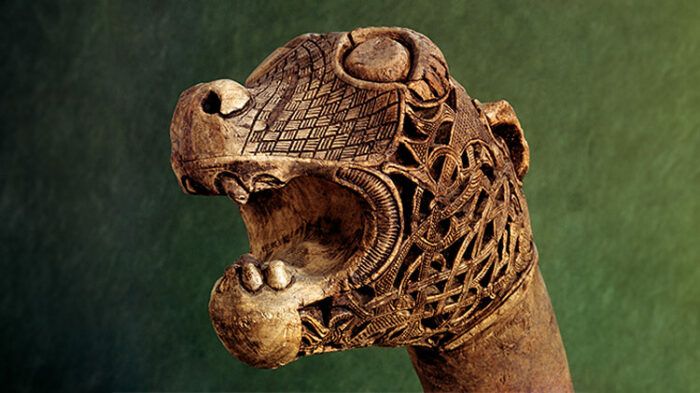
Susan told me about this one carved animal head pillar that was stored in a tank of water for roughly 50 years, surviving two world wars, and we both admired the decision-making involved.
They accepted that they didn’t have the technology at the time to do the piece justice, and so they put it in an aquarium and monitored it carefully for decades.
Eventually, due to pressure from Nazi occupation, as well as the development of freeze-drying technology, conservator and chemist Annemor Rosenqist and Brorson Cristenson developed a new way to treat the object and maintain its detail. (You can see the final result and the detail maintained in the cover photo for this post.) I’ll leave the specifics of this treatment for another time, but Susan and I were both fascinated and impressed by these choices: both the confidence to decide to put the piece in a tank of water until some unknown future treatment, and the confidence to remove it and attempt a new treatment when the time came.
I think for me there is a fear of suggesting that perhaps we don’t have the capacity now to do what is best—that we’ll be seen as unprofessional or incompetent. It’s great to see an example where that decision was made with confidence and proved to be the right one.
Whether you do nothing or something, however, it’s still a decision.
The workmanship of risk
I take comfort in David Pye’s description of craft as a workmanship of risk. That handcrafted work, by its very nature, involves not engaging with pre-set machines that can produce repeated results (theoretically), but accepting the risk of a practiced hand. Taking a carving chisel or a brush of varnish to a prepared wooden surface comes with the potential that you might slip and make an error.
If possible, we can practice. If you want to play Beethoven on your piano, you start by practicing your scales and then by practicing the piece. You can prepare yourself until the repetition is so consistent that the risk of failure is low. As much as you practice, however, eventually you have to perform, and on the day of your performance, part of what makes it incredible is knowing how possible it still is for mistakes to be made.
Restoration and conservation have this risk as well (however, very few crowds are exhilarated by it). A person likely only has one or two rocking chairs at most that used to belong to their grandparents and that hold with them valuable personal memories. The problems those specific chairs face are often unique to them, and the sentimentality is irreplaceable.
There are only three roughly 1200-year-old Norwegian Viking sleds in the world that I’m aware of. Our capacity to practice treatments on them and hope for the best is very low.
Susan was very thankful that testing can be done on some of the less significant archaeological timber pieces in order to learn more about what happened and what can be done. However, when the time comes, she said there are still a lot of unknowns. She recalled being among a team of expert conservators and chemists, and none of them—despite their best testing and assessments—could be certain about what exactly would happen if they attempted different things.

Making choices
The knowledge of what can go wrong can (and probably should) destroy some confidence, especially overconfidence. I reckon we should be at least somewhat wary of causing harm or reckless damage, and that’s not just my chronic anxiety speaking. But figuring out how to regain confidence in moving forward is the next step after that, I think. How long do I spend worrying about what I don’t know that I don’t know?
Dunning-Kruger may define the lack of confidence that is experienced once we learn more about a field like woodworking, but there is a step after that that involves building the confidence to keep moving forward when we know that we don’t know everything.
Susan and I discussed this question. In conservation, you need to assess the known risks; you need to try and understand what can go wrong and what might not. Sometimes it feels like while there may be many “wrong” choices, there are never “right” choices, only “justifiable” ones.
When we have these kinds of conversations together, sharing what has gone wrong and what has gone well, we can find better solutions together.
It’s one of the reasons there are certain codes of practice or professional standards in different places. Provided these codes and standards are developed in good faith with a diversity of people, getting folks together to discuss how to best handle these pieces and not make the same mistakes again, or at least reduce them, can be one of our greatest tools. Here in Australia we have the Burra Charter, which provides guidance on how to approach problems and emphasizes the importance of consultation throughout the process of working with any culturally significant place or piece.
Historic England has been engaging in the last few years on consultation to design better standards for handling waterlogged timber specifically. That said, it’s worth noting that one standard approach is not necessarily right everywhere and for everyone.
One kind of risk assessment that Susan mentioned was when her team was deciding how and when to treat the other damaged artifacts in their collections. They had to assess how much longer each piece would last if they did nothing. They had to quantify how much longer each item had—how many more years it would realistically survive.
If the object’s timeline was short—if the risk of doing nothing meant almost certain destruction—then even if they weren’t 100 percent confident with the treatment, they were more likely to give it a try. Even with these matrices and standards to stand behind, the final decision and follow-through are not guaranteed.
At Studio Conservation, where I work now, we often joke that the time we spend standing around stroking our chins and having a chat about the object we need to work on is some of our most important work. Ideally, we’d like to really understand what’s significant about the piece and what problems and risks are involved in the job. Tests might need to be done, both to learn more about what we are working on and what impact treatment might have. For example, just cleaning something can mean we accidentally wash away something important if we aren’t careful (a historic dye, a maker’s signature, an imbedded stain where someone’s grandmother’s hand had rested on the arm of a chair, etc). A variety of cleaning solutions may be tested in small quantities to make sure they won’t accidentally remove more than we want them to. Ultimately, we want to make sure that the choices we make are right for the object, as well as the people for whom the object is significant.
When someone asks me, “How would you deal with this?” often my answer is something akin to “I don’t know yet.” We can only hope that our clients understand this is not incompetence but care.
Where they are now
The Oseberg Sleds have just recently been moved. A new wing of the Museum of the Viking Age has been constructed, and many of the ships, as well as several artifacts including the sleds, are moving with them.
The sleds themselves will likely be moved in the coming spring. When we were there, the sleds had already been moved into a temporary room to protect them. A special track had been built, and they were being moved along it at a pace of inches a day because of how fragile they have become.
Large steel beam stillages had been built around the various Viking ships themselves so that they could be hoisted on overhead cranes into their new positions in the expansion of the museum. Even though the team has been calculating out and engineering a design that should flex something like less than 8mm across its entire length (the effort to study and understand the structural deformation of the ships is a whole discussion to itself), what ends up happening will only be revealed once the things themselves are moved in real life.
You can watch a time lapse video of the Oseberg Ship being moved here.
If you get the chance to visit this museum in Norway when it reopens, I highly recommend it. Go check out these sleds if they are on display, and know that while they might look static in their current situation, a great deal of thought, care, and catastrophe have gone into what they are today.


1Braovac, S., McQueen, C.M.A., Sahlstedt, M. et al. Navigating conservation strategies: linking material research on alum-treated wood from the Oseberg collection to conservation decisions. Herit Sci 6, 77 (2018). https://doi.org/10.1186/s40494-018-0241-y.
2Braovac and Kutzke. The Presence of Sulfuric Acid in Alum-Conserved Wood – Origin and Consequences. Journal of Cultural Material 13S (2012).
Sign up for eletters today and get the latest techniques and how-to from Fine Woodworking, plus special offers.


