

Birch-Bark Containers – FineWoodworking
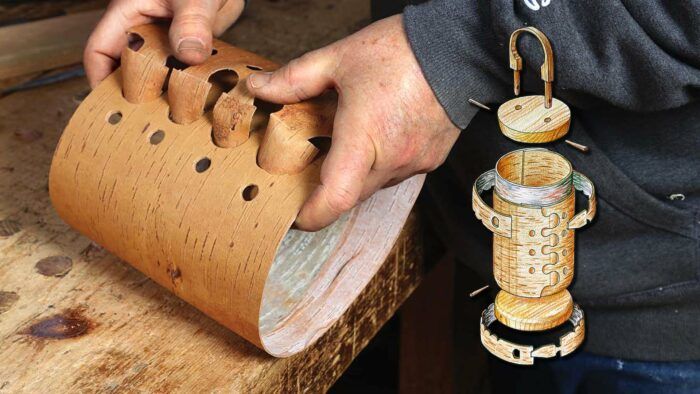
I first learned of these birch-bark containers through my Swedish friend Jögge Sundqvist. They’re made in many parts of the world, particularly Scandinavia and Russia. I made one in a class with Jarrod Dahl, then later visited the man who taught him, Swedish craftsman Ramon Persson. Some of the Swedish examples I’ve seen exhibit a wide range of joint configurations and extensive decoration, often including paint. The best inspiration for these today is the Russian maker Svetlana Koreneva (@koreneva_beresta).

These containers have endless uses, and their construction is simple. The body of the canister is two layers of bark, one inside the other. The outside layer has tabs and slots for joinery, while the inside layer has no joinery. Once the bottom and lid are in place, two narrower bands wrap around the top and bottom ends, adding another layer of decoration and enhancing the structural integrity.
Tools and Materials
There’s little solid wood in these pieces, so the main thrust of this project is bark work. I get my bark in large sheets from the Bark Canoe Store (barkcanoe.com), but you can find other online sources as well.
The size of the bark you’re using dictates the maximum size of your container. Other than measuring the strip’s widths, there’s no math required. I eyeball as much as I can.
The show side is the inside of the bark, which ranges in color from yellow to orange. The white-and-black surface we use to identify birch doesn’t show in the finished work. When you’re cutting out the strips, keep in mind that the orientation of the bark in the finished piece is the same as it was in the tree, only inside out. The horizontal lenticels—those dark lines that wrap around the tree—wrap around the canister too.
The tooling used to make the canisters is minimal: a utility knife, sloyd knife, carving gouge, scissors, small handsaw, spokeshave, chisel, drill, and maybe some punches for decorating.
Prepping the bark
I cut the outer layer of bark with a utility knife and a straightedge. I examine the bark to avoid any large flaws like cracks or splits. Natural bumps won’t affect how the bark works, but I try to position things so these are not on the joints.

On the strip’s outer surface I clean off all the loose bark. Some of it can be peeled off; I abrade away any remaining loose bark with a convex rasp to reduce the thickness and remove any bumps and lumps that would keep the two layers from lying tight to each other. I then thin the bark in a swath about 1-1/2 in. to 2 in. wide at each end of the outer layer to prepare for cutting the joints.

Fingerish joints

With a dull awl and a square, I score a line across the bark about 2 in. from one end. It’s just an impressed line I’m after, not a cut.

To make the slots, I start with a 3/4-in. chisel. I place it on the scored line and pierce the bark, pushing the chisel through it. The first cut is centered on the bark’s height and is followed by cuts right at the top and bottom edges that are only half the chisel’s width. Further cuts get spaced between these three.

To finish these openings, I switch to a gouge. A deeply swept gouge is excellent for this work; it forms the full half-circle in one move. A less-curved gouge will work too; you just have to step over to finish the cuts.


Next, I wrap the bark around itself to transfer the positions of the openings to the other end. After cutting those openings, I go back to the first set and cut just inside each opening to the end, leaving a long tab centered between the openings with a bit of a shoulder at the end. Some taper the width of those tabs to make them easier to insert when connecting the canister’s outer layer. I use a slight taper just at the end because of the optional, decorative hole I pierce in the outer layer. I want the tabs to show behind this hole.

Thinning these tabs makes them flexible for fitting the joints together. I use a convex rasp or coarse file on the white side of the bark to abrade away a couple layers of the white bark depending on how thick the sheet of bark is. I sometimes fine-tune this thinning with a sloyd knife.

Peter Follansbee is an unplugged woodworker in Kingston, Mass.
To view the entire article, please click the View PDF button below.
Sign up for eletters today and get the latest techniques and how-to from Fine Woodworking, plus special offers.
Download FREE PDF
when you enter your email address below.


