

The Block Plane Earns Its Keep Every Day
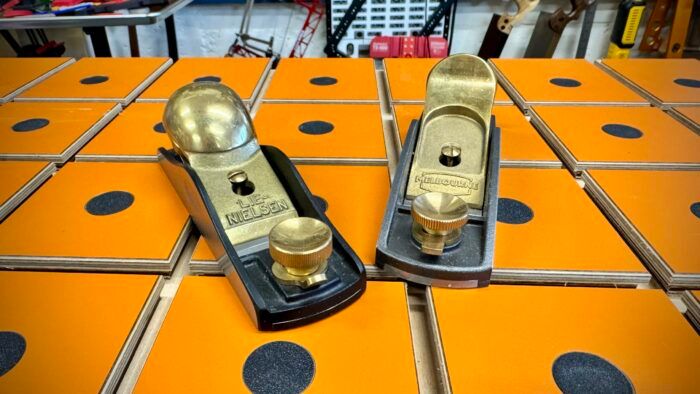
Every so often on Shop Talk Live we get into a segment called “Favorite Tool of All Time,” which is exactly what it sounds like. It is a dangerous question, because it forces you to stop pretending you are a well-rounded craftsperson who uses everything equally and instead admit the truth, which is that a few tools do most of the heavy lifting while the rest sit around looking important. For me, the answer has never really changed. It is the block plane.
That answer usually surprises people, or at least it feels too simple, like saying your favorite meal is a good piece of bread with butter. But that is kind of the point. The block plane is not flashy; it does not anchor the shop the way a bandsaw does, yet it is the tool I reach for constantly because it solves problems in a way that feels immediate, controlled, and precise.
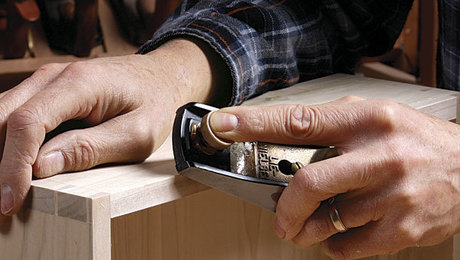
Most of my use starts where machines stop. After a board has been milled, cut, and assembled, there is always a moment when things are technically correct but not quite right, and that is where the block plane lives. I use it to soften edges and remove the arris, which is a small detail that makes a disproportionate difference in how a piece feels in the hand. A sharp edge might be accurate, but it is rarely pleasant, and a few passes with a sharp block plane fixes that in seconds without sanding dust or rounding things over into oblivion.
It is also my go-to for flushing banding, trimming inlay, and dealing with edging, especially in situations where a sander would be too aggressive or too blunt. The feedback is instant. You can feel when the surface is flat, you can see the shaving change, and you can sneak up on a perfect fit instead of blowing past it and having to figure out how to fix the damage. That kind of control is addictive once you get used to it.
Where the block plane really earns its keep, though, is as what I think of as an eraser.
Tearout happens. Grain does what it wants. You can do everything right and still end up with a small patch that looks like it was chewed out. Instead of panicking or reaching for sandpaper and hoping for the best, I often grab the block plane and take a few careful passes, paying attention to grain direction, to clean it up. I keep a second blade for this work with a slight camber ground into the edge, which lets me target the problem area without leaving hard plane tracks on either side.
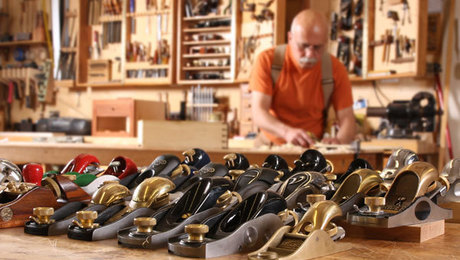
I also keep two block planes at the bench, set up for different jobs. One is my general-use plane, ready to go for breaking edges, flushing parts, and all the day-to-day work that comes up. The other is carefully honed and reserved for critical end-grain cuts, where a truly sharp edge and a dialed-in setup make the difference between a clean slice and a crushed surface. It might sound excessive to some, but swapping planes is faster than resetting one, and it keeps me from compromising either setup. To be fair, I use to own seven block planes, which was excessive. But what can a tool junkie do?
There is also something to be said for the fact that the block plane is always within reach. It is small enough to live on the bench, easy to pick up with one hand, and quick to adjust. You see a problem, you fix it, and you move on. That kind of frictionless workflow matters more than most people realize, especially in a shop where momentum is everything. Adam Savage refers to that as “first-order retrieval” of tools.
If I had to strip my shop down to the essentials, the block plane would make the cut without hesitation—not because it can do everything, but because it shows up everywhere: refining, correcting, and improving the work in ways that are hard to measure but easy to feel.
Fine Woodworking Recommended Products
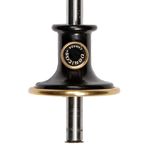
Veritas Wheel Marking Gauge
A wheel-type gauge is the easiest to use, and this wonderful Veritas model is a steal at $38.
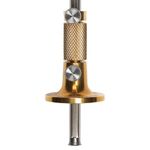
Tite-Mark Marking Gauge
These gauges can be easily and precisely adjusted with one hand, which allows you to set the tool while holding a ruler or workpiece in the other. The quality is exceptional, and all have sharp cutters that offer great visibility.
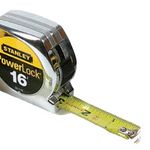
Stanley Powerlock 16-ft. tape measure
With its smooth lock, tough case, compact size, and excellent accuracy, this Stanley tape is perfect for workshop use.
Sign up for eletters today and get the latest techniques and how-to from Fine Woodworking, plus special offers.


