

Reha Dreams of Turning Timber

Long before she ever stood in front of a lathe herself, Reha Salvi tells me she used to wake from nights filled with dreams of woodturning. “Shane, I would wake up wondering where my lathe was. I’d never used one!”
Reha’s work first caught my attention on Instagram with a piece that reminded me of the gum nuts we have here in Australia. They were hollow-carved large-form replicas of eucalyptus seeds turned from local neem wood. The rest of her work—a rich sophisticated collection of raw, natural shapes and textures—captivated me further, but it really was the thoughts and words that accompanied them which kept me engaged.
She worked as an architect in both Mumbai and Chennai for over a decade before committing herself as a woodturning artist, but I had no idea before talking to her how complicated that journey was. Here in Sydney, when an architect wants to get into woodturning it’s a pretty straightforward process of purchasing a lathe and some tools, or perhaps joining one of the many woodturning clubs we have around the city. For Reha, if it weren’t for the sheer strength and power of her passion, as well as her personal dedication, she likely would never have made it. There were no woodturning clubs, she could not buy woodturning tools, and purchasing a lathe itself took some explaining.
In India, she tells me, woodturning as a hobby or art in and of itself is not really a thing. Or at least it wasn’t a few years ago when she was getting started.


Finding a craft
The Salvi family itself is famous for a kind of craft, but not in wood. Traditionally based in Gujarat, generations of Salvis have carried on an incredibly fine silk-weaving tradition, producing Patan Patola, a type of cloth with colored patterns of even quality on both sides of the material.
No one in Reha’s immediate family was a weaver of this material. When she was young, she was told there was a reticence to teach women the technique, as they would just eventually marry and leave the family. She learned later in her life, through social media of all places, that this perception seems to have changed more recently.
Instead, Reha became an architect, perhaps a different form of craft in itself. While she no longer works in that world, architecture is still an integral part of who she is even if it never fully satisfied her. The compromises and changes that occur when working with clients meant she was never truly producing the kinds of work she wanted. Her desire to create was powerful yet stifled.
She moved from Mumbai to Chennai in early 2020 just before the pandemic began affecting everything. In some ways, quarantine policies suited her. Coming from western India, Reha speaks Hindi and English, and while most of her colleagues in Chennai spoke English as well, the local language in the area is Tamil. On formal work calls, everyone spoke English, but in the office most of her co-workers spoke Tamil to one another, which made her feel more isolated in the office space than when she was working from home.
Despite this disconnection, they could clearly see a passion in her. She doesn’t remember ever mentioning anything to suggest as such, but shortly before she left they gifted her a book, Handmade in India. She pored over the book with a fervor, reading up on all the different practices and traditions across the country. Shortly afterward, she and a friend made the commitment to leave architecture and find some craft—some handmade art—to pursue.

The dream of turning wood
She knew of woodturning from her time working with craftspeople and artisans as an architect; however, in all those instances it was part of a larger process of production and not a craft in and of itself. Parts of decorative features or furniture pieces may possess turned elements, such as table legs, but there wasn’t a culture of turning bowls or vases or pen blanks. Despite that, she started to imagine turning as an art in and of itself. Before discovering the huge international community of creative turners, she was already creating ideas of what someone could make with this equipment.
Just like her colleagues in Chennai, the Google algorithm also picked up on her interest. She found herself constantly watching videos of woodturners from around the world. She’s probably watched every video Richard Raffan has put out multiple times, her eyes fixated on those images of long shavings flying dramatically from the wood as the turner transforms a chunky block into a fluid curvilinear form.
This is when the dreams began. Day in and day out watching those videos and yet not having access to the tools herself was haunting her sleep. The desire to become a woodturner had fully consumed her.
“I thought I could maybe be this person with the shavings flying past me!”

Finding a mentor
Reha spent considerable time in search of someone to teach her, traveling around western India where her chances of sharing a language with the artisan was higher. However, she was having no luck. She traveled to several workshops where turning was done. In every instance it was part of a production process, and there was little opportunity to train a “hobbyist.”
“They didn’t turn the lathes off,” she says. “They were always running.”
She recounts the constant confusion from others about why she was interested in turning. People told her regularly that turning wasn’t really an art. It wasn’t interesting in itself, just a part of a process. She was told it wasn’t for women, and she was asked why she would pursue this and not focus on her family. (Her husband, however, was probably her biggest supporter.) No one she met with had time to stop their production line long enough to let a newbie try out the tools. She was several months into committing to her new life as a woodturner and still hadn’t turned wood.
It was actually back in Chennai where she would get her first opportunity. An architect friend knew of a small furniture and woodworking shop where they might have the time available to let her practice.
She and her Tamil-speaking friend went together to check it out. It was a three-story production house, with show room, machine rooms, making spaces—the whole thing. And under the pretense of being two architects there to tour the facility, they got to meet the artisans and see inside. Reha really only had two questions on her mind: Do they have a lathe? Will they let me use it?
She did see one tucked away against a wall in one of the rooms, and unlike in other facilities, it wasn’t in constant use. As their meeting wrapped up, she asked the furniture maker about the lathe and whether she could use it.
“Are you a vegetarian?” he asked after looking her up and down. This was a new question among all of the ones she’d received in her quest.
“Yes,” she replied nervously.
Apparently, this was a nonstarter. He explained that as a vegetarian she wouldn’t have the strength to hold the tools for any period of time, and she would be too tired and not come back the next day. He would not waste his time on people who would not be able to commit to learning.
But she pressed him. This was the closest she had gotten to someone saying yes. She offered to pay him for his time, and not a small amount of money. She was burning through her savings on this mission, but she was going to see it through. She made it very clear there was absolutely zero chance she wouldn’t come back tomorrow.
And so, finally, Reha was allowed to use a lathe.


On the tools
She told me how scared she was. All this time dreaming and hoping and trying—what if it turned out not to be satisfying? What if she couldn’t do it? What if she didn’t really have a sense of shaping the wood as she had imagined it?
Even knowing how this story ends, I wanted to reassure her that she was going to absolutely love it. Which of course she did. It felt almost exactly as she’d literally dreamed.
She was able to come back to that workshop every day for five days straight, and she paid a pretty penny for the privilege. They showed her the differences between the tools and the various techniques used to shape wood, and after five days they said there really wasn’t much reason for her to keep coming in; she should just go get one herself.
And now, armed with the confidence that this was a passion she truly wanted to follow, she embarked on the next steps: to get a lathe, get some tools, and start turning.

I was really surprised when she told me that she couldn’t find anywhere to buy turning tools. She was able to get a lathe, but it required a lot of explaining that she did not in fact need an industrial model for production. She just needed something to put in her shop that could rotate wood at great speeds.
All of the chisels and scrapers and cutting tools, on the other hand, she had to make or have made. When she talks about this process, she references the Indian emotion of jugaad.
“It is a way of survival; a nonconventional, innovative, rule-bending approach to problem solving, fixes, and simple workarounds. We love creating new things with meager resources, and jugaad finds its way into almost all aspects of our lives in some way or the other.”
She’d pull up those YouTube videos and pause them during the nice close0-ups of each tool, trying to get a sense of exactly the shape they were meant to be. She could buy blanks of tool steel or high-speed steel and grind the ends to try and match what was on her screen. Turners in India often will put grinding wheels directly on their lathes and shape their tools there. Once she had a sense of it, she would go to knife makers and have them do the final shaping and polishing of the tools to get what she needed. This worked well for things like scrapers and parting tools, but gouges were a little more difficult. At one point she had a friend in Germany buy a cheap set online and bring them to her so that she could analyze them more closely.
Her first set, however, were these ground and shaped chunks of steel welded onto the ends of metal pipes, and that was plenty to get started.


A body of work
Reha worked a lot with scraps of teak or pieces of neem and mango wood to get started. Those woods are relatively cheap and available in Chennai. Sometimes she could find chunks of them being thrown away, or local trees that were being trimmed that she could use. She practiced all of the varieties of shapes she could form, working on refinement as well as creativity.
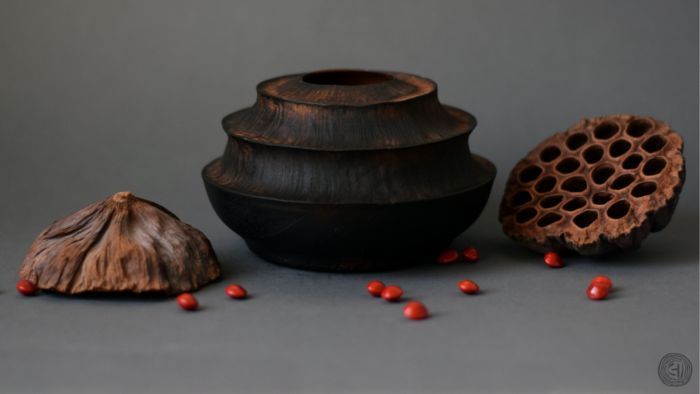
Her work quickly developed a raw and textured feel. While some surfaces are smooth and clear, others are charred or partially burnished with tool marks and organic carved textures covering the surfaces. Often the natural features or defects of the timber are highlighted or left as they are.
Thinking about architecture in Sydney, I wondered if she was ever motivated by a rejection of the architectural trend for clean lines, smooth surfaces, and unnatural materials. She says instead that it’s important to remember that the material she works with “is ancient and carries its own history, like birthmarks on skin.” She continues: “I see no reason to hide it. Concealing it would feel dishonest, so I choose to preserve it, bring it forward.”
She told me that where she grew up around Mumbai was quite far from the coast. The beach was nearly a two-hour drive through traffic from where she lived, and so it remained seemingly inaccessible for much of her life. Once she moved to Chennai, however, she and her husband could easily walk the coast in their free time. She became enamored by the beauty of the sea and obsessed with the variety of shells that covered the shore. She has collected boxes of shells, and she’s been learning about exactly what they are, what they are made of, how they form, and what creatures they are connected to. She also obsessively collects all sorts of seeds and seed pods, fossils, rocks, and even driftwood that gets washed up on the shore. Her fascination and respect for these natural forms is endless.


For several months after finally getting her lathe and her tools, she forced herself to go in almost every day. She found it hard sometimes. She still had serious doubts about following this mad passion, but she’d put so much work into getting here that she was definitely going to keep working at it every day.
There was a time where the doubt would creep in more, and days where it was harder than others. Given that this kind of turned art wasn’t common where she was, it’s fair to say that there wasn’t really an established market for it. There certainly wasn’t much of a local community to turn to for support. Apart from her husband and a few friends, she was mostly surrounded by people who didn’t really understand what she was trying to do.
The plan was to spend the better part of two years focusing on getting better, turning as much as she could, and documenting her journey. She hadn’t intended to apply for grants or submit works to galleries, but barely six months into her practice (kind of on a whim) she threw in an application to this one open call for the AD x JSW Craftsmanship Award. She was visiting friends back home in Mumbai when she got a call back from them.

The AD x JSW Prize for Contemporary Craftsmanship
“I was in traffic—in a café on the corner—in Mumbai, and I get a call. They ask if I can find a quiet corner to talk. I can’t find a quiet place! It’s Mumbai!”
The AD x JSW Prize for Contemporary Craftsmanship (supported by Architectural Digest India and the JSW Foundation) didn’t really have a category for woodturning, but she submitted her work on the off-chance and then forgot that she’d even done that. Now they were calling her wanting to ask her some questions. They were not confirming that she had won anything, but they said they were thinking of adding an emerging artist category with the prize being a three-month residency with Hampi Art Labs in Karnataka (roughly halfway between Mumbai and Chennai).
She doesn’t remember what she said or how she came across, but she must have presented well because she was shortly afterward announced as winner of the Emerging Artisan Award. It was a huge honor, and a chance to show off her work to a broader audience.
As part of the ongoing theme of her story, wood and woodturning were not major aspects of the work done in this residency. They instead had incredible ceramic artists and amazing opportunities to learn a few other techniques, including Kinnal craft, a rare and dying local traditional way of making brightly colored objects using a kind of painted tamarind and jute plaster on wood.
For Reha, being expected to produce art pieces from unfamiliar materials like ceramics and tamarind powder, and surrounded by what seemed like experienced artists who were putting out piece after piece, the doubt set in again.
“Eventually, I packed up all my tools and works and everything from the studio space and moved them all back to my room. I stayed in there for most of the last month of the residency.” In this last month in isolation she produced most of the works of her final exhibition, a blend of ceramic pieces and new creations inspired by aspects of the Kinnal process.
From my perspective, her ceramic works are impressive, powerful, and worth looking over. The pieces that take advantage of that tamarind and jute material used in Kinnal craft, on the other hand, is what I find most captivating.


Working with exposed tamarind paste on wood
Traditional Kinnal is very refined and often bright and colorful. It is historically produced by specific families in Karnataka, but attempts keep the tradition alive and even expand it mean it is being taught more broadly. Toys and sculptures and even furniture pieces are made from carved and jointed wood, with layers of pastes and colorful paints and coatings, all traditionally produced from local materials (although acrylics are finding their way into the process more often now).
Once the underlying shape of a piece is made, it is coated with a kitta, that plaster-like paste made from combining powdered jute and tamarind seeds with fine sawdust, which can also be carved and shaped. The final surface is usually painted or gilt and sealed. Watch the video above to learn more about the tradition and see some of the pieces that are made.
The whole process reminds me of water-gilded frames of gesso and bole on carved wood in Europe, or East Asian lacquer pieces with layers of lacquer grounds of various fineness with decoration and fine lacquer coatings. Some aspects remind me of similar paper-mache toys and sculptures I’ve seen before; despite the similarities, Kinnal is definitely a unique and special craft. It is a shame to hear that it is at risk of being lost.
This kitta, however, was the aspect of the process that spoke most to Reha, and rather than seal it and hide it, she wanted to explore ways it could be left exposed. Inspired by the nests that potter wasps build, her pieces are “like a forgotten relic being reclaimed by nature.”
From a technical perspective, there are some challenges with this material in her art, but also some opportunities.
The tamarind powder needs to be ground by stones only used for this. It’s so sticky that you can’t really get it off the stones and use them for anything else. She then got gunny bags and shredded the jute fibers herself. Rather than refining that jute down, however, she’s toyed with keeping the fibers at various lengths, and she uses some of the sawdust from the neem wood she has worked.
There’s a risk as well, because this exposed tamarind paste material is quite delicious to insects. However, neem itself has natural antibacterial properties, and the sawdust can potentially help keep the material from becoming a favored food. Reha has also been exploring ways to seal it with materials like linseed oil without changing its raw quality that she desires.
As with the seashells on the beach, I can see her immediate fascination turn to contemplative investigation as she grows to understand the materials more and more. As with waves slowly shaping a coastline, to her these pieces explore “how transformation is not always dramatic or immediate, but subtle, inevitable, and often beyond our control.”

The Dream Still Persists
While it felt like her quest to become a woodturner dragged on way too long (perhaps at times also feeling subtle, inevitable, and beyond her control), it’s only been a few years since she first started making her own works. Her first post on Instagram was in March 2024, which she set up to start documenting her journey just over two years ago. The residency, awarded later that year, started in January 2025.
Now she says she’s very busy producing and selling works and collaborating with others who seek her out, and there is more and more interest in what she does. When she talks with me about turning, she still lights up with unyielding excitement and love for this dream that she’s worked her way into reality.
The local community and interest is growing as well. A few of her friends are starting to build a community of creative wood craft, such as Abid Ali, who has founded India’s first woodcarving club. Her friends at Mistri Labs, a makerspace and filmmaking studio in Nainital, are now producing carbide-tipped turning tools that she says will be the first set commercially available in India. Reha herself has even been approached by other eager young craftspeople in her country who now dream of turning wood like she does.
She doesn’t think she’ll start taking on students just yet, as she still feels like she hasn’t been doing this craft long enough for that. I hope, however, that someday she does, as I believe there is great value even in just showing more people her passion, enthusiasm, and dedication.


Fine Woodworking Recommended Products

CrushGrind Pepper Mill Mechanism
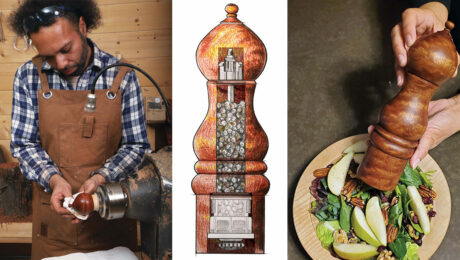
Matt Monaco designs his pepper mills to accept the CrushGrind mill mechanism, which he likes because it doesn’t require drilling through the top of the mill’s cap and having hardware exposed on top.
Sign up for eletters today and get the latest techniques and how-to from Fine Woodworking, plus special offers.


