

Cheating at Kumiko: Hida Chidori Goushi on the Table Saw
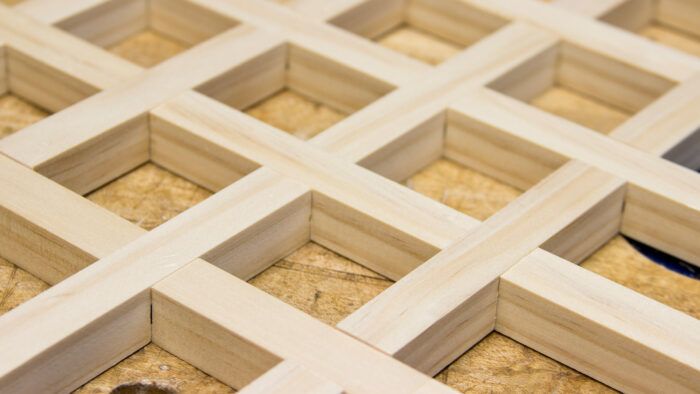
In February there was a post on the Fine Woodworking Forum by @peter.farnell asking about a Japanese kumiko technique. At a quick glance it looked like a simple weave; later it was clear that the simple weave was not simple, and not just a weave. What I took to be flexible flat sticks were actually inch-square solid lumber that was impossibly woven into a flat construction. I knew I had to try it.
Three days later, fighting the flu and hiding from NYC’s subzero windchill, I was in the shop rewatching a “Made You Look” video from the website. My first decision was that my saw skills and current patience level were not sufficient to try it with hand tools. I needed square sticks, regularly notched to accept each other, with the notches at two depths of one-third and two-thirds of the material thickness. A plan was hatched, a jig designed, and I moved on to milling material.
What I chose was scrap, a chunk of ¾-in. finger-jointed pine baseboard removed upstairs when I added a radiator on the third floor. There was a little wiggle in it from standing in the corner for months, so I cut it into chunks that eliminated nail holes and took it to the jointer. When I was done I had flat material just over 5/8 in. thick. I ripped it at the bandsaw and milled it into 5/8-in.-square sticks.
My plan required a bit more milling. I needed some flat material one-third the thickness of the sticks. I had some cedar planks that never made it to the BBQ last summer, so I ran them through the planer until a stack of three perfectly matched the thickness of the pine. I ripped them in half and set aside the four flattest ones for the jig.

Time to Build a Sled
I made my jig similar to a box joint sled. I found a plywood scrap and attached runners to ride in the slots on both sides of the table-saw blade. On the away side I glued a tall-ish scrap of maple from the burn bin. On my side I screwed a fence at one end from below so the fence would swing like a gate. With the blade set to just under the full thickness of the 5/8-in. sticks, I cut through the back of the sled to an inch before it hit the gate fence. With two-stick tape under the gate, I squared it to the blade and pressed it into place. I added a clamp and drove a couple of screws from the top followed by a few more screws from below, well outside of where the dado blade would be doing its work.

For repetitive cuts I prefer to adjust the blade to one height and lock it down rather than having to make multiple adjustments. In this case we had set cut depths given by the video of one-third and two-thirds the total thickness. By using the cedar as steps, I could get to those cut depths repeatably, even if I had to make more parts later. I made test cuts to dial in the blade height to exactly the sticks’ thickness riding on the sled. A few more test cuts confirmed the shims were perfect.

After making a setup block I swapped in a dado stack. Using the setup block, I set the height of the dado set just a tad short and plowed through the sled before fine-tuning the cut to the full thickness of the sticks and putting down one layer of cedar with two-stick tape at the far edge so it would not add thickness at the fence. A second layer went on with green painters tape.

The final function of the sled was to get identical spacing between plowed grooves so the grid would go together. Using the test cut parts I mounted an overhead aluminum pin, friction fit, so it could be raised and lowered for the two groove depths. It worked like a charm. I used double-sided tape to fix it to the sled’s back fence and eyeballed the spacing to about 1-1/2 in. between sticks. Test cuts confirmed that the aluminum pin was straight up and down and that the uncut spaces at both depths were identical. If the pin was angled at all, the distances between the grooves on the one-third and two-thirds settings would be different.
From here on it was just making sawdust—cut, flip, slide, and repeat, working down each stick. I made seven “frame pieces” and two “locking pieces,” as they were named in the video. My plan for a 5×5 pattern came up short at 4×5 because of losses to test cutting.

The parts fit together beautifully side-to-side. I did have a problem with depth. It turns out that the last time my dado stack was sharpened, my right-side blade was ground slightly smaller than the rest of the stack, so I had to clean out one corner of every groove—so much for avoiding chisel work.
Assembly
The assembly process is straightforward but twitchy. Snug enough to hold still while loose enough to let the locking pieces slide proved an elusive target. I took a single plane shaving from one face and one edge of each locker part; it helped a lot. A bit of force was needed here and there to get them moving. The farther in you need to slide a locker, the harder it is to move. If I were building a rectangular screen, I would make it so the locking parts all slid in from the short side.

Things I Learned
First, make sure your stock is truly straight and perfect. Any variation in the parts would be tough to get past. Twist would be a nightmare. Cleaning out fuzz is a bear, so make sure you’re sharp and your fence backs up the cuts perfectly. During assembly the parts move, even when you stop wanting them to. I think anything incorporating an HCG panel needs to be captured in a frame. The two-third to two-thirds overlapping of the frame pieces leave one-third of the total thickness floating in space and those parts out of contact. Getting all of the parts to lie perfectly flat over time is probably never going to happen except maybe on the smallest panels. A snug frame and a generous finish coat would probably make it feel solid. The more locking parts you slide in, the more solid the panel will be. Full contact with gluing surfaces only happens along the locking parts.
I wound up with a 10.5-in. by 13-in. panel. I guess it will float around the shop until it finds a home as a door panel or something like a trivet. I’m confident that with a properly sized sled setup dialed in, a screen of pretty much any size could be completed.
Sign up for eletters today and get the latest techniques and how-to from Fine Woodworking, plus special offers.


