

Solar’s Decorative Explorations – FineWoodworking
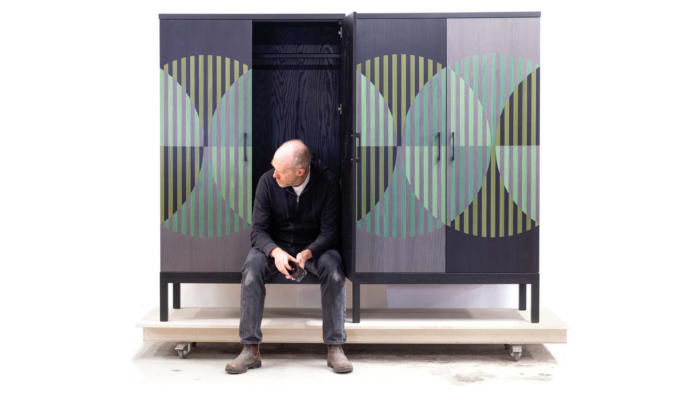
I got serious about being a furniture maker a little over a decade ago, and in that time I’ve been fortunate to have some clients who have given me wide latitude to experiment with decorative design ideas. I am really drawn to designs where a large number of simple shapes or pieces are combined to form a pattern that plays out across an expanse. I also tend to gravitate to designs that follow some kind of logic or controlled geometry. Sideboards and standing screens are furniture forms that I particularly like in this regard because their façades offer plenty of space for those patterns to unfold. For case pieces, I usually try to make the cabinet body as simple as possible. The pattern elements on the doors might be subtly echoed in the shape of a leg or panel edge, but otherwise the case is there to support the doors without drawing too much attention. To that same end, my case pieces are often finished with flat black lacquer.

In 2019 I was asked to do a large six-panel folding screen to occupy one end of a formal dining room. With each panel 7 ft. high and 2 ft. wide, this was far and away the largest object I’d made, especially in terms of surface area. My geometric impulses converged on a sort of pixelated gradient made of uniform rectangular tiles. I made the tiles—546 of them—of 1/8-in. Baltic-birch plywood covered in three different tones of wood veneer (white oak and two shades of walnut), plus a few in pure silver leaf. The tiles have black-painted beveled edges to add some texture and really reinforce the grid.

The arrangement of the four materials might look random at first, but it was the result of painstaking planning. I used code on my computer to generate semi-random distributions of the colors, then adjusted those by hand to get what seemed like the ideal layout. The tiles were bonded to 1-in.-thick hollow-core panels (thin MDF skins over a honeycomb core), which provided rigidity without too much weight. I bonded all 91 tiles for each panel in one go in a vacuum press, using epoxy as the adhesive. The blackened oak frames were then assembled around each tiled panel. Lift-off hinges connect the panels, allowing the screen to be configured in different shapes and sizes.

Not long after finishing the tiled screen, I was asked to make a cabinet for a new home outside Ottawa. Some maple trees had been removed during construction, and the clients had them milled into lumber in the hope of using it for furniture.
They asked me to design a sideboard to hold sheet music and instruments. When I got my hands on the wood, however, it was clear that it was not going to be useful structural material; it had warped badly during drying, and discoloration was present throughout the boards. There was some vivid spalting, but only in a few inches at one end of the stock—not enough to make normal door panels.
With tile grids still on my mind, I decided to cut the clients’ wood into 1/16-in.-thick veneer pieces about 4 in. square and then mix them up in a semi-random pattern on the doors. These small pieces let me make the most of the limited amount of spalted stock, and even the areas with dark blotches or stains ended up being useful when turned into a small part of a larger pattern. The rest of the cabinet could then be made from clean, uniform commercial maple stock and as understated as possible.
For smaller pieces like this I make my pattern and layout decisions on the fly. Once these tiles were made, I spread them all out on a worktable and started organizing them into 24-tile groups for each door. I might have a general idea about how the tiles will be arranged—maybe a light-to-dark gradient, for instance—but that’s just a starting point.

I often stand on a stepladder so I can look down on the whole layout in one go. I try not to focus on individual details but instead get a general sense of the flow of colors and tones across the whole pattern. If something looks out of place or unbalanced or just too orderly, I rearrange tiles until I’m satisfied.
Christopher Solar makes furniture in a former bread factory in Ottawa, Ontario.
To view the entire article, please click the View PDF button below.

Fine Woodworking Recommended Products
Circle Guide
If you like to draw your designs on paper, you’ll find the simple circle guide to be very helpful.

Stanley Powerlock 16-ft. tape measure
With its smooth lock, tough case, compact size, and excellent accuracy, this Stanley tape is perfect for workshop use.
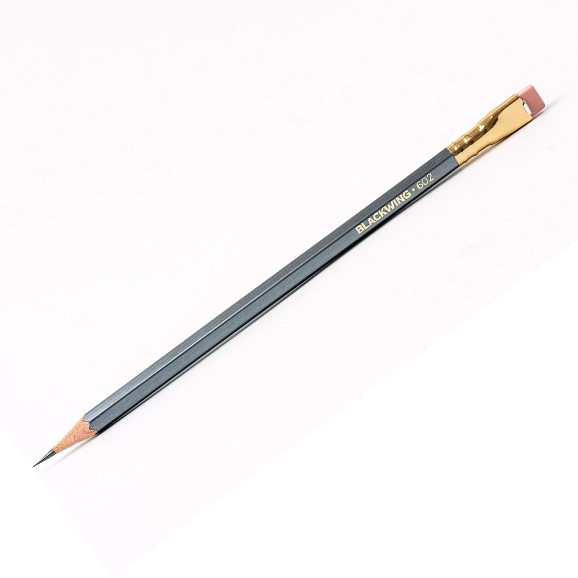
Blackwing Pencils
If you’ve listened to Shop Talk Live, you’ve heard them talk more about these pencils than you could possibly imagine.
Sign up for eletters today and get the latest techniques and how-to from Fine Woodworking, plus special offers.
Download FREE PDF
when you enter your email address below.


