

From the Archives: History of the Ball-and-Claw Foot
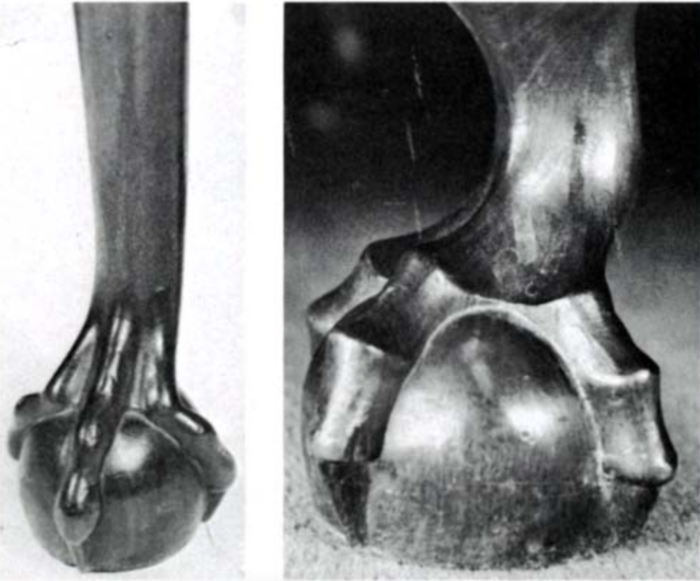
An excerpt from Fine Woodworking Issue #10, Spring 1978
Click here to read the full digitized issue from 1978.
The ball-and-claw foot, favored by 18th-century English and Colonial cabinetmakers, is a fascinating furniture ornament.
The derivation of the form is clear—a dragon’s triple claw grasping a sacred, sometimes “flaming” jewel, usually a pearl, or a crystal ball. In Chinese mythology, this motif denotes the guarding of purity, integrity and wisdom from evil demons. It appears frequently on ancient Chinese bronzes and brocades, but the progress of its influence from the East through western Europe to England and its application from one artistic medium to another are not so apparent and imply a rich crosscurrent of influences.
The arts of China and Japan began to impinge on Europe in the Middle Ages, when the first imported specimens of porcelain excited the wonder of craftsmen and collectors. Europeans began trading formally with the Chinese with the establishment of a permanent settlement on Macao by the Portuguese in 1557. Portugal and Spain maintained a virtual monopoly on trade with the East Indies until the turn of the 17th century, when England and the Netherlands entered the trade. In 1588 in England, Packe published The Historie of the Great and Mightie Kingdom of China from the Spanish original, and several treatises on China and Japan followed. The East India Company was established in 1600 and its Court Minutes and accounts by travelers contain a considerable amount of information concerning the early trade in Eastern wares. Objects in the exotic style aroused widespread interest and admiration in Europe; by 1670 the taste for chinoiserie was strongly developed in France, and toward the end of the reign of Charles II (1660–1685) choice collections of Oriental curiosities began to appear.
These collections must have contained a goodly number of bronzes with ball-and-claw feet that served as prototypes for objects of English silver that appeared in the last quarter of the 16th century. Goldsmiths and silversmiths quickly became familiar with the new exotic ornamentation and reflected their admiration in their work. Some of the finest articles of London silver rested on ball-and-claw feet, as exemplified by a standing silver gilt salt, hallmarked for London, 1581, and the famed Rogers salt, hallmarked for 1601. Many Dutch and German immigrant silversmiths worked in Elizabethan England and they played an important role in promulgating this motif, inspired by objects Dutch navigators had brought home in the 16th century.

The ball-and-claw motif was soon applied in other metalwork. Goldsmiths and silversmiths work in the most precious and costly materials; hence, they are most often in the forefront of decorative experimentation. Craftsmen in other fields—textiles, glass, furniture—were exposed to the same pattern books from which metalworkers drew their ideas. The ball-and-claw foot found its way into the design books and became a stock ornament, freely used regardless of its original context. The element was slowly incorporated into the vocabulary of the cabinetmaker as an innovative and interesting way to end the cabriole leg of a chair, table, stool or bureau.
Although the ball-and-claw foot was not taken directly from Oriental furniture pieces, many features of European chairs may well have been drawn from Oriental sources. Chinese chairs were brought home by European voyagers as objects of curiosity. The outline of the splat of the Queen Anne chair has been likened to the contours of Chinese vases. The spooned effect of the splat on the Queen Anne chair was used on Chinese chairs dating at least 150 years before the reign of Queen Anne (1702–1714). The cabriole leg, another naturalistic form compared to the leg of a leaping goat, may be of Chinese derivation as well. ball-and-claw feet did not actually appear on Chinese furniture until the mid-to-late 19th century, when it began to be made for the Western market-an example of reverse influence.
Naturalistic forms have always retained an inherent appeal for the English. For craftsmen in all the arts the exotic birds, animals, sea creatures and flowers that riot over their creations were part of the Elizabethan concept of an ordered world and the dance of life and death. The lion, eagle and oak tree in particular passed into the tradition of English thought and when a silversmith or a cabinetmaker designed an object to please his patron, his themes included the finest flowers, the rarest fruit and the noblest beasts and birds. The ball-and-claw foot was a worthy addition to this repertoire of ornamentation, and it was natural for the English craftsman to translate the paw of the Chinese dragon into a bird’s talons.
The ball-and-claw foot became quite popular in England around 1710, reached its apex in the reign of George I (1714–1727) and continued through the reign of George II to c. 1750. The style is often mistakenly considered an invention of Thomas Chippendale, although his Director (1754) contained no such designs; the vogue was outmoded and no longer eye-catching and had been replaced by scroll feet. The American Colonial craftsman, slower both to adapt and discontinue the fashionable London trends, continued to favor the ball-and-claw foot well into the end of the 18th century. In the last quarter of the 19th century, when American Colonial furniture enjoyed a revival, this foot treatment was revived, often cast in brass with the claw clutching a glass ball.
In the Colonies, the various ways in which the ball-and-claw foot was carved became a regional stamp and often a clue to the identification of the cabinetmaker. The use of the ball and claw was almost universal. In New York a large, squared, box-like foot was preferred, while in Philadelphia the claws firmly grasped a slightly flattened ball. The Boston and Salem cabinetmakers angled the side talons away from the center with much of the ball beneath showing through. The talented Goddard and Townsend families in Newport produced the undercut ball and claw, with openings carved through between the talons and the ball. This refinement was sometimes employed on the best pieces of English furniture in George II’s reign, but was rarely attempted by Colonial cabinetmakers other than in Newport.


English examples also show a rich diversity of carving on the ball-and-claw foot, both in walnut and mahogany. These feet appear on a wide variety of furniture including wing chairs, side chairs and armchairs; dropleaf, tripod, tea, and console tables; stools, slant-top desks and bureau bookcases. The foot most frequently emulated by New York cabinet makers is one in which a bird’s claw firmly grasps a heavy, square-shaped ball. Just as the dragon’s paw symbolized the power of the Chinese emperor, the eagle’s claw indicated the social importance of the cabinetmaker’s patron. Three claws are stretched across the front and a fourth, and shorter, claw clutches the rear. Varying degrees of tension are expressed in the ankle and the leg, sometimes shown in the muscles right up to the knee curvature. Sometimes a ringlet is carved in relief just above the ankle. For greater realism long talons were often added, and webbing carved between the claws. When both characteristics appear the effect can be striking, almost disquieting. The combined effect of a curved leg, seemingly preparing to leap, and a clutching claw with tension expressed in the muscles can be most realistic.


In England the lion represents authority, and many feet look more like paws than bird claws. In many cases the claws are set so close together that the ball is not visible. The claws multiply-often five and six are carved tightly together. The carving of the paw is quite often highly naturalistic, with hairs shown in relief (commonly known as “hairy-paw” feet), long toenails or a series of nodules run ning along the claws. Sometimes the paws are elongated, rather drooping and without tension, like an animal in repose.


On tripod tables, the ball is altered to improve stability and balance on uneven floors. The ball, referred to as “half walnut,” is more squat and sometimes cut in half. In these instances the cabriole leg curves in closer to the ground and eliminates space for the fourth claw.

About 1755, when English cabinetmakers had exhausted the multitudinous ways in which to carve the ball and claw, they turned to other styles, including the scroll toe, a tapering leg terminating in a spade foot and various turned feet. Variations on the paw foot with ball and a hoofed foot with ball reappeared briefly during the Regency (1811–1820) when they were often gilded, with the ball barely visible beneath the closed paw.


Sign up for eletters today and get the latest techniques and how-to from Fine Woodworking, plus special offers.


