
Busy Hands, Clear Head – FineWoodworking
Most people I know who enjoy woodworking, in any capacity, find a certain amount of peace in the activity. They may be drawn to the craft for the beauty of the final product, their love of design, the appeal of the tools or the materials… perhaps it’s the confidence and pride they anticipate from completing a project. For many of us, it’s a combination of all of these things. It’s a great stack of attributes. In addition to all of those things, however, is the unmistakable peace, joy, or general sense of well-being that accompanies the process, the time spent in the shop, not just the final product.
In the Garage
I feel safe
No one cares about my ways…
–Weezer, In the Garage
In looking back on my own woodworking journey, I discovered that at times of change or tumult, I instinctively turned to making furniture. Initially, this was very practical in some ways. After graduating from college, I moved home with my parents for a few months before moving to Baltimore to start graduate school and my first professional job. It was a liminal space and an uncertain time. At 22, in a little bit of debt, but generally very fortunate, that uncertainty was mostly benign and exciting. I felt like an adult: I was a college graduate, and I was moving farther away from home than I’d ever lived.
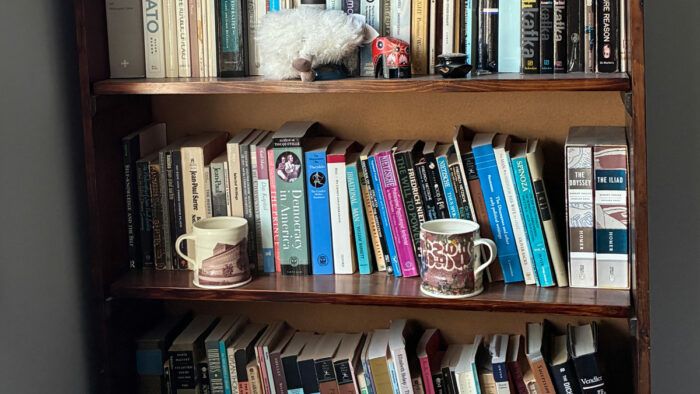
Rather than properly planning a future path or beginning to tackle the reading list for the graduate program, I decided that summer that the best use of my time and limited resources would be to build some bookcases. I had spent the previous four years studying literature and philosophy, and I kept every book that I read. And yes, I am proud to say that I read every book on every syllabus for every class I took. Maybe not as closely as possible, but these books represented the physical manifestation of my education. Four years of my life (a considerable percentage at the time). They were, collectively, my most prized possession.
 My previous experience up to that point had been putting together department-store furniture with Cams and Allen keys. I had never heard of Fine Woodworking magazine; YouTube had not been invented, and I wasn’t about to go to the library to get a book out on building furniture. I was 22, had grown up using tools, building all kinds of things: from Rube Goldberg devices for Science Olympiad competitions to wooden toys for neighbors kids. My time working at an area Renaissance Festival introduced me to basic carpentry, and time spent working on farms gave me the understanding that no one is coming to save you: figure it out.
I had watched a lot of Norm Abram but had no intention of using dados, biscuits, or other specialized tools or traditional joinery. I had a handsaw, a square, a drill, and a driver. I picked up some clear white pine 1x12s from the big-box store. I screwed together the cases. For the shelves, I simply bought a nice-looking piece of trim and created ledges for the shelves to rest on. No rabbet for the panel: instead, I had the person at the store cut a piece of ⅛” thick masonite to fit the back, and I nailed that sucker right onto the case (just like the Kmart furniture I’d assembled for my college apartments).
I stained it all a nice walnut color. To date, it remains one of my few stain jobs and perhaps the best part of the whole project. I made two of them–matching. All things considered, it was built on a back deck, with limited tooling (no clamps!) and a lack of knowledge of proper furniture building… they were, let’s just say, functional, and leave it at that. But I was proud of them. I now had a place for my books and a proverbial feather in my cap. I also had the experience. Every day after work (8 hours of staring at a screen), I came home, used my hands, and got out of my head. All of the concerns, uncertainty, undefined and unfamiliar emotions related to the excitement and pride of finishing school and the fear of moving away and being an “adult”…it all faded away into the focus required to make a decent cut with the handsaw. It didn’t cure the anxiety; It just gave my nervous system a break, which is what I needed. These deeper realizations are only clear now. At the time, I was just a kid who felt compelled to make stuff and was fortunate that no one was trying to keep me from doing it.
This was the beginning of a pattern. When I moved to Baltimore with my then-girlfriend (and now wife), I made a few modifications to our apartment. I added a simple counter where we could sit and drink coffee. I did this with just some off-the-shelf balusters from the home center and some advice from a knowledgeable person in an apron at the hardware store. The next year, I moved into my grad school group house: I needed a desk, I had very little money, and a tiny room. So I just built one. Balusters for legs, a plywood desktop, and some dimensional pine for shelves. I hadn’t even used a router at that point, let alone had access to one, so I simply sanded the edges down. When we moved to DC after I finished grad school, I built a new desk, storage cabinets, and other things we needed. I did all of this with basically off-the-shelf materials, a hand saw, and a drill. Nothing had a finish (except for the original bookcases, which had become my traveling companions).
As a young couple, my industriousness and the special how-hard-can-it-be-ness of a 25-year-old gave us a few pieces of functional furniture that saved us a lot of precious money. It also gave me that all-important ability to get out of my head, where the anxieties and excitement of early adulthood swirled. The satisfaction of creating something in the world that had, at that point, only been an idea does a lot for one’s overall well-being. At times of uncertainty and limited control, it gave me something tangible over which I was the master. It was a salve…a break. Those pieces planted an important seed for me…and a future career.
That future career was still many years away. In the period between moving to DC and the time when I dove into the woodworking rabbit hole, I had gone full throttle into my government career. I was about four years into that career when something started to feel…off. I had a lot of anxiety, felt unsettled, and really couldn’t explain why. I was newly married, had a good career, was making a good salary…friends, family, etc., all good. I was befuddled and a little discontent.
I was getting ready for a temporary overseas assignment, and my wife and I were driving across town to have dinner with some dear friends. NPR was replaying an interview from earlier in the week. The subject was Matthew Crawford, who had recently published Shopcraft as Soulcraft. It was what NPR calls a “driveway moment.” We arrived at our friends’ home, and I didn’t want to get out of the car. I wanted to keep listening to the interview. Alas, it was time to go. I had heard enough to know that I needed to read the book. Prior to hearing that interview, I had been thinking about building things again. I don’t think I truly knew at that point how healing it was for me. I simply had the impulse to build something. We didn’t need any furniture; I just wanted to get my hands on tools again. Hearing Dr. Crawford solidified that impulse, and after dinner, I ordered his book and started researching classes.
I spent the summer overseas and away from my friends and family. Being in a different country has a special effect on your mind and opens up new possibilities. I spent my downtime reading Crawford’s book, running alone, looking at the ocean, and thinking about the future. I also enrolled in an Adult-Ed class for the fall–Tuesday nights from 6-9 pm, I’d be taking a beginner woodworking class. I would finally learn how to cut real joinery, use a table saw and a router, etc. I was pumped.
That class was my point d’appui, the departure from the world as I knew it, to one where woodworking would be my new companion, a form of therapy, a hobby, a way to connect to others, and eventually a career.
The thing about turning something you love into a career, however, is that some of the lustre can be lost. As I wrote in previous posts, the cost of being in the shop every day is that you are running a business and spending a lot of time and attention on things that are not woodworking. What once served as a salve can become a source of stress. For me, at least once a year, I need to step back and just make something for myself: a piece of furniture for the house, a gift for a family member or friend, or, most recently, a tool cabinet for myself. I’ll detail the tool cabinet in the next entry.

Sign up for eletters today and get the latest techniques and how-to from Fine Woodworking, plus special offers.


