

The Curious Incident of the Benchdog Marks in Stavanger
Our mystery begins in Norway’s oldest cathedral, a large, staunch stone building in the west-coastal fjord city of Stavanger. Construction is said to have started around 1100 and completed perhaps 50 years later. Our case, however, begins in the 1650s. It involves the carving and painting of a large decorative wooden pulpit and five ornate baroque hand-carved epitaphs. The pulpit itself, considered one of the finest examples of baroque craftsmanship in the country, was completed in 1658, and the epitaphs were carved and painted over the following decade or so. We know this from church receipts and records.
The story told is that all of these huge wooden projects were carved and painted by one person, “Anders Lauritzen Smith,” a painter from Scotland. Anders is known to have lived in Stavanger at the time, and his descendants have become prominent figures in the history of the city.
It was in the winter of 2019-2020, however, that the cabinetmaker for the cathedral, Michael Heng, picked up the phone to call historian Hans Eyvind Næss, with a suspicion that this could not be true; Anders Smith did not, in fact, carve this pulpit. Michael was fairly certain of this, but he couldn’t prove it. Not yet.
Hans was skeptical at first; in his own published works he had repeated the story that Anders Smith had made these pieces. Everyone knew this to be true, but as Michael made his case, Hans admitted that something was off and decided to help investigate further. The two of them worked together alongside furniture conservator Stina Ekelund Erlandson and three paintings conservators for three years before first publishing their findings: Anders Lauritzen Smith had neither carved nor painted either the large pulpit or any of the epitaphs in Stavanger Cathedral.
The history books needed to be changed


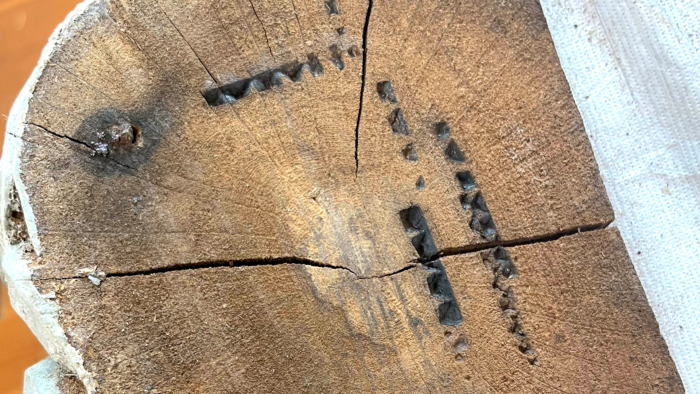
As part of their evidence, they reviewed the painting techniques on the epitaphs, searched town records, and compared details in the woodworking on these pieces, as well as some that looked similar in other cities. The one piece of evidence that really caught my attention, however, is a collection of benchdog marks still remaining on many of the boards.
Many of you will be familiar with benchdogs, the friendly pegs or blocks we put in our benches to hold wood in place while we work it. These days, it seems we like our benchdogs to be wooden. Historically in Norway, however, a benchdog was often a smithed piece of steel or iron, with actual teeth that would bite into the end of a board. The teeth of a benchdog were hand filed, and each one left a unique bite mark in the end of a board, like a fingerprint.
So Michael and Stina started documenting these marks, taking photos, measurements, and making molds of them with silicone putty. Through this, Michael realized that there were only five distinct benchdog marks across all pieces in Stavanger, which alone helped him to confirm which pieces had likely been made by the same craftsperson, and which may not have.


How Michael knew to review history
What really caught my attention in this story is the intertwined nature of experiential craft knowledge and established research techniques to find a real historic answer. Because the thing is, unless you have a familiarity with using benchdogs like this, it’s unlikely you would have even known what those marks were, let alone that they might hold the key to solving this mystery.
I asked Michael what led him to be suspicious about the epitaphs to begin with. He said he’d developed an eye for assessing crafted works like this from years of working with and discussing them. He had trained as a cabinetmaker, using machines and modern techniques, but picked up a job out of school at the Mahogni Christensen workshop doing restoration and traditional work as well. He had restored several pieces for other cathedrals. During his lunch breaks, he and the master there, John Bjerga, would sit and discuss these objects, who had made them, and what the subtle differences were in their craftsmanship.
There can be little variations in the molding curves and shaping details due to the tools available in a particular shop and the skills of the craftsperson. The exact nature of a curve on preindustrial work is usually defined by the chisel or molding plane used to make it, and when each plane is made individually, there are subtle differences between them.
But there are also personal aspects of a handmade work. How many chops with a chisel does it take to get a curve? A more experienced hand can often work quicker and with fewer passes of the tool to make a desired shape. A younger hand might tap-tap-tap slowly along a curve to get it right and prevent blowout.
The combination of working the wood himself and assessing the pieces gave Michael an intuitive and intellectual understanding of the work, and he brought this understanding with him when he started working at Stavanger. By simply looking at these pieces he could tell that something was off about the Anders Smith story.
The combination of craft experience and historical research is something I’ve seen before in other places, but especially in Norway. It’s something I feel deserves more attention, as tacit and experiential knowledge has often been unfairly disregarded (especially indigenous knowledge).
So I’m going to come back to Michael and his benchdogs a little later on, to reveal who the maker was for these pieces and what their evidence is. For the moment, though, I want to look at some of the systemic ways that heritage craft and research are combined in Norway. I want to tell you a second Norwegian woodworking mystery, set nearly 400 miles away and on the other side of a mountain range.

Thor-Aage Heiberg and the somewhat oddly shaped chisel
In the more northern Norwegian city of Trondheim, Thor-Aage Heiberg coordinates the Traditional Building Craft bachelors’ program at the Norwegian University of Science and Technology (NTNU). He has a kind and confident voice, a careful nature, and a gift for passionately explaining traditional tools and techniques. I’ve never met someone who impressed me more with a combination of knowledge, talent for teaching, and genuine concern for the value of craft and life on earth.
In a beautiful carpentry workshop complete with large traditional benches, students learn heritage carpentry techniques hands-on. They learn how to look at Scotch pine boards and determine whether they should be used for flooring, walls, windows, or what-have-you. They learn how to process these boards, planing and joining them, all using preindustrial techniques and hand tools. They learn how to build buildings and doors and window frames in a historic fashion.
They are also required, as part of the university degree, to engage in research to learn more about these historic methods. Not only are they expected to be competent in their craft, but they are expected to add to what is known about lost woodworking arts. They must find some process, product, or tool that was used in the past, and try to learn more about it. This can involve recreating lost techniques, doing scientific analysis of historic materials, or something of the vein.
For Thor-Aage himself in 2016, along with a fellow heritage carpenter Ellev Steinsli, it was the rediscovery of a 19th-century process for making mullioned windows. This process was cleverly recreated in part from trying to understand some of the old hand tools that had been collected from rural properties over the years, including a strangely shaped chisel (referred to now as a mitered iron) found on an old farm south of Trondheim.


The Mitered Iron and the Window Plane
There were two styles of mitered irons recovered from rural sites outside Trondheim. Both looked a lot like a chisel with a right angle. Some of them had protruding ends at the outsides (like those shown above), and some of them did not. In the same places that some of these were found, they also recovered a specialized wooden plane and marking tools.
The purpose of these irons was not understood when they were found, but it was clear they had been designed for a very specific job. Given that there was more than one, they were not just a fluke or oddity. Clues for their use came from examining the wooden planes that accompanied them.
Like trying to match a puzzle piece to a puzzle, you can take a molding plane and hold it up to historic objects to find a match. The wooden planes that accompanied these irons were a perfect fit for the cross pieces (or mullions) in the 19th-century windows that adorned the property.
With this in mind, Thor-Aage and Ellev sought to reproduce those tools as well as whatever the lost technique was for making the windows.

Craft Practice as Research
Alongside the traditional research of searching records and photos, their process (as discussed in their thesis) involved making replicas of the old tools they found and then experimenting with them until they could figure out a process that would produce the same style of window. The process itself had to be efficient and make sense to them as craftspeople.
This whole research project hinges in part on their practical experience with preindustrial tool use. If the process didn’t make sense to people who could actually work with these tools, then the hypothesis wouldn’t really hold water.
So they made replicas of the planes, the iron, and the marking tools. They found pretty quickly how the planes would be valuable for making the mullioned forms. Taking some guidance from Doormaking and Window-Making (Lost Art Press). They built a set of wooden jigs, and with those they could, in a matter of minutes, produce perfectly formed and shaped pieces for mullioned windows.
I actually got to try this practice when I visited Thor-Aage at NTNU in Trondheim. I was visiting with some folks who had both more and less woodworking experience than I did, and we were able to produce near-perfect pieces without much trouble at all. Starting with unsquared boards, we rapidly squared them, thicknessed them, shaped them, put the moldings in, and added the mitered joinery with very little hassle. We also found out what that mitered iron was for.

Making windows and using the mitered iron
The jig board itself is just a series of steps in track form. The planes ride along, getting the board to the right thickness and width, and then putting the mullion shape on one side (including the rebate for the glass pane) and then the other side. It can also help get the length set, and you can use a miter jig to cut the ends as you need them.
One of the more complicated cuts in these pieces, though, is the double miter where the muntins meet between panes. This is where the mitered iron comes in. You take that mitered iron, line the point in the middle up, rest the two protruding legs on the outside, and quickly chop a perfect mitered rebate. It’s incredibly fast and incredibly efficient.
As someone who uses hand tools, I found it so clear how valuable this system is. That experiential knowledge is genuinely good evidence to suggest that this was likely to be the intended use for this tool.


This is the value of including craftspeople in crafts research. The result is the rediscovery of lost techniques, and a connection with the crafted objects around us. I was truly impressed by the bachelor’s program at NTNU and how it incorporated this kind of research fluidly alongside practical work for the benefit of Norwegian craft history knowledge.
Maintaining living craft practice means there are people like Thor-Aage in Trondheim and Michael in Stavanger who can look at historic carvings and know from experience what the marks and details on them mean. To that effect, let’s return to Stavanger and resolve the Anders Smith Mystery.

Return to Stavanger
Back in 2020, cabinetmaker Michael Heng and historian Hans Eyvind Næss were on the phone almost every night discussing new findings in the case of who produced these 17th-century baroque carvings.
Because Stavanger is a small town with impressively impeccable records going back centuries, Hans was able to determine who was living there that was capable of doing this work at the time. According to records, there was only one craftsperson there in the mid-1600s who would have been allowed to work on a project like this, and it wasn’t Anders Smith (even though he was living in Stavanger at the time); rather, it was a man named Peiter Billedhugger.
In order to operate as a professional craftsperson of high standard at the time (high enough to have worked on cathedral projects), you needed two things. You needed to have achieved master level with the guilds, and you needed to have gained official registration with the state. With both of these, you obtained the title of “Borger.”
The only woodcarving Borger in the area on record in 1660 was Peiter Billedhugger. Anders Smith was operating only as a painter, and he wasn’t an official Borger in painting either. Additionally, Peiter had also operated as a woodcarver in Bergen, Kinn, and Førde, where Michael had personally seen epitaphs with similar craftsmanship to those in Stavanger.
With the records supporting Michael’s hypothesis, and with a potential suspect, it was time to review the evidence more thoroughly.

Benchdog marks help solve the case
Paintings conservators were brought in to investigate and analyze the paintings themselves. They looked into the details of materials used, composition, brush strokes, and the artist’s style to compare the pieces. I imagine their own experience was essential to the research in the same way that Michael’s was. You can read more about the general findings from the team here, but our focus is on the woodcarving side and, in particular, the benchdog marks.
Once Michael and Stina had realized that they could find these marks on the ends of boards in the carvings, they knew they had a valuable tool in determining whether two pieces had been made in the same workshop. With the molds of the benchdog marks from the Stavanger pieces, they got permission to investigate similar pieces in other cathedrals, including ones where records show Peiter had also worked.
As expected, the marks on the Bergen, Kinn, and Førde cathedral carvings matched with some of the marks on pieces in Stavanger. In addition to that, they checked the shapes of the moldings as well and confirmed that they were likely also made by the same set of molding planes. In combination with records showing that Peiter had worked in both locations at the appropriate times, they felt pretty confident in saying that despite the popular narrative up to that point, Anders Smith had not carved the pieces in Stavanger. Peiter had almost certainly carved most of them.
When it came to the paintings, it seemed they were done by a few different people, still unknown.


A few loose ends
While the benchdog marks and molding shapes could confidently identify that the pulpit and the first three epitaphs had been made in Peiter’s workshop, the benchdog marks on the last two epitaphs carved did not match any of those found elsewhere. Michael had also observed that the handiwork on those epitaphs were not as refined as the earlier works.
Perhaps after Peiter retired, a new carver came in to continue his work. Perhaps he just had new benchdogs made and started to alter how he worked when he got older. The research is ongoing.
At the conference in Amsterdam where I first heard Michael tell this story, he mentioned that he might keep taking moldings of benchdog marks he finds, and request that others do the same. Perhaps a historic database of workshop benchdogs could be formed to help create a resource for further research. Maybe someone else has a piece with marks matching those last two epitaphs in Stavanger Cathedral.
Regardless, I feel like none of this would be known if Michael hadn’t sat with his master during lunch breaks talking about the craft and the techniques and the details on the pieces they were restoring and looking at, and if he hadn’t had his eye refined through years of practical hands-on experience with old techniques and tools.



Sign up for eletters today and get the latest techniques and how-to from Fine Woodworking, plus special offers.


