
From the Archives: Make Custom Moldings with a Versatile Scratch Beader
This is an excerpt from Fine Woodworking #11, Summer 1978
Click here to read the full digitized issue.

The scratch beader is a tool of many virtues. It is quickly and easily made. With practice, it is a substitute for a router (table or hand) and for molding planes. It can do things those tools cannot, depending on the particular job. It can cut any molding (or groove or rabbet) you are willing to make a cutter for, including intricate shapes.
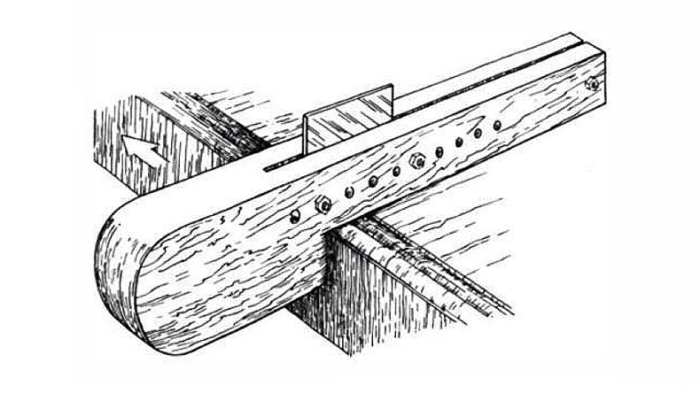
The beader consists of hardwood stock with a projecting arm, which has a vertical sawkerf along its length. The tools are held in the sawkerf by bolts. The shoulder between the stock and the arm guides the tool as it is drawn along the edge of the work.
Making a cutter for the beader is easy. File or grind a piece of any scrap steel; old sawblades or cabinet scrapers are ideal, but in a pinch one can use almost anything. The steel should be wide enough to accommodate the desired shape plus another 1/4 in. or 3/8 in. to recess behind the shoulder. Recessing the tool stiffens it during each stroke. It should be long enough to accommodate the design and stick out the top, and no thicker than the kerf in which it will be placed.
The cutter is formed by cutting and filing the desired shape, as a negative cross section, in one end of the blank. The cutting edge is filed straight across the edge of the tool. With steel no thicker than an old sawblade, a mere awareness that the trailing edge should not extend below the cutting face will allow sufficient clearance. With heavier steel, a more deliberate relief will be required, as on the sides of a tool that is to follow a curve. But do not leave any more relief than necessary. The tool cuts like a scraper, not a chisel, and it should not want to cut the wood under vertical or horizontal pressure.
If you wish to harden and temper the tool, fine. It is not ordinarily worth the effort for one-of-a-kind applications. If the shape is complex and not easily sharpened without destroying the design, hardening may be desirable. Usually one is not obliged to harden unless the molding to be cut involves a lot of wood. This is not a production tool. It is for small or nonrepetitive jobs, and it permits a flexibility of shapes that production tools cannot match.
It is used by placing the beader at right angles, vertically and horizontally, to the shape or groove to be cut. With cuts of any depth, say 1/8 in. or 3/16 in. or more, the tool is first placed partway below the arm and secured tightly on both sides by two or more small machine bolts of any convenient size. The beader is then drawn along the surface to be cut, holding its shoulder against the nearest edge or surface, and at a right angle to the surface to be cut. The beader should be held upright at all times, but at the very start some slight tilt in the direction of the stroke may be useful. One or two trials will show that the leading edge of the cutter will then have the effect of providing a quite shallow cut. But as soon as the cutter has got into the wood, the beader should be used upright. As the work progresses, the cutter may have to be reset deeper until the final design has been cut.
A beader will be used most often to shape an edge, but it may also be used to cut a groove (for inlay, for example) or molding in the surface of a plank following a straight or curved edge. In this case the shoulder of the tool, which locates and maintains the distance between the groove (or inner edge of the molding) and the outer edge, may be rounded to about the smallest arc of the curved edge being followed. This makes it easier to hold the tool steady as you follow a curve, it keeps the distance of the cut more constant, and it permits you to keep the long axis of the tool normal, or perpendicular, to the curved edge as you follow it.
The beader is best used on hardwood, and with care it will cut across the grain—even in situations where a plane or router would tear. It will not cut cleanly to the very end of a blind groove, nor, in the case of sharp angles, can it be worked right to the intersection. Work up to about a half inch away and finish with a knife or chisel. Take care always to keep the shoulder bearing on the work as you scrape. And put a bolt through the hole nearest the end of the arm so the sawkerf won’t pinch your hand as you work.
Beaders may be made in a variety of sizes, although they are difficult to use for large moldings. Some beaders, for delicate work, are quite small. Start with simple designs; later, all sorts of applications will invite your interest. Whatever size you try, keep to the general proportions shown in the drawing. Too long a beader encourages twisting as you scrape, which is not good. Beaders don’t last forever, because the cutter tends to enlarge the kerf in which it is held during use. When this happens, you’ll have to make a new beader. Make one and practice on some scrap and you’ll soon appreciate the versatility of this inexpensive device.

Fine Woodworking Recommended Products
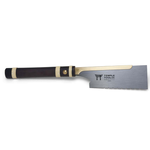
Little Demon Dozuki from Temple Tool Co.
The saw worked as promised. With such a fine tooth count crosscutting was a breeze.
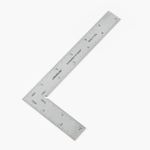
Veritas Precision Square
This precision square is incredibly versatile, from checking squareness to dialing in machine setups.
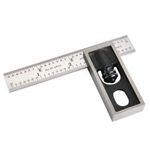
Starrett 4″ Double Square
Head is easy to remove, replace, and lock down; narrowest blade, at 5⁄8 in., made it easier to fit into tight places; hard to read under bright lights.
Sign up for eletters today and get the latest techniques and how-to from Fine Woodworking, plus special offers.