

Make a Pocket-Size Coffin Plane
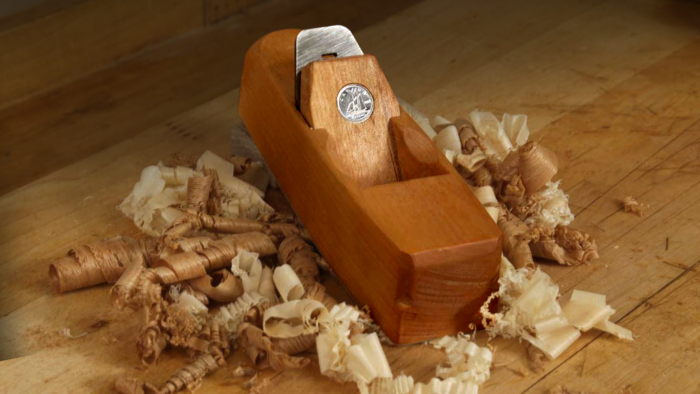
When I was asked to talk about wooden planes at my woodworking club, I chose to focus on my favorite plane, what I call my pocket coffin plane. I picked it up at an estate sale almost 50 years ago near Lunenburg, an area of Nova Scotia known for boatbuilding. The blade of the plane was taken from an early Stanley block plane and fitted into the wooden body. I estimate that it was made around 1900. The body is craftsman-made from lignum vitae, which was a common wood in the boatyards of that time. Clearly proud of the tool, the maker stamped his initials on the front and top. I set out to re-create the plane to show others how to make it. In the process, I developed a high regard for the history and longevity of a simple tool that’s made well.

Most woodworkers have the necessary tools for making a plane. A set of sharp chisels is essential; there is lots of chopping and paring involved. Floats, although traditionally used for bedding a blade and well suited for the job, are not required. They can be replaced with shopmade sandpaper sticks or a “dulled” chisel, which makes a great scraper for fine-tuning. A small, tapered flush-cut saw is needed. These are not expensive (I found mine online for $15), and you can easily make your own; in the past I have fashioned a handle for a reciprocating-saw blade, though it requires grinding away the set to produce a good-quality cut.

As for the material, I have no access to the lignum vitae of the original plane, so I went with yellow birch for the body instead. Readily available and stable with straight grain, the yellow birch is surprisingly dense, which works well to take the abuse of an everyday-use plane. The pitch of the blade is set at a low angle (38°), so the plane can be made from 8/4 stock. I fitted the new one with a 1-5/8-in.-wide blade from Lee Valley; this Stanley block-plane replacement blade is the thickest available at 1/8 in., which makes for a nice, smooth cut. Taking a fine shaving with a self-made plane is one of life’s great pleasures.
Begin with the layout
The key to a good wooden plane is its ability to stay flat. To stave off warping, I keep the rough plane blank stickered in the shop for as long as possible to acclimatize. After it dries, I keep the length oversize, around 12 in. long, to allow for easy clamping to my bench while I work it. I like to orient the blank such that the outer part of the tree is the sole. That way, as the plane shrinks and moves, the edges of the bottom will be the high spots and will be easy to flatten down to the sole, as opposed to having to flatten the middle and working outward. Once I have marked the top and bottom of the plane, I determine the front and back as well. The grain should slope downward from the front toward the rear, so when I push the plane, it runs with the grain.

The plane’s total width ends up being 2-3/16 in. That’s 1-5/8 in. for the blade, 1/4 in. for each sidewall, and 1/16 in. for wood movement. I add that allowance because I’ve found many older wood planes with seized blades or cracks in the sidewall due to wood movement.

I mark the start of the mouth opening 3 in. from the front, and its end another 1/4 in. past that. This is a very important area of the plane. If the opening is too tight, shavings will get clogged and the plane won’t cut; if it’s too large, the wood fibers being cut will be unsupported, causing tearout. The final opening will be about 5/16 in., but I start with 1/4 in. and don’t open it further until the blade is set in place to make sure I don’t go too far.

On the side of the plane body, I draw all my different angles: 38° for the bed, 48° for the abutment, 70° for the wear, and 110° for the escapement. The wear and abutment angles start at the front of the mouth, and the others from the back of the mouth. With those lines drawn, transfer them square across the top and back down the other side to the mouth for a visual reference from any side of the plane. On the top, mark the sidewalls and the cheeks. The cheeks each taper 1/4 in. from the shoulder of the abutment to the escapement, creating a nice wide opening for the shavings to clear.

Clear out the waste
Excavation starts with the body bottom up. At the mouth of the plane I make a 1/8-in.-deep mortise with my chisel; this will prevent tearout from the drilling that follows. Next, at the drill press, with its table angled 20° and the plane body still bottom-up, I drill a group of 1/8-in.-dia. holes, deepening the mortise I began with a chisel. This angled mortise creates the wear, and it will help keep the mouth narrow as the plane bottom gets worn down.

Still at the drill press, but now with the body turned right side up and the table set to 90°, I use a larger bit to clear out as much of the waste as I can without plunging into my layout lines.

I cut a block to 38° as a guide for my chisel and clamp it to my piece. I take a couple of roughing cuts, working from the drilled-out body toward my layout line, then a final fine cut right to the line, leaving a flat, consistent angle for the blade to bed nicely. To prevent blowout when my chisel exits the mouth, I place a sacrificial piece under the plane. I follow the same steps but with a 20° guide block to clear the rest of the throat and establish the escapement angle.


I clean everything up with a final pass, making sure the mouth is clear and the cheeks are square and even 1/2 in. from the outside edge before moving on to cutting the shoulders for the abutment.

Bill Howes collects and creates woodworking tools in Halifax, Nova Scotia, Canada.
|
From Fine Woodworking #326 To view the entire article, please click the View PDF button below. |
 |
Fine Woodworking Recommended Products

Stanley Powerlock 16-ft. tape measure
With its smooth lock, tough case, compact size, and excellent accuracy, this Stanley tape is perfect for workshop use.

Veritas Wheel Marking Gauge
A wheel-type gauge is the easiest to use, and this wonderful Veritas model is a steal at $38.
Veritas Precision Square
This precision square is incredibly versatile, from checking squareness to dialing in machine setups.
Sign up for eletters today and get the latest techniques and how-to from Fine Woodworking, plus special offers.
Download FREE PDF
when you enter your email address below.


