

In Defense of the Spring-Pole Lathe
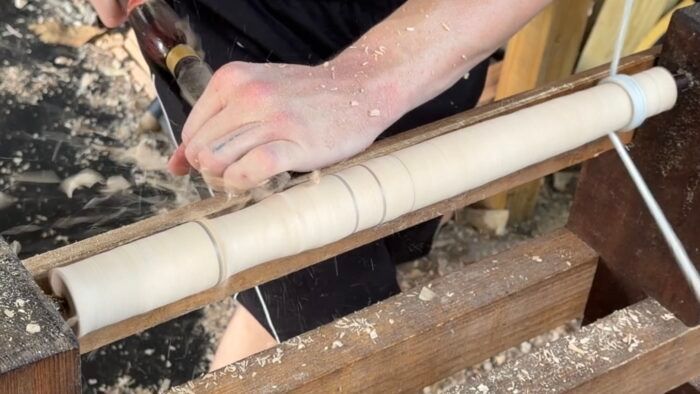
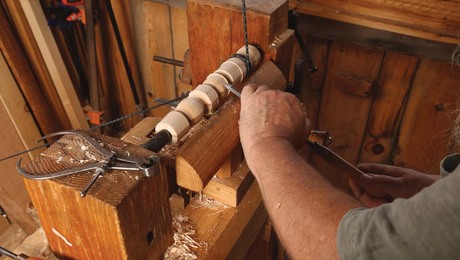
The spring-pole lathe is an odd bird. As a reciprocating, foot-powered lathe, it has two disadvantages: Not only do you have to raise your heart rate to use it (God forbid), but it literally doesn’t work half the time—for every cutting stroke, there’s a return stroke as the work spins back. Because of this, when the spring-pole lathe comes up in discussion, I often see folks wondering, “Why not just build a flywheel treadle lathe? If you’re going to use a foot-powered lathe, at least let its motion be continuous.” I understand this impulse. To the casual observer, the treadle lathe doesn’t seem that different from the spring-pole lathe, and surely it must be at least twice as efficient without a return stroke. Is that true, though? I’m not particularly convinced.

I believe that this way of thinking partially comes from a view of the spring-pole lathe as a strictly worse version of the treadle lathe, the former being made obsolete by the latter. This, however, is demonstrably untrue. Though the spring-pole lathe is first attested in the 1200s, it’s unclear when the first treadle lathes were produced. Da Vinci sketched one in the 1400s, though modern lathes built from that sketch have proven to be extremely ineffectual. By the 1600s, we see a treadle lathe pictured in Joseph Moxon’s Mechanick Exercises, though Moxon devotes much more discussion to the pole lathe than the treadle lathe.


A century later in France, Andre Roubo described a spring-pole lathe in use by a professional cabinetmaker working with dried wood. It’s not until the 19th century that we see the decline of the spring-pole lathe, but even then it stayed in professional use as a staple of the High Wycombe chairmaking industry, driving the production of roughly 4,700 chairs a day at the industry’s peak. It ultimately fell out of professional use in the 1950s.

So what’s going on here? How could the spring-pole lathe compete with continuous-motion lathes? Though there are certainly a number of factors at play, I think the most obvious is build complexity. A spring-pole lathe can be built with simple tools in a day or two. The most mechanically rigorous factor is in creating a flat bed and parallel centers. The treadle can be as simple as a loose plank. While an appropriately sized spring pole (around 12 ft. long) can be difficult to source in the modern era, many turners (myself included) use a bungee cord instead—cheap, effective, and compact.

Compare this to a treadle lathe, in which the treadle connects to an arm that turns the flywheel, which is connected to a pulley that’s fit into the headstock and drives a spindle, which drives the workpiece. The number of moving parts is multiplied; there’s now metalwork that needs to be outsourced, and making and balancing a flywheel is no mean feat. That’s a lot more upfront cost in time and parts for both the modern hobbyist and the historical professional, as well as more moving parts to wear and repair in the future. Surely, though, that upfront cost pays for itself via the increase in efficiency. The treadle lathe cuts twice as much as the pole lathe; it must be twice as efficient, right?


Not quite. All those extra moving parts don’t just complicate the build process—they also add friction into the system, resulting in a loss of energy between the leg and the workpiece. Though I unfortunately don’t have a treadle lathe to do my own experiments on, from what I can find, modern treadle lathe owners generally report between 700 and 1,000 revolutions per minute (RPM) on their lathes. Compare this to my spring-pole lathe—I’m averaging 1,200 to 1,800 RPM during the cutting stroke for general spindle turning. Half that number to take the return stroke into account and we still end up in the territory of 600 to 900 active RPM—not much slower than the treadle lathe at all. Granted, these numbers take more energy from the operator to achieve on the pole lathe than on the treadle lathe, but let’s be honest here—you probably need the cardio. I know I do.

Taking all of this into account, I think we can see why the spring-pole lathe was and still is a formidable machine. Many of the advantages that it had for preindustrial craftspeople translate well into the modern hobbyist’s shop. So next time you see a spring-pole lathe, rather than wondering why someone would build such an antiquated machine, take a moment to consider the beauty of its efficiency through simplicity. After all, how many other medieval machines survived the industrial revolution?


Fine Woodworking Recommended Products
CrushGrind Pepper Mill Mechanism
Matt Monaco designs his pepper mills to accept the CrushGrind mill mechanism, which he likes because it doesn’t require drilling through the top of the mill’s cap and having hardware exposed on top.
Sign up for eletters today and get the latest techniques and how-to from Fine Woodworking, plus special offers.


