

The Maine Japanese Woodworking Festival: Part 1
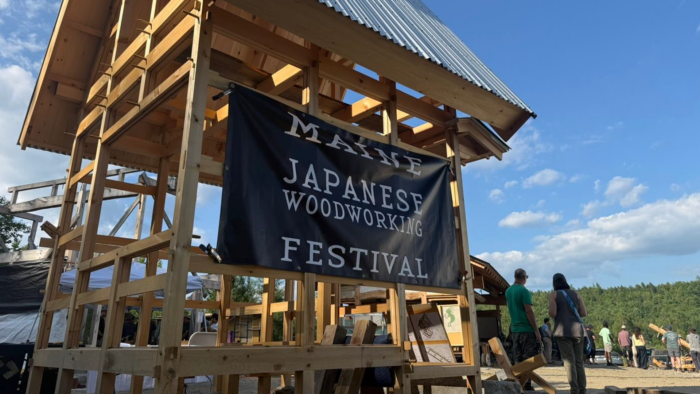
Building your skills in Japanese woodworking often feels like an uphill struggle. An ocean of online sources of variable quality can leave people confused and even misguided, and while an in-person immersion in Japan is far superior, it’s expensive, both in time and money. And even for those that do make a pilgrimage to Japan—as in my case—coming home presents a challenge if the goal is to keeping moving forward. So when I discovered an opportunity in Maine to be around some of the most authoritative voices on the craft, I jumped at the chance to participate. By the end of the weekend I had discovered that the opportunities to build Japanese woodworking skills closer to home were far richer and more abundant than I’d ever imagined.
The adventure begins
The Maine Japanese Woodworking Festival happens over three days in July, on a functioning homestead in Mercer, Maine, where Jason Fox and his family live. Getting there from Boston is a drive along beautiful coastal Maine, full of opportunities to experience many types of beauty (including a stop at Lie-Nielsen if, like me, you share a love of all high-quality tools across East and West).
As you enter this special place in the woods, you’re immediately taken away from everything going on in the world and immersed in community and craft. And it’s not just woodworking; Jason has brought in related disciplines too, including pottery, blacksmithing, plastering, and more. There was a large camping area along with hotels/Airbnbs nearby, along with tents for presentations, workshops, and competitions including a Kezurou Kai, where attendees could put their plane-tuning skills to the test and compete for prizes. One thing that immediately struck me was the wide range of backgrounds and skill levels represented among those who traveled in, from people who had never picked up a chisel to those who been practicing for many years. Whatever the experience, all were welcome.

Hands-on workshops in joinery, hewing, and so much more
The festival began with workshops allowing attendees to immediately sink their teeth and tools into wood. Hisao Zen held a workshop on cutting a mitered, wedged, fan tenon corner joint.
Yann Giguère held a hewing workshop, demonstrating how to use Japanese axes, saws, and adzes. Before long, a termite-like swarm of woodworkers were all working together to transform logs into usable lumber. This continued with the ‘Log to Board’ workshop Morgan Donn and Yann held, exemplifying the historical progression of tool use. Liz Johndrow from Earthen Endeavors and Ariel Burns from Maine Heritage Timber Frames did a plaster demonstration, and Hiroshi Awano from Awahiro Japanese Carpentry did a copper roof demonstration.

The instructors took great care to help attendees both learn and apply the skills. This theme continued through the three days, and one thing that stuck with me was how approachable and generous both instructors and experienced attendees were in sharing their knowledge.
For example, after the sawing workshop held by Jim Blauvelt, I asked him if he would mind sharing 10 minutes to watch my sawing technique and help correct any errors. He did, happily. I learned a lot, including that I could improve my accuracy by easing off the pressure on the return stroke, as it would allow me to feel more feedback. Later I saw Jim helping a young teen woodworker learn how to tap out a plane blade.

Matt Connorton and experienced attendees including Nolan Hatfield from Studio NOHA and Garry Johnson helped me improve my kanna tuning skills. So many of these moments were spread over the three days, and I think that’s what made the event so special to me personally. That level of access to expertise, and that keenness for helping each other grow our skills together, is exactly what I’d missed since returning home from Japan.
Deep dive presentations and a Micro Minka Tour
The following day there were demonstrations and talks on a diverse set of topics. Makomako covered Urushi lacquering and kintsugi, the repair of cracked or broken pottery. Paul Tuller held a deep dive into Fusuma doors and the Japanese home. Brian Holcombe showed the commercial application of building tea houses.

Kokichi Ozaki, a temple and shrine carpenter involved in the restoration of National Treasures in Japan, joined remotely to give an overview of his work and his efforts to reinvigorate the Japanese chisel industry with Project Sekito, a collaboration with Zen-Wu Toolworks.

Pierre Nadeau showed a traditional Japanese forge, sharing knowledge on the production and types of Japanese steel and how they are used in tools.

Jason held a tour of the Micro Minka, a miniaturized traditional Japanese farmhouse built by students during the summer timber-frame intensive, teaching Japanese joinery and construction techniques.


Joinery and planing competitions
The third day gave attendees the opportunity to apply their skills to compete for prizes. Several had spent much of the second day studiously preparing their tools in the planing tent, including Nolan Hatfield of Studio NOHA, seen tuning his kanna below.

The planing competition (kezurou kai) saw attendees compete for the finest shaving. Prizes included a rare Funahiro plane generously donated by Brian Lam of Paklan.org, which was all the more meaningful since the maker had unfortunately recently passed. Other prizes included a set of chisels by Project Sekito and Zen-Wu Toolworks. Brian Holcombe scooped first place.

The joinery competition saw a complex joint (kanawa tsugi) executed to high quality under time pressure. It was a showcase of aggressive waste removal and how to transition fluidly to fine work with planes and chisels. Jason shared that mastering this way of working isn’t just about your tools; letting your brain catch up and switch gears is key. Sometimes taking a minute so your thinking switches from coarse to fine can save a ton of rework down the line.

One of the things I gained deeper understanding of was the value of such competitions to real work. I learned that they give woodworkers a reason (and a deadline) to pursue the highest level of skill with their tools, which they can then bring back to their shop and apply on real projects. Hopefully I’ll be pulling shavings in the tent next year. We’ll see how that goes!
Tool vendors and swaps
The festival included access to outstanding vendors, including Andrew Ren, Nihonsan Tools, and more. What was special was that these vendors also fully participated as part of the community, sharing their knowledge and guiding people to the right tool choices. There was even a vintage plane stand, stocked by one of the youngest attendees. He was fascinated with woodworking and dreamed of going to Japan, so he’d bought a lot full of Japanese tools and, with his father’s guidance, was researching and then selling them.


In my conversations around this area, one thing that surprised me about the attendees was how many people had embraced both Western and Japanese tools. Even those who had since moved to Japanese tools had kept much of their Western kit. That was encouraging for someone like me who has a shop full of ductile cast iron already. It helped me understand that the Western-versus-Japanese divide is a bit of a myth, because there’s a large body of people quietly incorporating what’s valuable from both.
Participating in something bigger than ourselves
Yann Giguère often brought a philosophical perspective to his talks—craft as practice, setting intention, and the value of a community mindset. He shared that woodworking can be a very solitary affair, and there’s huge opportunity from knowing each other, both professionally and personally. Supporting other woodworkers and contributing to one another’s success raises the overall quality of the craft and the work we produce.
The festival itself began with this philosophy. It started with Yann’s woodworking meetups in Brooklyn and developed into a full festival bringing people together from across the world. When Yann moved to Oregon, Jason carried the concept forward. By the end of the weekend I had experienced what Yann described in a very real way, and if I had to explain the whole experience succinctly to a friend, it would boil down to this: It felt like stepping into something bigger than yourself, where a passionate, skilled, and compassionate set of people were coming together to build something bigger. I hadn’t felt that since my time at Somakosha.
“The most special thing about the festival is always the people. It’s how we come together, how we show up, and how we care. It’s always amazing.” —Yann Giguère

An end—and also a beginning
On the Saturday night, a celebration was held with a bonfire, fireworks, and partying into the night. Gratitude was given to the craftspeople who had come before us, and the youngest woodworker lit the bonfire. It was a fitting close to a fantastic few days.
But while the festival is three specific days in July, the learning in Maine doesn’t have to end there. For those looking to keep pushing their skills forward, Jason has also recently started the Wabi Sabi School for Japanese Craft, a nonprofit organization teaching woodworking and related crafts.
As the festival drew to a close, Jason and I sat down to talk about his perspectives, the festival, and the school he has opened. You’ll find that conversation in part 2 of this series.


Fine Woodworking Recommended Products
Veritas Standard Wheel Marking Gauge
The gauge is very easy to set, since it has an internal O-ring to keep light but constant friction on the rod. A very comfortable gauge to use.
Leigh D4R Pro
The D4R Pro is Leigh’s flagship jig. Like the other Leigh jigs in our test, it represents a different world of quality, from its clear, comprehensive instructions to its ingenious engineering, impeccable manufacturing, and unmatched capabilities.
Freud Super Dado Saw Blade Set 8″ x 5/8″ Bore
Leaves a dado with a flat bottom and even performs excellent on plywood and melamine.
Sign up for eletters today and get the latest techniques and how-to from Fine Woodworking, plus special offers.


