

8 Tips for Using Shellac
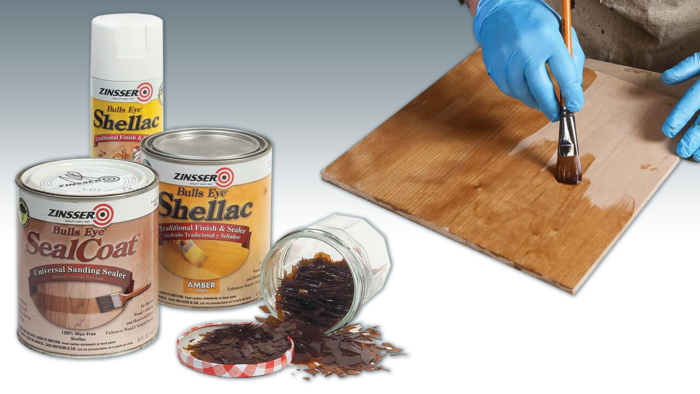
In the world of finishing, shellac is magic stuff. It is a natural product made by a tiny insect—the lac bug. It is harvested from trees and for centuries has been processed by hand into flakes and used for everything from pill coating to violin finishing. When mixed with alcohol it forms a coating that will stick to almost anything, and in turn allow almost anything to stick to it.
A thin “washcoat” of shellac is still the preferred first application for many finish schedules, as it can seal in contamination or oil and provide a secure base for layers of colors and topcoats. And it can seal or lock in layers of color when used for decorative effects or color matching. It is commonly available in three forms: dry flakes (which must be mixed with alcohol); premixed liquid most widely available from Zinsser as Clear, Amber, or Seal Coat; and an aerosol spray. The colors can vary from light to dark, and the product can contain naturally occurring wax or can be dewaxed.
So far there are no synthetic formulations that can duplicate these magical properties, but shellac is not perfect. It is susceptible to damage from alcohol and heat, so a whisky glass or a lasagna pan left on a table will leave a mark. However, shellac is also very easy to repair, as new shellac will chemically bond to old shellac almost indefinitely, and being a natural product, it is totally food and kid safe. Shellac can work with other finishes or stand alone, and it is available at box stores, hardware stores, and online. It is one finish that should be part of every furniture maker’s tool kit.
From flakes to liquid
Sold online, shellac flakes vary in color from super-blonde (the lightest) to garnet (the darkest) and can be waxed or dewaxed. Blonde shellac goes on clear, while the darker colors give the wood a richer tone. When mixing shellac from flakes, use a coffee grinder to create a fine powder, which will shorten the time for the flakes to dissolve.


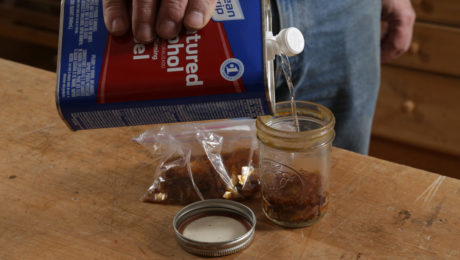
Then add alcohol. Denatured alcohol (sold as fuel) works fine, but pure grain alcohol from the liquor store (Everclear) works better and, unlike denatured alcohol, has no toxic ingredients. The ratio of flakes to alcohol is flexible and forgiving, but the consistency should be thinner than house paint or varnish. With flakes, start with a mason jar half full of flakes and then fill it with alcohol. With ground flakes, start with one-third of a jar of ground shellac before filling the jar with alcohol.

Out of a can
The Zinsser canned shellac products Clear and Amber are formulated as “3-lb. cut” and contain wax. Seal Coat is a 2-lb. cut and is dewaxed. The “cut” is a simple measure of the amount of shellac flakes by weight to the amount of liquid alcohol, so 2-lb. of shellac in 1 gal. of alcohol is a 2-lb. cut.


In order to create a wash coat for bare wood or a light sealer coat between layers of color and finish, simply add an equal amount of alcohol to the canned shellac, which will result in a 1-1/2-lb. cut for the Clear and a 1-lb. cut for the Seal Coat. Either of these will dry super-fast and leave a very thin, quick-drying film that will form one continuous coat no matter how many times more shellac is applied.
Make your own dewaxed shellac
Whether you mix your own shellac or buy a premixed product, it is likely to contain some wax, a natural part of the lac bug’s secretions. If the wax is not removed, it could cause adhesion problems with some finishes or paints. For most applications, the wax is not an issue, especially if it is well stirred. However, you can create dewaxed shellac by letting the mixture sit for a week or two and then siphoning off the shellac with a turkey baster, leaving the wax behind.


Color coordinating
Because shellac is a natural product, batches vary from year to year and place to place depending on the weather and what the bugs are eating. It is possible to get dry flakes that are very pale or “blonde” and in a range of amber colors all the way up to claret red. For many years, skillful artisans have used the natural colors of shellac for touching up or painting in grain lines in furniture repair, or to simulate the effects of age.

It is now possible to use concentrated liquid dyes like TransTint to create virtually any color by simply adding a few drops to the liquid shellac. The possibilities are truly endless.


Brush it on
When brushing shellac, it is tempting to load up a large square-edged paintbrush, but this leads to brush marks and “fat edges” because the coating dries so fast.

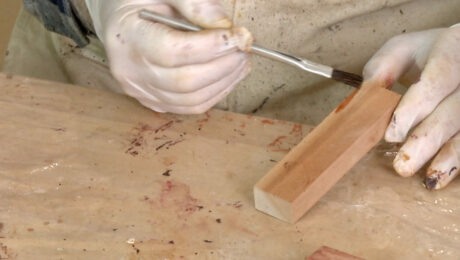
A great technique is to use a small rounded brush called a Filbert mop, which holds only a small amount of shellac. With short, quick strokes and good planning, it is possible to create a smooth, consistent coating even on a large surface.

For larger surfaces, a good-quality varnish brush with neat tapered or flagged tips can be used effectively with thin shellac, applied with the very end of the brush only.

As a bonus, shellac brushes do not have to be cleaned. After use, gently wipe most of the shellac off the brush with a cloth and let it harden. Then just dip the brush in alcohol for 15 to 20 minutes before use and it is ready to go.

A final finish
Building applications of shellac can be done in rapid succession until the point where the film becomes gummy and sticky. At that point, allow the shellac to rest for a few hours. More applications can then be added, all of which will form one chemically bonded “coat.”

There is no need to sand between applications unless there is dust or debris, and when the film is dry, 220-grit or 320-grit sanding will usually resolve it. The thickness of the final film depends on the pound cut of the shellac and the brushing technique, and wear surfaces such as tabletops need more protection than aprons or legs. Five or six applications are needed for a wear surface and perhaps only one or two for legs or the interior of drawers. You can do a final buffing out with 0000 steel wool and wax.

Pad it on
There are also ways to wipe on or apply shellac with a pad that are generally known as French polishing. These require skills that take time to develop. True French polishing involves a rubbing pad charged with shellac and alcohol that is pushed hard on to the surface, creating friction that literally grinds the shellac and wood dust into a super-thin, super-clear mirror finish.

Make a pad by filling a lint-free rag with cotton. Twist the pad closed, and charge it with alcohol, saturating the pad. Pack the pad against your palm to flatten it, and then saturate it with shellac. Pad the shellac onto the wood in straight or figure-8 motions, adding more shellac to the pad as needed.

It is possible to simulate that mirror-finish effect with numerous brush applications, which when fully dry can be gently abraded at 400-grit to 800-grit or even finer, and then waxed or polished.
Spray it and forget it
There is only one commercially available aerosol shellac product, which is made by Zinsser. It can be used to seal contamination or oily wood, it can condition end grain so that it does not absorb too much color, and it excels at sealing in spot repairs like wax fill sticks. It can also be a very effective final finish for small projects and for pieces that will need to be repaired or refinished.

You can also use gel stain and spray shellac to harmonize the color contrast in a single piece of wood. Paint the gel stain onto the light areas, spray the shellac over it to melt the gel stain into the shellac below, and blend with a brush while both finishes are still wet.


Mike Mascelli is an upholsterer and wood finisher with over 45 years of experience, specializing in period furniture and classic cars.
To view the entire article, please click the View PDF button below.

Fine Woodworking Recommended Products
Bumblechutes Bee’Nooba Wax
Ease of Use = Very good
Sheen = Very good
Appearance = Very good
Non-Yellowing = Very good
Water/Stain Resistance = Excellent

Bahco 6-Inch Card Scraper
The size and thickness are what matter here. A consistent performer, this Bahco scraper is found in many shops we visit.
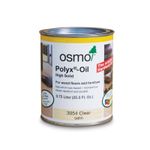
Osmo Polyx-Oil
“If I had to choose one of these hard-wax oils to keep on hand, it would be Osmo Polyx-Oil. It’s relatively affordable and very easy to apply.” -Adam Godet
Sign up for eletters today and get the latest techniques and how-to from Fine Woodworking, plus special offers.
Download FREE PDF
when you enter your email address below.


