

Creation Story of a Cabinet on Stand

View the 16-episode video workshop “Cabinet on Stand with Tim Coleman” here.
My love affair with cabinets began when I was a student of James Krenov at the College of the Redwoods in the 1980s. At the time, Jim had a bench in the corner of the classroom and did all his making there. Officially he taught twice a week, but he was at his bench most days working on his latest piece. As students, we worked at our own benches on our fledgling cabinets, while having a front-row seat to witness the master at work.
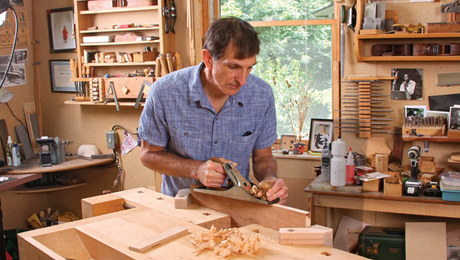
Two years ago when Fine Woodworking proposed shooting a video series of me building a cabinet on stand, I thought of Jim at his corner bench and the window we had into his process. There is a bit of theater to building a cabinet in front of a room full of people, and Jim seemed to know this. Was this video my own chance to offer a window as Jim did? Is there a performer in me? There was only one way to find out—I signed up.
In addition, I agreed to write an article exploring the inspirations, choices, thought processes, and missteps behind the build—the internal stories that shadow the customary how-to. This is it.
An elusive idea
Each cabinet I create is a unique sculpture, and like James Krenov, as I build I observe and respond to what’s happening in the process. This working method—“composing,” as Jim called it—puts the wood in the picture early in the process. As the wood reveals itself, it influences decisions. It has not always been easy for me to build in this uncertain way, and it has taken me many cabinets to learn to trust my intuition. But without an idea, and without the wood to carry it out, there is no composition.
The search for an idea begins in my portfolio. I have copious photos and drawings of pieces from my past, and this collection has become a sourcebook for ideas, a catalog of my preferences—woods I like, joinery choices, shapes, proportions, and style influences. We all have preferences, and the more pieces we create the clearer this becomes. So I search in my portfolio, hoping that somewhere in there the design for this next cabinet is hiding.
Take two
 |
 |
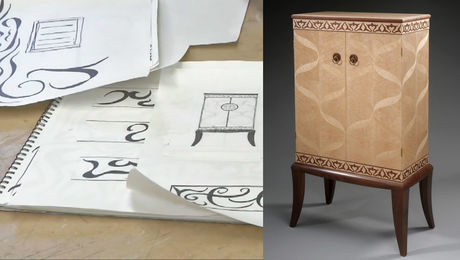
As I search, two cabinets captivate me. One is a fall-front cabinet on stand with fretsawn borders. The overall scale of the piece seems right for the new cabinet, and I like the proportions of the cabinet to the stand. It is an adaptable design, a case on a tall curvaceous stand, and the case offers a canvas for me to paint with veneer patterns.
Then there’s a chest of drawers, with a scroll-like crown suspended by posts above the main body of the chest. For years I’ve wanted to incorporate this kind of crown into a cabinet but never landed on the right design. I make a doodle of the crown atop the fall-front cabinet, and I see potential. I’m ready to begin.
I realize that it can sound like the design came to me as if I had been hit by a bolt of lightning. Far from it! This uneasy process took weeks of tumbling ideas in my head and going on many long bike rides as I tried to pedal my way to a vision of this elusive cabinet. Designing happens in my head more than on paper, and eventually something emerges.
Osgood’s wood: A good idea meets great material

Some years ago, the brilliant furniture designer and maker Jere Osgood felt he could no longer manage the intense work necessary to create his iconic furniture pieces. I knew Jere (who died at 87 in 2023) as a member of the New Hampshire Furniture Masters and was always inspired by his innovative designs and his humble and generous way.
A close friend of Jere’s, Ted Blachly, organized a sale of Jere’s vast collection of wood accumulated in more than 60 years of making. I bought as much as I could afford, and a little more: large slabs of claro walnut, curly maple, dousie, yew, partridge, wenge, mahogany, and two massive pieces of quartersawn figured cherry. All of the wood was beautiful, almost sacred because it came from Jere.

I hold the image of the new cabinet in my head and sort through Jere’s wood for possibilities. The thick cherry boards are enticing, but their wide quartersawn faces have a uniformity that keeps me from seeing their potential for decorative veneer work. I search some more, but the curly cherry keeps making its way to the top of the pile.
Tim Coleman works wood in Shelburne, Mass.
|
From Fine Woodworking #325 To view the entire article, please click the View PDF button below. |
 |
Fine Woodworking Recommended Products

Blum Drawer Front Adjuster Marking Template
This template acts as a “dowel center” for punching a hole to mark where to drill fro clearance holes.
Sign up for eletters today and get the latest techniques and how-to from Fine Woodworking, plus special offers.
Download FREE PDF
when you enter your email address below.


