
The Allure of the Wall Cabinet: Irish Elm, Mahogany, and French Walnut

For me, design is about more than the physical object; it’s about the experience. Shadows, lines, edge profiles, and textures all contribute to a piece’s depth and character. How a user interacts with the piece, how a drawer opens, or how a door reveals its interior adds another layer to the design. My goal is to create pieces that invite exploration, blending function with artistry to create objects that feel alive and timeless.
My journey as a designer began with formal training in industrial design, but I eventually moved away from that field. While industrial design equipped me with valuable technical skills, I found it unfulfilling due to the ethical dilemmas associated with mass production and a disposable consumer culture. These concerns drove me toward a more sustainable approach to design—one that is deeply connected to materials and craftsmanship.
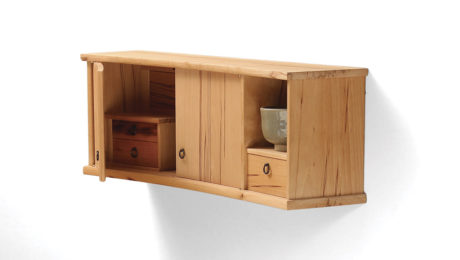
Quartersawn Irish elm cabinet

The design is intentionally understated, with clean, simple lines across the front. This restraint allows the remarkable character of the timber to take center stage, inviting the viewer to appreciate the natural complexity and beauty of the wood. The dramatic figure possesses an almost three-dimensional quality. Its depth and movement continually reveal new details as the light changes. Comprised of three doors and one drawer, this cabinet appears as one seamless piece, but it is four separate carcases carefully joined to form a single cabinet.
Loosen your grip, embrace the possibilities
Initially, my education focused on learning the stages of the design process: generating multiple initial concepts, followed by research, analysis, technical drawing, and rendering techniques—all before the advent of CAD software. I was trained to create precise, detailed plans and to use workshops to craft physical mock-ups of my designs. However, my personal approach has evolved significantly since then. Today I rely very little on detailed drawings. Instead, I make small, quick sketches—simple visual reminders of a concept or idea—leaving much of the design open to exploration and adaptation.
A defining feature of my design process is its fluidity. I intentionally avoid committing to rigid ideas too early, creating space for changes and unexpected developments. This flexibility fosters creativity, letting the materials themselves guide the process. The arrangement of patterns, the selection of complementary materials, and the interplay of textures and colors are all central elements in my work. I believe that the materials hold inherent creative potential, and by letting them inspire me, I am able to create designs that feel like a tribute to the material itself.
Reclaimed mahogany cabinet
This cabinet is made entirely from reclaimed wood salvaged from an Edwardian chest
of drawers. After rescuing the original piece, the clients used it for a number of years before asking Hartung to rework the materials into something new.
As a reference to the original piece, he used design motifs from the Edwardian and Georgian periods, such as the cross-banded veneers on the front edges, while utilizing the crotch figure on the two pivot-hinged doors. A strong feature of this piece is the use of chatoyancy—the way light playing across a surface from different angles can change wood’s color depending on the direction of the grain. The drawer sides are Spanish chestnut, also salvaged from the original piece.
Wall cabinets captivate
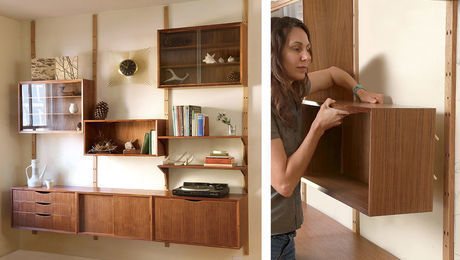
Wall cabinets are the form I return to most often because they exist somewhere between furniture and painting. Hung on the wall, they invite a quiet, contemplative encounter before they are ever opened. I begin with the language of the wood itself—the movement of grain, shifts in color, the meeting of shadows and lines—composing these elements much as a painter might arrange forms on a canvas. Yet, unlike a painting, the cabinet conceals another dimension. The opening of a door, the discovery of space within, creates a gentle dialogue between the two-dimensional surface and the hidden depth behind it.
Working on a smaller scale also allows me to use rare and unusual selections of timber. Through including a combination of saw-cut veneer and solid wood, even a very small piece of extraordinary timber can become central to an entire cabinet. The intimate scale also permits a greater intensity of workmanship, a level of refinement and detail that becomes far more difficult to sustain across the expanse of larger furniture. I find these restrictions creatively liberating; the boundaries of the wall cabinet become an invitation to creativity, playfulness, and the quiet enjoyment of interacting with an object.
Rippled French walnut parquetry cabinet

The driving inspiration behind the parquetry arrangement on the front of this cabinet was the gradation from light to dark walnut and all the shades in between. Because the positioning of handles can make a huge visual difference, Hartung went through various options in placing the handles. After a few experiments, it also became clear that any finish at all—oil, wax, or shellac—would change the color to the detriment of the piece, so Hartung opted not to apply any finish to the front.
Stevan Hartung works wood in Wicklow, Ireland.
|
From Fine Woodworking #325 To view the entire article, please click the View PDF button below. |
 |

Fine Woodworking Recommended Products
Circle Guide
If you like to draw your designs on paper, you’ll find the simple circle guide to be very helpful.

Sketchup Class
If you’re ready to jump into designing with CAD, this is a great place to start.

Drafting Tools
Add a hole guide to this kit, and you’ll have the tools you need to work out your designs with scale drawings.
Sign up for eletters today and get the latest techniques and how-to from Fine Woodworking, plus special offers.
Download FREE PDF
when you enter your email address below.


