

A Treadle Lathe for the 21st-Century Shop

This summer I visited my friend Joel Moskowitz at Tools for Working Wood in Brooklyn. The company occupies a two-story industrial space at 112 26th Street in Sunset Park, not far from Brooklyn’s working waterfront. The storefront and showroom are at the front, while much of the company’s production takes place behind them. The building itself has an appropriate history: More than a century ago it housed Joshua Oldham & Sons, a manufacturer of saws and sawmill blades.
Upstairs is Joel’s experimental domain—part design studio, part research library, and part inventor’s workshop. It is where ideas drawn from old tools, manufacturing history, and contemporary engineering are investigated, tested, modified, and sometimes developed into new Gramercy Tools products.

On this visit, Joel showed me the company’s most ambitious project yet: the Gramercy Tools Folding Portable Treadle Lathe.
An old machine reconsidered
Before electric motors became commonplace, turners powered their lathes in several ways. Pole lathes used a springy pole, cord, and foot pedal to rotate the work during the cutting stroke and then return it in the opposite direction. Treadle lathes added a crank and flywheel, producing continuous rotation without requiring either electricity or a second person to turn a great wheel.

By the 19th century, treadle lathes were made in many configurations for turning wood and metal. As compact electric motors became widely available during the early 20th century, however, foot-powered machines largely disappeared from commercial workshops.
Joel’s new lathe does not attempt to reproduce one particular antique machine. Instead, it asks a more interesting question: What might a treadle lathe look like if it were designed today, using modern materials, bearings, fittings, and manufacturing methods?
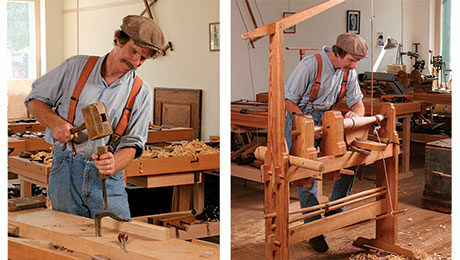
The result is a full-size lathe built around a welded aluminum frame and a substantial cast-iron flywheel. It has a 13-in. swing and 30-3/4 in. between centers, so this is not a demonstration model or historical curiosity. The headstock and tailstock accept No. 2 Morse-taper accessories, and the spindle has a standard 1-in.-8 thread for commonly available faceplates and chucks.
The lathe weighs 87 lb., much of it concentrated in the flywheel. That weight is intentional. Once the wheel is rotating, its stored momentum carries the work through the cut and helps smooth the pulses delivered by the operator’s foot.
A lathe that makes room for itself
The defining innovation is its folding frame. Joel had been thinking about a treadle lathe for approximately 15 years, but one obstacle kept returning: space. A conventional lathe, whether powered by a motor or a foot, demands a permanent footprint. That can be difficult to justify in a small shop and almost impossible in a New York apartment.
If the lathe were to be useful to people with limited space, it would have to fold. Just as important, setting it up and putting it away could not become an elaborate ritual. A machine that is troublesome to unfold will eventually remain folded.


The development process became far more involved than Joel initially expected. Nearly three years of concentrated work produced several prototypes. The team showed an early version at Handworks in Amana, Iowa, in 2023, where many visitors tried it and offered feedback. It also suffered a dramatic failure in its treadle assembly. That failure helped reveal how much force was traveling through the drive mechanism and led the team to replace numerous bolted connections with welded ones.

The production machine represents the work of several people. Joel originated and directed the project, while engineer Kris Pastuszka designed the folding mechanism and many of its details. Shop supervisor Naomi Baxter and Joel Sena oversee the manufacture of the numerous parts produced in Brooklyn, and professional turner and instructor Alan Dorsey contributed practical turning advice during development.
When the work is finished, the machine folds without being completely dismantled. Folded, it remains approximately 47-1/2 in. long and 23-1/2 in. wide but stands only about 18 in. high after the tool rest and tailstock are removed. Wheels allow the folded machine to be rolled into storage or stood vertically against a wall. 
The lathe is made in the United States, although some components—including the cast-iron flywheel, bearings, and fasteners—are imported.
Learning the little dance
Operating the lathe introduced me to a new form of coordination. The foot pedal—what we generally call the treadle—slides along the frame so it can be positioned beneath the area where the turner is working. This is especially useful when moving along a long spindle. The operator can also treadle with either foot and switch legs when one gets tired.
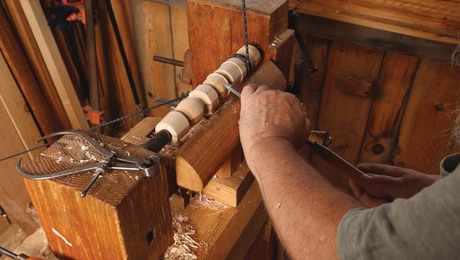
Starting the machine requires positioning the crank correctly and giving the pedal a deliberate downward stroke. Once the flywheel begins revolving, you settle into a sustainable rhythm. At first I had to think about the position of the crank, the movement of my foot, the speed of the work, and the tool in my hands. Within a minute or two, the treadling began to feel natural.
The closest comparison is learning to ride a bicycle or operating an old treadle sewing machine. My grandfather taught me to use one of those sewing machines, so the coordination felt familiar. There is an initial moment when the movements seem to compete for your attention. Then the body understands the sequence, and the repetitive motion recedes into the background.
The lathe has two speed ranges, selected by moving the drive belt between the stepped paths on the flywheel and headstock pulley. Most spindle turning is done in the higher range, while the lower range provides more torque for larger-diameter work.
You can use familiar turning tools, but an electric-lathe turner must adjust expectations. The treadle lathe operates at a lower speed and has only a fraction of the power of a motorized machine. Sharp tools and lighter cuts are therefore particularly important. If the edge is dull or the cut too ambitious, the machine tells you immediately—not by drawing more current, but by slowing beneath your foot.
Traditional carbon-steel and modern high-speed-steel tools can both be used, as can contemporary carbide tools. Nevertheless, the traditional cutting tools seem especially well matched to the machine because a sharp, finely honed edge removes wood with less resistance.
Who is it for?
At a listed price of $3,900, the Gramercy lathe is not inexpensive. Shipping will also be considerable because its packed weight is approximately 95 lb. It would be misleading to present it as a budget substitute for a small electric lathe.
Its appeal lies elsewhere.
This machine is for woodworkers who savor quiet work, physical participation, and the connection between a tool and the body operating it. It offers a way to experience an earlier form of turning without having to build a historical reproduction or dedicate permanent floor space to it. It may appeal to hand-tool woodworkers, apartment dwellers, historical demonstrators, schools, and turners who want a markedly different relationship with their work.
Using it engages more than the hands and eyes. One leg supplies power while the other supports and balances the body. The operator controls not merely the cut but the energy entering the entire system. Slow the treadling and the work slows. Increase the rhythm and the flywheel responds. The machine never separates the source of power from the person making the object.

The result is both traditional and unmistakably contemporary. Its principle belongs to the pre-electric workshop, but its execution could only have come from designers and makers with access to modern aluminum fabrication, precision bearings, standardized lathe accessories, and years of accumulated knowledge.
For me, the most compelling part of the experience was not nostalgia. It was the realization that a machine powered by muscle need not be primitive, and a modern tool need not isolate its operator from the work. Joel and his team have produced a rare synthesis: an old idea made practical for a new generation of small shops.
And unlike an exercise bicycle, when you step away from this machine, there may be a bowl, a tool handle, or a chair spindle waiting for you.
Special thanks to my friend Thiago Endrigo Silva for filming the short videos of me turning on Joel’s lathe.
Sign up for eletters today and get the latest techniques and how-to from Fine Woodworking, plus special offers.


