

The Allure of the Wall Cabinet Part: Bog Oak, Yew, and Holly

In the beginning
Every project begins with one or two foundational ideas, often very subjective and specific to each piece—an initial spark or point of inspiration that acts as an anchor for the design—and the rest of the ideas evolve around it. While other details may shift and evolve, these core principles remain constant. For example, I may decide to use pronounced shadow lines and a textured surface, forming two of the driving ideas behind the piece.
I work very directly with the materials, letting their inherent qualities influence the shaping, finishes, and overall design. The nature of the wood—whether it has a fine or open grain, a distinctive figure, or unique colors—determines how it is used. For me, design and making are inseparable, with decisions about form, function, and aesthetics unfolding throughout the creative process.
A significant amount of my design work happens through observation—standing and looking at the wood or components, imagining their potential. If I create a mock-up, I prefer to use the actual components of the piece, cut oversize, rather than using a different material. Working with the intended materials ensures that the conclusions I draw are accurate and applicable. Occasionally I will draw a design at full scale on a drawing board, but this is rare.
Yew burr cabinet
Inspired by the Japanese tradition of kintsugi—repairing and honoring breaks this piece embraces the natural character of the yew. It’s a beautiful but delicate timber, often marked by inclusions. The cabinet embraces 23 patches that have become an integral part of its evolution and design.
 |
 |
Irish wild cherry cabinet
The wood for this piece came from a storm-felled tree in County Carlow. It has an unusual feature known as a pigment figure, which is characterized by streaks of color independent of the growth rings. A figure like this can be overpowering in a design, so Hartung spent many hours finding the right combination of color and pattern to maintain a subtlety that complements the overall geometry of the piece.
 |
 |
Bog oak parquetry cabinet
| Made from 5,000-year-old quartersawn bog oak, this cabinet highlights striking medullary rays and a subtle palette of tones: deep blacks, warm browns, and hints of silver.
The parquetry involves a slow, intuitive process of carefully arranging saw-cut veneers while avoiding symmetry and obvious patterns. The approach allows motifs to emerge naturally, adding depth and intrigue to the piece. The cabinet is hand-planed, scraped, buffed to a soft sheen, and left without finish. |
|

Bog oak cabinet
This cabinet marks Hartung’s first use of bog oak, after which he fell in love with the material. He realized that applying any finish would destroy the subtlety of the extraordinary silvers and grays in the wood, and he discovered that hand-planing followed by burnishing the wood with a cotton cloth gave it an exceptional sheen without the need to apply any finish.
 |
 |
Holly cabinet with crab-apple drawer sides
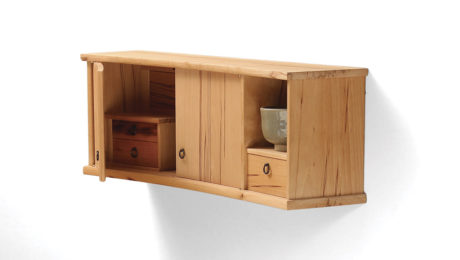
This was the first in the series of hedge-wood cabinets Hartung made for the National Museum of Ireland’s permanent collection of craft and design. One of the notable qualities of holly is its very white color and its nearly complete lack of figured grain. Instead, it is dense and hard, with a bonelike quality or the feel of unglazed porcelain. Hartung wanted to preserve that distinct trait in this piece, focusing on texture and shadow lines instead of relying on patterns in color or grain.
 |
 |
Design carries into the building process

Design doesn’t stop when the making begins; it continues throughout the building process. Decisions about finishes, edge profiles, and even the mechanisms for opening a door or drawer are all integral to the design. These choices affect not only the visual and tactile qualities of the piece but also its interaction with the user. I strive to create an element of intrigue, encouraging curiosity and exploration in those who engage with my work.
This is part two in a two-part series. Read part one here.
Stevan Hartung works wood in Wicklow, Ireland.
|
From Fine Woodworking #325 To view the entire article, please click the View PDF button below. |
 |

Fine Woodworking Recommended Products
Compass
An essential tool for drawing circles and curves accurately. Also good for layout.
French Curves
An essential for drawing and designing with curves.

Stanley Powerlock 16-ft. tape measure
With its smooth lock, tough case, compact size, and excellent accuracy, this Stanley tape is perfect for workshop use.
Sign up for eletters today and get the latest techniques and how-to from Fine Woodworking, plus special offers.
Download FREE PDF
when you enter your email address below.


