

Build a Contemporary Plant Stand

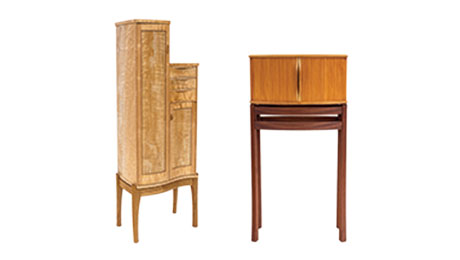
When I designed this plant stand, I wanted to accentuate its verticality, so I made the legs long and kept the table surface fairly small, allowing the plant to continue the upward movement of the piece. The shape of the legs was at the heart of the design. Years ago, while I was a student at the College of the Redwoods studying under James Krenov, I was attracted to a piece he had made that had five-sided legs. The fifth side of those legs projected out diagonally from the corners of the cabinet, giving the piece an engaging, satisfying stance. I adapted that leg design for my plant stand and emphasized its importance by running the legs right up past the table top and notching them to receive the top.

Wood and grain selection
I chose a plank of black walnut for the stand’s legs and rails and for the bridle-joined frame of the top. For the top’s panel I used narra, a lovely species from Papua New Guinea that pairs well with walnut. I could have made a floating, solid-wood panel, but I opted for a veneered one, which allows a tight fit to the frame without the need to consider wood movement. If I had used solid wood, I would have needed a gap around the panel; that didn’t sound like a good idea, since dirt from the potted plant could get into that expansion space. I also preferred the crispness of the panel surface connecting directly to the frame.

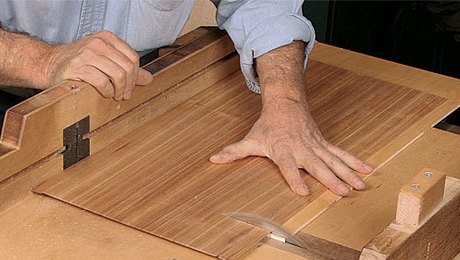
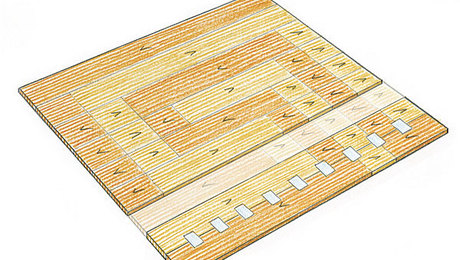
So I sliced the narra into thick veneers and glued them to a stable substrate. Cutting your own veneers and gluing up your own panels is surprisingly approachable and is quite a versatile furniture-making method.
When you lay out the parts in your plank, the legs are a natural starting point. For a traditional leg, a plank with riftsawn grain is a good choice, since it ensures that all four faces of the leg will have similar straight grain patterns. But with the five-sided leg, using true riftsawn grain may result in one of the leg’s faces being flatsawn. To avoid having the little Krenov on my shoulder give me the side-eye, I made a paper cutout of the leg’s cross-section and held it up to the plank’s end grain. After rotating the cutout until I could see I wouldn’t be getting fully flatsawn grain on any of the faces, I traced the cutout.
Leg and rail joinery

After you’ve determined where the legs will be cut from the plank, bandsaw them out, leaving plenty of margin around the layout. Then mill the leg blanks square, making sure that the two faces comprising the inner corner of the leg—where the mortises will be cut—are at 90°. To simplify the mortising, don’t cut the legs to their five-sided shape until all the joinery is cut and fitted. I cut the mortises using a hollow-chisel mortiser with a 3/8-in. hollow chisel.


The mortises for the upper rails are all at the same height, and they intersect. Their depth is important. You don’t want to cut them so deep that you remove the far wall of the intersecting mortise, which would reduce good glue surface. I set the depth of the mortiser so that a small amount of wood needs to be pared away with a chisel, leaving a straight wall for the long tenon cheeks. The lower rails are located at two different heights to add visual interest to the upper part of the base. This means that the mortises don’t intersect and the tenons can be full size, strengthening the joinery.

I cut the rail tenons on the table saw using a finger-joint blade set—a pair of square-ground blades together measuring 3/8 in. wide. This setup cleanly cuts the shoulders and cheeks at the same time. To maximize the glue surface of the upper rail tenons, miter their inner cheek. The miters can be cut on the bandsaw or with a handsaw.
Craig Vandall Stevens is executive director and principle instructor at Philadelphia Furniture Workshop.
To view the entire article, please click the View PDF button below.
Fine Woodworking Recommended Products
Suizan Japanese Pull Saw
A versatile saw that can be used for anything from kumiko to dovetails. Mike Pekovich recommends them as a woodworker’s first handsaw.
Sign up for eletters today and get the latest techniques and how-to from Fine Woodworking, plus special offers.
Download FREE PDF
when you enter your email address below.


