

From the Archives: An A–Z of Making and Fitting Drawers
This is an excerpt from Fine Woodworking #11, Summer 1978
Click here to read the full digitized issue.
With the exception of those who make only chairs, the makers of furniture are regularly called upon to produce pieces with one or more drawers. Often the design of the drawers must meet specific requirements. For example, a china cabinet usually has at least one felt-lined drawer with dividers; one drawer in a desk should have provision for pens, pencils, and other small supplies. Drawer exteriors may also demand special attention. A chest of drawers is a good example of a piece of furniture whose appearance depends on the proportions, shape, and material of the drawer fronts.
In this article I will look at what goes into making and fitting a drawer. The methods and recommendations given here apply to traditional, first-class work, and they involve handwork. For the large production jobs a shaper or router with dovetail attachments significantly reduces the time.
A drawer has a front, two sides, a back and a bottom. The front must match or complement the piece of furniture of which it will become a part, and therefore the wood is chosen mainly for appearance. The thickness of a solid front should not be less than 2 cm (3/4 in.) in order to have enough material for dovetails, and for a mortised lock if the customer wants one. As a rule the grain of the front runs horizontally. To do otherwise would result in a drawer which would have no strength without unusual measures to reinforce the joints. Moreover, the drawer front would undergo considerable dimensional changes caused by fluctuations in humidity.
These problems do not exist with plywood fronts, because the direction of the grain in the face veneers is of little consequence. Plywood fronts are often used in simple, modern furniture and in kitchen cabinets. To preserve the pattern of the face veneers, particularly when the grain is vertical, no rails show between the drawers. Because of this, and because plywood drawer fronts need a veneered top edge, their construction and fitting are quite different from solid-front drawers and fall outside the scope of this article.
The wood for the sides and back does not need to match the front. Ability to resist warping, to be hard-wearing and to finish nicely are the most important considerations. Depending on availability, ash, beech, birch, maple, oak, or sycamore can be used. Cedar, fir, pine, poplar, and spruce are less satisfactory because they do not stand up to hard wear. Sides are 8 mm to 12 mm (5/16 in. to 1/2 in.) thick, and the back has either the same thickness as the sides or a little bit more. The direction of the grain in a drawer side must permit you to plane it from front to back along the top edge and on the outside. If the grain runs the wrong way and the drawer sides cannot be planed from front to back, you risk damaging the drawer front when fitting the top edge or when the outsides of the drawer cleaned up after assembly. The second thing is that when a drawer side has any tendency to bow, it must be placed with the hollow side out. When the bottom is put into the drawer, the side will straighten automatically. If the drawer side curves out, binding will be a constant problem. Naturally, if the side has anything more than just a slight bow, it should be rejected.

The bottom is usually made of plywood, 3 mm to 6 mm (1/8 in. to 1/4 in.) thick. Heavier plywood may be used for extra-large drawers or when the weight of the contents is going to be excessive, although thinner plywood with a reinforcing center strip glued underneath it is preferred for better work. Birch and beech are good choices for plywood bottoms and they are readily available in several thicknesses. For first-class work, Douglas fir or poplar plywood should not be considered unless the bottom is lined. Convention dictates that the grain on the bottom run in the same direction as that of the drawer front. This means you have no choice but plywood when the drawer has a vertical front, since there is only one way a solid bottom can go in: with the grain running from side to side. The grooves for the bottom must be neither too tight nor too loose. In the first case, the bottom may force the sides apart or cause them to split; in the second, the drawer may rattle. It is also important that the width of the bottom be accurate, to ensure that the drawer remain square and that the sides stay straight. The bottom should be long enough to extend 2 mm to 3 mm (1/8 in.) beyond the back of the drawer, but not so long as to be even with the ends of the sides. If you should have to shorten the sides during the final fitting, you do not want to have to trim the bottom too.
Before plywood became available, and even after that but before it was accepted for high-grade furniture, drawer bottoms were always made solid. I see no advantages in using solid bottoms for contemporary work. But they are a must for certain reproductions if they are to appear authentic, and in the repair and restoration of old furniture when the original condition must be preserved or restored. A solid bottom requires a fair amount of work and it is not something that is highly visible or immediately apparent to an uninformed observer, and for that reason not appreciated.

Suitable timbers for solid bottoms are clear pine, spruce, fir, and basswood. If woolens are to be stored in the drawer, aromatic cedar might be considered. Preference should be given to quartersawn boards, and the wood must be thoroughly dry. You should aim for a bottom with maximum stability and maximum freedom from warping and cupping. The boards are edge-glued to obtain a width equal to the depth of the cabinet. The grain of a solid bottom must run from side to side, so that the shrinkage and expansion of the bottom can then be allowed for at the back of the drawer, the bottom can be glued to the front, and the sides will be kept square with the front because there is no movement of the bottom in that direction.
A thickness of 5 mm to 6 mm (1/4 in.) is good for most drawers if they are not too wide, but in repair work or in reproductions the thickness may have to be much more. When the original was made, thicknessing was done by hand, and the sawmill did not provide boards much thinner than 1 in. The bottom was made like a panel, with the center part left the full thickness and a border about 1-1/2 in. wide all around it planed down to 1/4 in. or 3/8 in. The flat side of the panel was placed on the inside of the drawer. The width of a solid bottom must be a perfect fit in the drawer. The grain runs in this direction, and this dimension therefore doesn’t change. The front to back length of the bottom (across the grain) must be such that at its driest the bottom is at least even with the backside of the drawer back, and that at the other extreme the bottom does not extend beyond the drawer sides. The bottom is screwed to the back with flat head screws. The screw holes in the bottom are elongated across the grain of the bottom, so that the bottom can move and still be held. This eliminates the danger of splitting (winter) and buckling (summer). The bottom must be glued to the drawer front with good-sized glue blocks. Do not glue the bottom into the groove at the front, because this would make future repairs very difficult. It is imperative that the bottom and the front be securely kept together, else the bottom will pull out of the groove when the wood dries.
Assembly
Assuming that all material has been chosen and cut slightly oversize, and all the components have been paired and marked (“Triangle Marking,” Fall ’77, p. 46–47), fitting and assembly can begin. Note the order, fitting comes before assembly.

Take the drawer front and plane the bottom edge. It must be made true and parallel to the top edge, and the height of the drawer front must be a perfect fit in the drawer opening. Square one end of the drawer front and place it in the opening to scribe the other end. It does not matter whether this mark is made on the face or on the inside of the drawer front, but cutting must be done on the face because cutting from the inside may leave the face rough. When the second end has been cut you have a front that fits the opening exactly. No force should be necessary to place the front in the opening, but there should be no clearance either at this stage.
The back is next. Its top and bottom edges must be parallel to each other. The distance between them, that is, the height of the back, is less than the height of the front. It is not possible to give exact measurements, but it is from 2 cm to 2.5 cm (3/4 in. to 1 in.) less. The bottom of the back must clear the drawer bottom when the bottom is slid into place, and the top edge is lower than the sides by about 0.5 cm (1/4 in.). This clearance at the top of the back allows air to escape when the drawer is being closed. Without it a well fitting drawer acts like a piston. The length of the drawer back must be the same as that of the front.
The drawer sides must have a true bottom edge, and the ends of the sides must be square to this bottom edge. The height of the sides is of no consequence yet, provided that it is more than is ultimately required: The sides should be just a little too high to fit into the drawer opening. The length of the sides is equal to the full inside depth of the cabinet (from the face of the front rail to the inside of the back) minus the 0.5 cm (1/4 in.) or so you leave in the drawer front for half blind dovetails. In a cabinet without a back, or whose back is not sturdy enough to act as a drawer Stop, measure to a rail or stop, securely fastened as close as possible to the back of the cabinet. Thus the drawer stops are always present, and fixed, and the drawer sides are fitted to these stops. It is a good practice to make the drawer sides as long as possible, even when the drawer itself is short. This is some insurance against a drawer being pulled out too far and falling on the floor, and the wear from the sides on the front rail is more even.
So now we have a perfectly fitting drawer front, a back exactly as long as the front but lower than the front, and two sides with straight bottom edges and square ends. Before putting these pieces aside, restore the pairing marks on the top edges where necessary. If the piece of furniture has more than one drawer, repeat the whole procedure for each drawer. One more thing remains to be done before the drawers can be assembled. A groove must be made in the drawer fronts and sides to receive the bottom. The reference line for this groove is the bottom edge of the drawer fronts and sides; that is, take measurements from this edge. The depth of the groove must not exceed half the thickness of the sides, and enough wood must be left between the groove and the bottom edge of the drawer to allow clearance and to support the bottom without danger of splitting the sides.
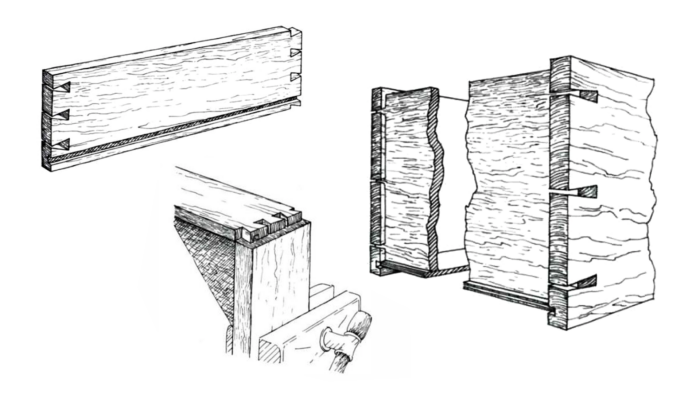
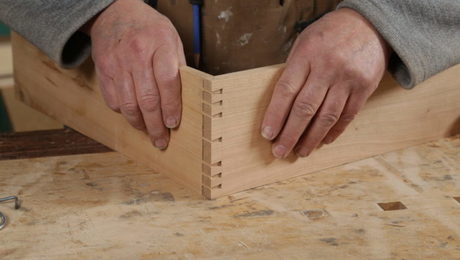
The next step is making dovetails at both ends of each side. The half-blind dovetails joining the drawer sides to the front should not present any difficulties (“Hand Dovetails, ” Spring ‘76, p. 28–32). On the other hand, the joint I use at the back might appear unconventional to some. The sides extend approximately 0.5 cm. (1/4 in.) beyond the back for a drawer as deep as the cabinet.

Because the dovetails extend beyond the back of the drawer, they look best when the tails are wide—almost touching each other-and the pins on the drawer back are small. The illustrations should make this clear. Dovetails are not practical at the back of shallow drawers with long sides. It is better to join the sides and the back with a sliding dovetail, in which the back is slipped into place from below, or let the back into a dado in the sides.

When all the dovetails have been cut, the location of the pins is marked on the drawer fronts and on the back. The bottom edges must be used again for reference, but because the grooves for the drawer bottom have already been made with the bottom edge as reference, the grooves can now be used to align the drawer sides, fronts and backs. Take a small piece of the plywood you intend to use for the bottom, insert it in the grooves of both the drawer front and its mating side, and the two pieces will be correctly aligned and will stay that way while you scribe the pin locations. The drawer back has no groove but it can be held against the piece of plywood to align it with the sides.


I do not dry-fit dovetail joints. They are too easily damaged in fitting, with a subsequent loss in accuracy in the final joint. By holding one piece on top of the other it is not difficult to judge the fit, and it is entirely possible to obtain perfect results without actually assembling the joint first.
One more observation before we return to making drawers. Many workers divide a space in equal pans when laying out dovetails. This results in half-pins that are often too small. Dovetails depend for their strength on a wedging action. If the two outside dovetails are too close to the edge, not enough wood is left to keep the joint tight and closed under all conditions. Severe strains on the joint may even cause a split to start at the half-pins. The answer is wider half-pins. They can be achieved either by making the two outside dovetails a little narrower than those in the center, or by setting out the half-pins first and then dividing the remaining space evenly.
With all the dovetails made and ready to be glued up, now is the time to clean up the insides of all the pieces, and varnish or paint them if you are so inclined. Finally the drawers can be put together. Care must be taken to keep them square while the glue is drying.
If you take a board or a piece of plywood, 2 cm (3/4 in.) or more thick and a little bit longer than the width of your bench, and put this across your bench, you have a good support for the drawer when you are planing the outsides clean. The board must be secured to the bench, and if the inside of the drawer is already finished, the overhanging end of the board must be covered with cardboard or cloth. Clean up the outside of the drawer, and you are ready for the bottom. Some workers like to have the bottom in the drawer when they work on the sides, but leaving the bottom out is more satisfactory because it allows much better support. The drawer looks best when the bottom is just long enough to extend to the outside of the drawer back, or maybe 2 mm or 3 mm (about ⅛ in.) beyond that. It should not be quite as long as the drawer sides. When the bottom has been sanded and finished, it should be inserted and screwed to the back of the drawer. This is a first-class drawer and nails simply won’t do. If the bottom is plywood, use two or three flathead screws, countersunk. If it is solid, use screws in slots to allow for movement.

Some workers like to put glue blocks on the underside of the bottom along the drawer front and sides. Glue blocks are made out of square material about 8 mm (3/8 in.) on a side and are approximately 5 cm (2 in.) long. Two of the long surfaces are coated with glue, and the block is rubbed back and forth a few times in the desired location. The rubbing will distribute the glue evenly, and if you do it right, there will be so much suction that it quickly becomes impossible to move the block. Clamping is not necessary. I believe that glue blocks are not necessary when the stock is dry and free from defects. But if there is any doubt that the drawer front or sides will stay flat and straight, glue blocks provide peace of mind.

The sides of the drawer are still too high. The height of the drawer front should be scribed onto the sides, and the top edges should be planed down to make them even with the drawer front. If you did everything right, you now have a drawer that fits tightly in the opening, more so in height than in width. This is because the height has not been changed since fitting the drawer front, but the width has been slightly reduced by cleaning off the outside dovetail joints. The reduction is hardly noticeable, but it provides just the clearance the drawer needs across its width. Clearance in height is obtained by taking one shaving off the top edges of the front and the sides. This is probably all you need to produce a drawer that fits well and moves freely. If you think the drawer is still too snug, take off one more, very light, shaving, but only after you have rubbed a candle along all the edges and tried the drawer once more. Paraffin is also good to make the drawer slide better, but beeswax or other sticky substances should not be used because they attract dust.
The length of the sides can now be checked. Where the drawer front is going to be in relation to the front of the cabinet is determined by the length of the drawer sides, because the drawer stops are already in place. The front of the drawer can be flush with the cabinet, in which case you should not have to do anything to the drawer sides. A front recessed not more than 1 mm (a fat 1/32 in.) often looks better than a perfectly flush front.
If a recessed front is desired, the sides must be shortened by 1 mm or less. For those who have not yet been exposed to the impending metric system, your thumbnail is about 1 mm thick. As a finishing touch, slightly break the sharp edges of the drawer, give the last 2 cm or 2.5 cm (1 in.) of the top edge of the drawer sides a slope to correspond to the slope of the dovetails, and chamfer the protruding dovetails at the end of the drawer sides.

A drawer with a molded front is made as described above, with one difference: The dovetails joining the sides to the front are through dovetails, and the length of the sides is equal to the depth of the cabinet minus the thickness of the molding. The molding is not applied until the drawer has been fitted and all adjustments have been made. The molding covers the exposed dovetails in the drawer front. This type of drawer is reserved for more traditional work.

A drawer with an overlapping front must fit perfectly when assembled, because the oversized front makes subsequent planing impossible. The rabbeted part of the drawer front must fit in the cabinet with just the right degree of clearance, and the drawer sides must also be the right height before the drawer may be assembled. They can be planed and checked in the opening before assembly. It is somewhat more difficult to give this drawer a perfect fit because of its construction. On the other hand, the very feature that makes fitting difficult, that is, the overlap, also conceals a less-than-perfect fit. The stock for this drawer front should be thick enough to permit dovetails 12 mm to 15 mm (1/2 in. or more) long, with enough left for an overhang that is not going to break the first time the drawer is closed. Although this type of drawer does not seem to need stops, it is highly recommended that the ends of the sides, not the overlapping edges of the front, take the impact on closing.
A completely different way of making an overlapping drawer is to make a flush-front drawer first. The overlapping front is a separate piece attached after the drawer has been fitted. When this method is used it is imperative to have stops behind the ends of the drawer sides. If this is not done, chances are that the separate front will sooner or later become a separate front in a very literal way.

Sign up for eletters today and get the latest techniques and how-to from Fine Woodworking, plus special offers.


