

Making a Sewing Box – FineWoodworking

Synopsis: Israel Martin’s sewing box demonstrates how leftover materials can be transformed into a practical, aesthetically pleasing personal project. Martin combines careful hand-tool techniques, creative use of wood species, and thoughtful design to create a unique thread-organizing box that balances function, beauty, and clever spatial design.
Recently, between building furniture commissions and teaching in my shop, I decided that it was time to make something for myself. I wanted it to be something that wouldn’t take too much time and that could be made largely with leftovers from other jobs. What would it be?

I love going to the mountains, whether near where I live in northern Spain or elsewhere, and I really like the backpacks and other gear used in climbing and mountaineering. A few years ago I got a sewing machine and started making my own climbing gear. For furniture making, I use hand tools and solid wood, but my sewing process is the opposite of that. In this endeavor I use machines and almost no natural textiles, which is a refreshing change. I soon accumulated quite a collection of sewing threads and tools. What about a box to organize all that stuff?
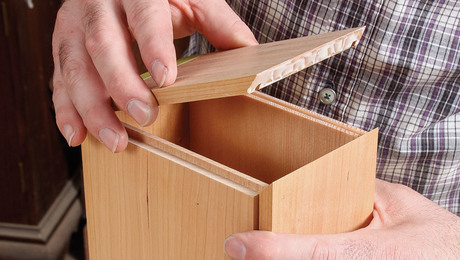
As for the design, I wanted a compartmented container that would hold everything and separate the spools by color, but I didn’t want it to look like a sewing box. I also wanted to challenge myself to make two boxes that would have a piston-fit inside a third, larger box. Although I wanted the inner boxes to fit nicely inside the outer box, I didn’t design them to rest right on the bottom. Instead, I elevated them on ledgers, giving me a shallow space beneath them where I keep scissors, fabric cutters, and other thin or flat items. With its straight simple lines and crisp joinery, the design also owes something to Matt Kenney’s work, which I admire.
The outer box
Because I always use hand tools in my work, from dimensioning rough lumber to the finished product, I prize my cutoffs. When I can use leftovers in a new piece it greatly speeds up the process, since the scraps are already flat and square and a lot closer to final dimensions. In addition, I don’t have to explore a raw plank looking for the best grain; that has already been done.

The outer box is made from a piece of quartersawn chestnut left over from making a tool cabinet. I started the sewing box by planing some of that chestnut and sawing it to thickness. While resawing the piece, I realized it was time to sharpen my Disston D8. I like sharpening this 5-1/2-ppi saw because its big teeth mean that when it’s sharp, it’s super fast. After sawing all the carcase pieces, I planed them again and cut them to final length. Then the fun part began: making dovetails. Chestnut is a really nice wood to work with, soft like pine but with shorter grain, and cutting joinery in it is a real pleasure.
I always start with the tails. After making the tails, I cut the grooves for the bottom: through-grooves on the pin board with a plow plane, and stopped grooves with chisels and a mini router plane on the tail boards. I used the groove to help align the boards as I transferred the tails to the pin board.
For the bottom of the outer box I used a piece of mahogany—for its stability and because it was a wide, flatsawn piece. After planing it, I cut bevels on the underside, reducing the thickness to fit into the grooves in the sides.
| From Fine Woodworking #323
To view the entire article, please click the View PDF button below. |
 |


Fine Woodworking Recommended Products
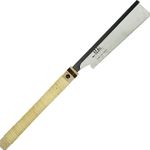
Suizan Japanese Pull Saw
A versatile saw that can be used for anything from kumiko to dovetails. Mike Pekovich recommends them as a woodworker’s first handsaw.
Sign up for eletters today and get the latest techniques and how-to from Fine Woodworking, plus special offers.
Download FREE PDF
when you enter your email address below.


