

Michael Puryear’s Quiet Observation – FineWoodworking
For me, design is the result of observing things in the natural and man-made worlds. I aim to look with “a quiet eye,” which to me is looking with curiosity and without judgment—not needing to name or identify something, but appreciating it as a form that catches my eye. It’s important to notice these forms that attract you and mentally store them away until they feel appropriate for a piece.
These observations may contribute to an idea for a whole piece or a detail within a piece. I originally used a sketchbook to remind me of the things I had seen. Now I simply remember them. I don’t recommend using a camera. Sketching separates the thing from its surroundings, allowing it to be observed independently, while a photograph locks the element in its environment.
Three components are involved in making something: the concept, the material, and the technique. The concept, which is what I’m focusing on here, is the first element—what the thing will look like, the design. Function plays a part in the concept. At times it drives the concept, but at other times it might take a back seat. The material is what the piece is made of, and the technique is the process used to achieve your result.
Once I have a clear idea in my mind of what the piece will look like, I do a loose sketch. Then I create an orthographic drafting on a large enough sheet of paper to have three views in scale: a front elevation, a plan, and a side elevation. From this it is possible to create a model by making several copies of the drafting and then cutting out the three views, gluing them onto materials of approximate thickness with a light coating of spray adhesive (so they can be easily peeled off). I cut out those shapes and attach them to each other with hot glue. I carve any parts that need to be three-dimensional, such as legs. I draw on details such as knobs. This gives a sense of the piece in three dimensions, which may also be helpful for your client to envision the final piece.
Only after I have the concept fully resolved do I move on to finalizing the materials and starting to build.
Reminiscent of Japanese swords

While in Brazil helping with the installation of his brother’s exhibition at the São Paulo Art Biennial, Puryear received a commission for this bubinga bench. The client had requested a bench she could use to put her stockings on. Its seat is upholstered in leather, and the rails and stretcher, inspired by Japanese swords in their scabbards, are curved to maintain unity with the rest of the curvilinear parts. The legs are elliptical forms loosely reflecting paired Yoruba steel gongs.
The round table

This ash table, bleached on top and dyed below, was built for a New York City apartment with a large foyer that serves as an entrance but also as a dining area. The location and function informed the design. For formal use, the table would stand at the center of the foyer; for everyday use, however, it was to be placed by a corner that projects into the space. Puryear designed this piece so that a quadrant of the top could be removed and the table fitted against the projecting corner.
Design by joinery


These chairs, with their distinctly Scandinavian feel, can be used separately or joined together, with or without arms. Inspired by the book The Art of Japanese Joinery by Kiyoshi Seike, Puryear used a kashigi-ōire joint (a notched mortise and tenon) to connect the rear brace to the back post.

Arches and the weight of color

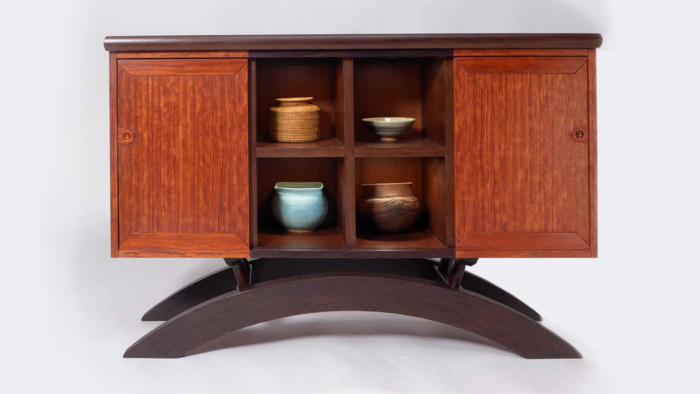
One of Puryear’s design techniques is to float a rectilinear shape above an arch, as in the coffee table below and the buffet above. Arches imply support even when there is no apparent connection between the two elements; and even heavy things appear lighter when you can see under them. In terms of the color relationship, Puryear places the darker color on lower elements, which grounds the piece and makes the lighter-colored section above appear to float. The bleached and dyed ash coffee table is in the collection at the Newark Museum of Art in New Jersey. The buffet, commissioned by an art dealer in Washington, D.C., is made of wenge and bubinga and follows the same principles. Even with a large case above, the arch in the base makes the top appear to float above it.

The power of lines

In his frequent travels from New York City up to the Hudson Valley, Puryear often noticed the high-tension electric lines strung along the New York State Thruway. They hang from glue-laminated arches supported by two telephone poles. He found them intriguing structures and adopted the idea for a table base, using variations of it several times.
Michael Puryear is a woodworker in New York’s Catskills region.
From Fine Woodworking #324
To view the entire article, please click the View PDF button below.
Sign up for eletters today and get the latest techniques and how-to from Fine Woodworking, plus special offers.
Download FREE PDF
when you enter your email address below.


